
城乡癌症负担和医疗差距:来自印度癌症登记处的发现。
Rural-urban disparity in cancer burden and care: findings from an Indian cancer registry.
机构信息
Department of Preventive Oncology and Varanasi Cancer Registry, Mahamana Pandit Madan Mohan Malaviya Cancer Centre (MPMMCC) and Homi Bhabha Cancer Hospital (HBCH), Tata Memorial Centres, 221005, Varanasi, Uttar Pradesh, India.
Centre for Cancer Epidemiology, Tata Memorial Centre, Homi Bhabha National Institute, 400012, Mumbai, India.
出版信息
BMC Cancer. 2024 Mar 6;24(1):308. doi: 10.1186/s12885-024-12041-y.
BACKGROUND
Cancer incidence and mortality vary across the globe, with nearly two-thirds of cancer-related deaths occurring in low- and middle-income countries. The rural-urban disparity in socio-demographic, behavioural, and lifestyle-related factors, as well as in access to cancer care, is one of the contributing factors. Population-based cancer registries serve as a measure for understanding the burden of cancer. We aimed to evaluate the rural-urban disparity in cancer burden and care of patients registered by an Indian population-based cancer registry.
METHODS
This study collected data from Varanasi, Uttar Pradesh, India, between 2017 and 2019. Sex and site-specific age-standardised rates for incidence and mortality per 100,000 population were calculated. Rural-urban disparities in cancer incidence and mortality were estimated through rate differences and standardised rate ratios (with 95% confidence intervals). Univariable and multivariable regressions were applied to determine any significant differences in socio-demographic and cancer-related variables according to place of residence (rural/urban). Crude and adjusted odds ratios with 95% confidence intervals were calculated.
RESULTS
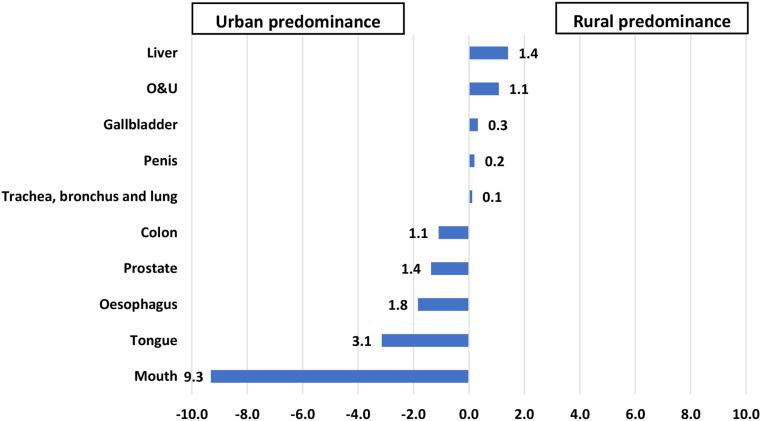
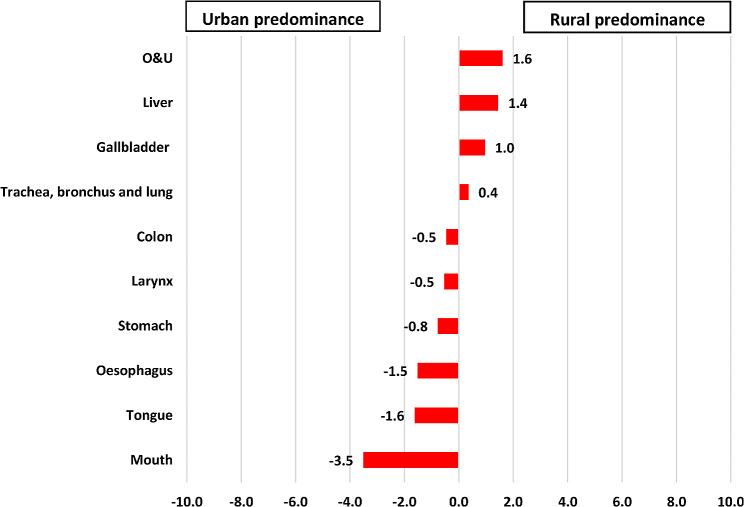
6721 cancer patients were registered during the study duration. Urban patients were older and had better literacy and socioeconomic levels, while rural patients had higher odds of having unskilled or semi-skilled professions. Diagnostic and clinical confirmation for cancer was significantly higher in urban patients, while verbal autopsy-based confirmation was higher in rural patients. Rural patients were more likely to receive palliative or alternative systems of medicine, and urban patients had higher chances of treatment completion. Significantly higher incidence and mortality were observed for oral cancer among urban men and for cervical cancer among rural women. Despite the higher incidence of breast cancer in urban women, significantly higher mortality was observed in rural women.
CONCLUSIONS
Low- and middle-income countries are facing dual challenges for cancer control and prevention. Their urban populations experience unhealthy lifestyles, while their rural populations lack healthcare accessibility. The distinctness in cancer burden and pattern calls for a re-evaluation of cancer control strategies that are tailor-made with an understanding of urban-rural disparities. Context-specific interventional programmes targeting risk-factor modifications, cancer awareness, early detection, and accessibility to diagnosis and care are essential.
背景
癌症的发病率和死亡率在全球范围内存在差异,近三分之二的癌症相关死亡发生在中低收入国家。城乡之间在社会人口统计学、行为和生活方式相关因素以及获得癌症治疗方面的差异是造成这种情况的因素之一。基于人群的癌症登记处是了解癌症负担的一种手段。我们旨在评估印度基于人群的癌症登记处登记的癌症患者的城乡负担和护理差异。
方法
本研究于 2017 年至 2019 年在印度北方邦瓦拉纳西收集数据。计算了每 10 万人的发病率和死亡率的性别和部位特异性年龄标准化率。通过率差异和标准化率比(95%置信区间)估计癌症发病率和死亡率的城乡差异。应用单变量和多变量回归来确定根据居住地(农村/城市)在社会人口统计学和癌症相关变量方面是否存在任何显著差异。计算了 95%置信区间的粗和调整后的比值比。
结果
在研究期间共登记了 6721 名癌症患者。城市患者年龄较大,文化程度和社会经济水平较高,而农村患者从事非熟练或半熟练职业的可能性较高。城市患者的癌症诊断和临床确认率明显较高,而农村患者的口头尸检确认率较高。农村患者更有可能接受姑息治疗或替代医学系统,而城市患者完成治疗的机会更高。城市男性中口腔癌和农村女性中宫颈癌的发病率和死亡率均明显较高。尽管城市女性乳腺癌的发病率较高,但农村女性的死亡率明显较高。
结论
中低收入国家在癌症控制和预防方面面临双重挑战。其城市人口存在不健康的生活方式,而农村人口则缺乏医疗保健可及性。癌症负担和模式的明显差异需要重新评估具有城乡差异理解的癌症控制策略。针对危险因素修改、癌症意识、早期发现以及获得诊断和护理的机会的具体情况的干预方案至关重要。



 Zotero 插件