
与临床变量和疾病严重程度评分相关的小儿脓毒症炎症血液生物标志物。
Pediatric sepsis inflammatory blood biomarkers that correlate with clinical variables and severity of illness scores.
作者信息
Leonard Sean, Guertin Hailey, Odoardi Natalya, Miller Michael R, Patel Maitray A, Daley Mark, Cepinskas Gediminas, Fraser Douglas D
机构信息
Pediatrics, Western University, London, ON, Canada.
Emergency Medicine, Lakeridge Health, Ajax/Oshawa, ON, Canada.
出版信息
J Inflamm (Lond). 2024 Mar 7;21(1):7. doi: 10.1186/s12950-024-00379-w.
BACKGROUND
Sepsis is a dysregulated systemic inflammatory response triggered by infection, resulting in organ dysfunction. A major challenge in clinical pediatrics is to identify sepsis early and then quickly intervene to reduce morbidity and mortality. As blood biomarkers hold promise as early sepsis diagnostic tools, we aimed to measure a large number of blood inflammatory biomarkers from pediatric sepsis patients to determine their predictive ability, as well as their correlations with clinical variables and illness severity scores.
METHODS
Pediatric patients that met sepsis criteria were enrolled, and clinical data and blood samples were collected. Fifty-eight inflammatory plasma biomarker concentrations were determined using immunoassays. The data were analyzed with both conventional statistics and machine learning.
RESULTS
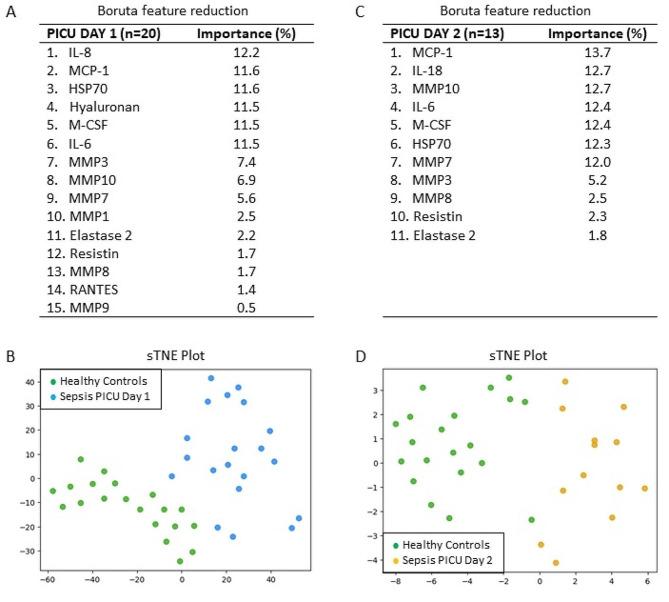
Twenty sepsis patients were enrolled (median age 13 years), with infectious pathogens identified in 75%. Vasopressors were administered to 85% of patients, while 55% received invasive ventilation and 20% were ventilated non-invasively. A total of 24 inflammatory biomarkers were significantly different between sepsis patients and age/sex-matched healthy controls. Nine biomarkers (IL-6, IL-8, MCP-1, M-CSF, IL-1RA, hyaluronan, HSP70, MMP3, and MMP10) yielded AUC parameters > 0.9 (95% CIs: 0.837-1.000; p < 0.001). Boruta feature reduction yielded 6 critical biomarkers with their relative importance: IL-8 (12.2%), MCP-1 (11.6%), HSP70 (11.6%), hyaluronan (11.5%), M-CSF (11.5%), and IL-6 (11.5%); combinations of 2 biomarkers yielded AUC values of 1.00 (95% CI: 1.00-1.00; p < 0.001). Specific biomarkers strongly correlated with illness severity scoring, as well as other clinical variables. IL-3 specifically distinguished bacterial versus viral infection (p < 0.005).
CONCLUSIONS
Specific inflammatory biomarkers were identified as markers of pediatric sepsis and strongly correlated to both clinical variables and sepsis severity.
背景
脓毒症是由感染引发的系统性炎症反应失调,可导致器官功能障碍。临床儿科学面临的一项重大挑战是早期识别脓毒症,然后迅速进行干预以降低发病率和死亡率。由于血液生物标志物有望成为早期脓毒症诊断工具,我们旨在检测大量儿科脓毒症患者的血液炎症生物标志物,以确定其预测能力,以及它们与临床变量和疾病严重程度评分的相关性。
方法
纳入符合脓毒症标准的儿科患者,并收集临床数据和血液样本。使用免疫测定法测定58种炎症血浆生物标志物浓度。采用传统统计学方法和机器学习对数据进行分析。
结果
纳入20例脓毒症患者(中位年龄13岁),75%的患者确定了感染病原体。85%的患者使用了血管活性药物,55%接受有创通气,20%接受无创通气。脓毒症患者与年龄/性别匹配的健康对照之间共有24种炎症生物标志物存在显著差异。9种生物标志物(IL-6、IL-8、MCP-1、M-CSF、IL-1RA、透明质酸、HSP70、MMP3和MMP10)的AUC参数>0.9(95%CI:0.837-1.000;p<0.001)。Boruta特征约简产生了6种关键生物标志物及其相对重要性:IL-8(12.2%)、MCP-1(11.6%)、HSP70(11.6%)、透明质酸(11.5%)、M-CSF(11.5%)和IL-6(11.5%);2种生物标志物的组合产生的AUC值为1.00(95%CI:1.00-1.00;p<0.001)。特定生物标志物与疾病严重程度评分以及其他临床变量密切相关。IL-3可特异性区分细菌感染与病毒感染(p<0.005)。
结论
特定炎症生物标志物被确定为儿科脓毒症的标志物,与临床变量和脓毒症严重程度密切相关。

 Zotero 插件