
非血红素铁(II)/2-氧代戊二酸依赖性天冬氨酸羟化酶AspH的独特催化策略。
Unusual catalytic strategy by non-heme Fe(ii)/2-oxoglutarate-dependent aspartyl hydroxylase AspH.
作者信息
Krishnan Anandhu, Waheed Sodiq O, Varghese Ann, Cherilakkudy Fathima Hameed, Schofield Christopher J, Karabencheva-Christova Tatyana G
机构信息
Department of Chemistry, Michigan Technological University Houghton MI 49931 USA
Chemistry Research Laboratory, Department of Chemistry and the Ineos Oxford Institute for Antimicrobial Research, University of Oxford OX1 3TA Oxford UK.
出版信息
Chem Sci. 2024 Feb 5;15(10):3466-3484. doi: 10.1039/d3sc05974j. eCollection 2024 Mar 6.
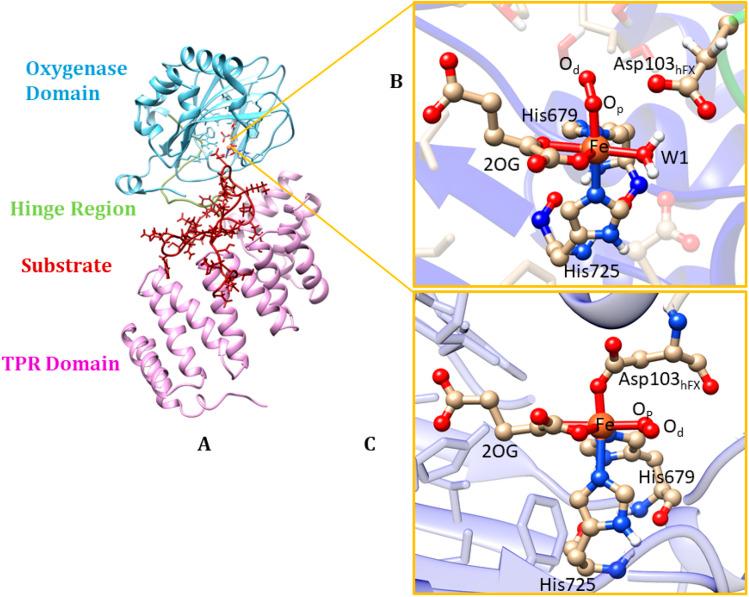
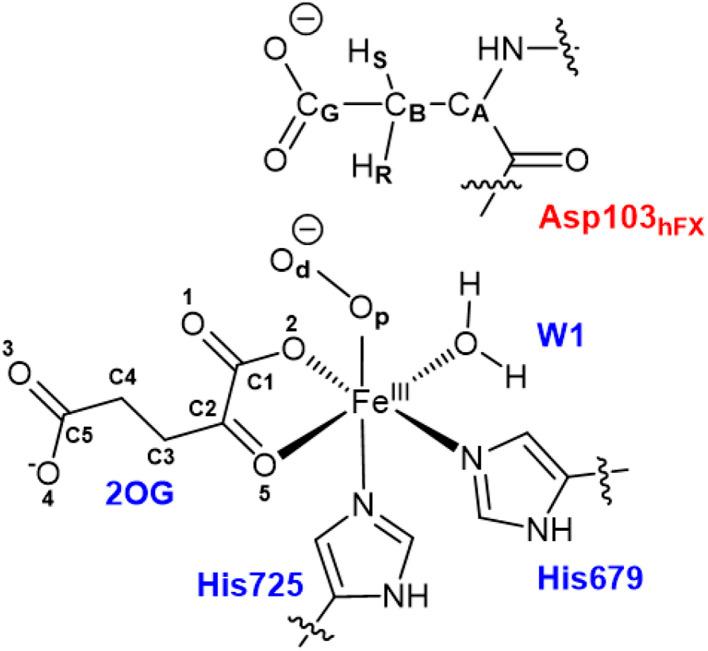
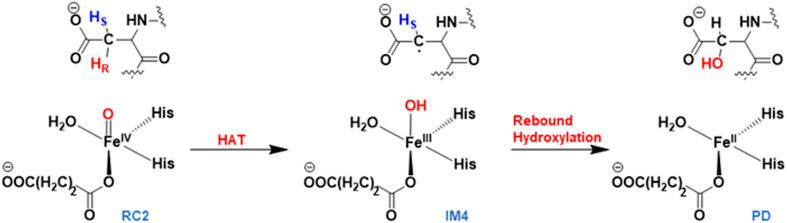
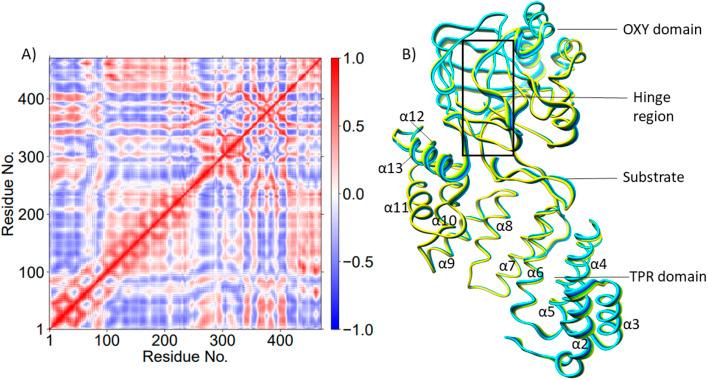
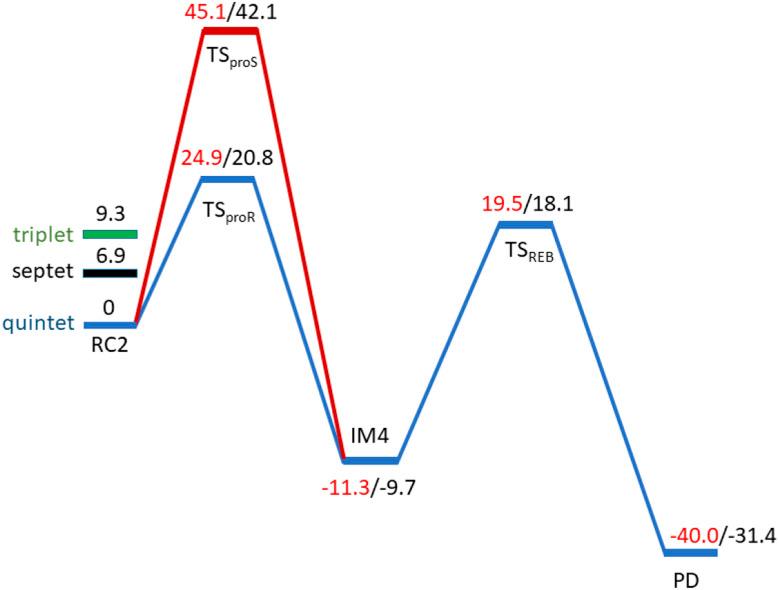
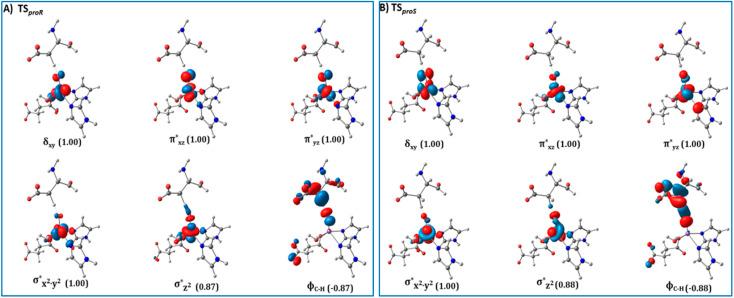
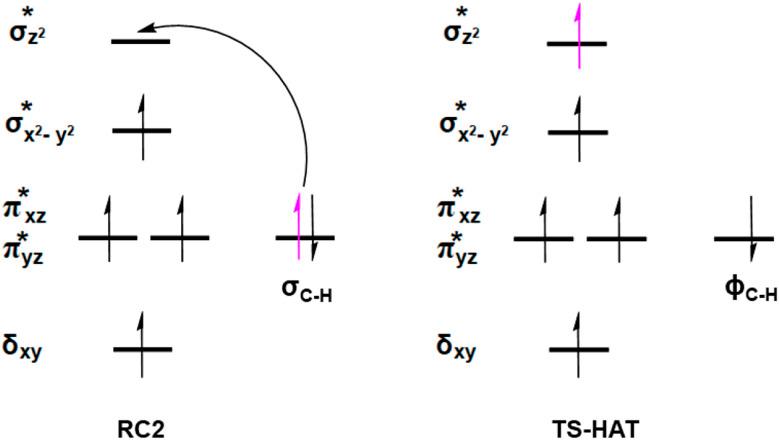
Biocatalytic C-H oxidation reactions are of important synthetic utility, provide a sustainable route for selective synthesis of important organic molecules, and are an integral part of fundamental cell processes. The multidomain non-heme Fe(ii)/2-oxoglutarate (2OG) dependent oxygenase AspH catalyzes stereoselective (3)-hydroxylation of aspartyl- and asparaginyl-residues. Unusually, compared to other 2OG hydroxylases, crystallography has shown that AspH lacks the carboxylate residue of the characteristic two-His-one-Asp/Glu Fe-binding triad. Instead, AspH has a water molecule that coordinates Fe(ii) in the coordination position usually occupied by the Asp/Glu carboxylate. Molecular dynamics (MD) and quantum mechanics/molecular mechanics (QM/MM) studies reveal that the iron coordinating water is stabilized by hydrogen bonding with a second coordination sphere (SCS) carboxylate residue Asp721, an arrangement that helps maintain the six coordinated Fe(ii) distorted octahedral coordination geometry and enable catalysis. AspH catalysis follows a dioxygen activation-hydrogen atom transfer (HAT)-rebound hydroxylation mechanism, unusually exhibiting higher activation energy for rebound hydroxylation than for HAT, indicating that the rebound step may be rate-limiting. The HAT step, along with substrate positioning modulated by the non-covalent interactions with SCS residues (Arg688, Arg686, Lys666, Asp721, and Gln664), are essential in determining stereoselectivity, which likely proceeds with retention of configuration. The tetratricopeptide repeat (TPR) domain of AspH influences substrate binding and manifests dynamic motions during catalysis, an observation of interest with respect to other 2OG oxygenases with TPR domains. The results provide unique insights into how non-heme Fe(ii) oxygenases can effectively catalyze stereoselective hydroxylation using only two enzyme-derived Fe-ligating residues, potentially guiding enzyme engineering for stereoselective biocatalysis, thus advancing the development of non-heme Fe(ii) based biomimetic C-H oxidation catalysts, and supporting the proposal that the 2OG oxygenase superfamily may be larger than once perceived.
生物催化的C-H氧化反应具有重要的合成效用,为重要有机分子的选择性合成提供了一条可持续的途径,并且是基本细胞过程中不可或缺的一部分。多结构域非血红素铁(II)/2-氧代戊二酸(2OG)依赖性加氧酶AspH催化天冬氨酰和天冬酰胺酰残基的立体选择性(3)-羟基化。与其他2OG羟化酶不同的是,晶体学研究表明,AspH缺乏特征性的二组氨酸-一天冬氨酸/谷氨酸铁结合三联体中的羧酸盐残基。相反,AspH有一个水分子,它在通常由天冬氨酸/谷氨酸羧酸盐占据的配位位置上与铁(II)配位。分子动力学(MD)和量子力学/分子力学(QM/MM)研究表明,与第二配位层(SCS)羧酸盐残基天冬氨酸721形成氢键可使配位铁的水分子稳定,这种排列有助于维持六配位铁(II)扭曲的八面体配位几何结构并实现催化作用。AspH催化遵循双加氧活化-氢原子转移(HAT)-回补羟基化机制,不同寻常的是,回补羟基化的活化能高于HAT,这表明回补步骤可能是限速步骤。HAT步骤以及与SCS残基(精氨酸688、精氨酸686、赖氨酸666、天冬氨酸721和谷氨酰胺664)的非共价相互作用调节的底物定位,对于确定立体选择性至关重要,立体选择性可能以构型保留的方式进行。AspH的四肽重复(TPR)结构域影响底物结合,并在催化过程中表现出动态运动,这一观察结果对于其他具有TPR结构域的2OG加氧酶具有重要意义。这些结果为非血红素铁(II)加氧酶如何仅使用两个酶衍生的铁配位残基有效地催化立体选择性羟基化提供了独特的见解,可能为立体选择性生物催化的酶工程提供指导,从而推动基于非血红素铁(II)的仿生C-H氧化催化剂的开发,并支持2OG加氧酶超家族可能比以前认为的更大的提议。





 Zotero 插件