
日本广岛县基于人群的X线胃癌筛查
Population-based X-ray gastric cancer screening in Hiroshima prefecture, Japan.
作者信息
Vu Nhu Thi Hanh, Urabe Yuji, Quach Duc Trong, Oka Shiro, Hiyama Toru
机构信息
Department of Internal Medicine, University of Medicine and Pharmacy at Ho Chi Minh City, Ho Chi Minh 700000, Viet Nam.
Department of Endoscopy, Hiroshima University Hospital, Hiroshima 734-8551, Japan.
出版信息
World J Clin Oncol. 2024 Feb 24;15(2):271-281. doi: 10.5306/wjco.v15.i2.271.
BACKGROUND
X-ray gastric cancer (GC) screening has been shown to decrease mortality. Population-based X-ray GC screening has been performed in Hiroshima Prefecture, Japan, since 1983 but time trends and the efficacy of the method over 39 years have not been assessed.
AIM
To evaluate time trends and efficacy of population-based X-ray GC screening and identify challenges and suggested solutions for the future.
METHODS
This was a population-based retrospective study. The data were derived from aggregated data of the Hiroshima Regional Health Medical Promotion Organization, including the number and rate of participants and those requiring esophagogastroduodenoscopies (EGDs), the number and rate of participants diagnosed as having GC, and the positive predictive value of the abnormal findings detected by X-ray and confirmed by EGDs. The number and rate of esophageal cancers were also collected. Further, the cost of detecting one GC was evaluated.
RESULTS
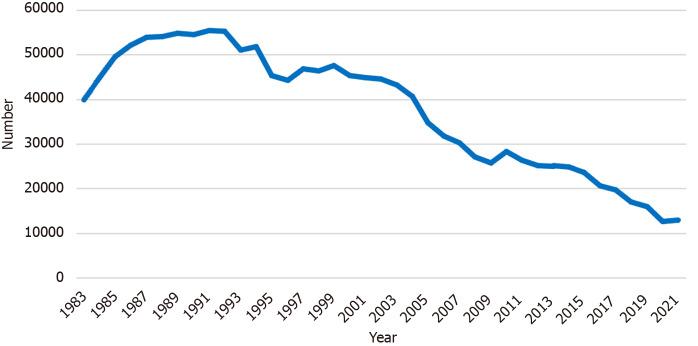
The number of participants has decreased during the last four decades, from 39925 in 1983 to 12923 in 2021. The rate of those requiring EGDs decreased significantly in recent years ( < 0.001). The number of participants diagnosed as having GC has also declined, from 76 to 10 cases. However, the rate of cases diagnosed as GC among the participants remained around 0.1%. The positive predictive value increased significantly in recent years except during 1983-1991. The number and rate of accidentally detected esophageal cancers have risen recently, from 0% in 2008 to 0.02% in 2021, one-fifth of the diagnosis rate of GC. One GC diagnosis costs approximately 4200000 Japanese Yen (30000 United States Dollars) for the X-ray screenings and EGDs.
CONCLUSION
X-ray GC screening in Hiroshima has been efficient, but one challenge is the cost. Esophageal cancers may also need to be considered because they have gradually increased in recent years.
背景
X线胃癌(GC)筛查已被证明可降低死亡率。自1983年以来,日本广岛县开展了基于人群的X线GC筛查,但尚未评估39年来该方法的时间趋势和效果。
目的
评估基于人群的X线GC筛查的时间趋势和效果,并确定未来面临的挑战及建议的解决方案。
方法
这是一项基于人群的回顾性研究。数据来源于广岛地区健康医疗促进组织的汇总数据,包括参与者数量及参与率、需要进行食管胃十二指肠镜检查(EGD)的人数及比例、被诊断为GC的参与者数量及比例,以及X线检查发现并经EGD确诊的异常结果的阳性预测值。还收集了食管癌的数量及比例。此外,评估了检测出一例GC的成本。
结果
在过去四十年中,参与者数量有所下降,从1983年的39925人降至2021年的12923人。近年来,需要进行EGD检查的比例显著下降(<0.001)。被诊断为GC的参与者数量也有所下降,从76例降至10例。然而,参与者中被诊断为GC的比例仍保持在0.1%左右。除1983 - 1991年外,近年来阳性预测值显著增加。最近,意外检测出的食管癌数量及比例有所上升,从2008年的0%升至2021年的0.02%,为GC诊断率的五分之一。通过X线筛查和EGD检测出一例GC的成本约为420万日元(3万美元)。
结论
广岛的X线GC筛查一直很有效,但一个挑战是成本。近年来食管癌也可能需要考虑,因为其数量逐渐增加。



 Zotero 插件