
外泌体在溃疡性结肠炎中的新作用:靶向含NOD样受体家族吡咯结构域蛋白3炎性小体
Emerging role of exosomes in ulcerative colitis: Targeting NOD-like receptor family pyrin domain containing 3 inflammasome.
作者信息
Li Xin, Ji Li-Jiang, Feng Kai-Di, Huang Hua, Liang Mei-Rou, Cheng Shi-Jin, Meng Xiu-Dong
机构信息
School of Basic Medicine, Guizhou University of Traditional Chinese Medicine, Guiyang 550025, Guizhou Province, China.
Department of Anorectal Surgery, Changshu Hospital Affiliated to Nanjing University of Chinese Medicine, Changshu 215500, Jiangsu Province, China.
出版信息
World J Gastroenterol. 2024 Feb 14;30(6):527-541. doi: 10.3748/wjg.v30.i6.527.
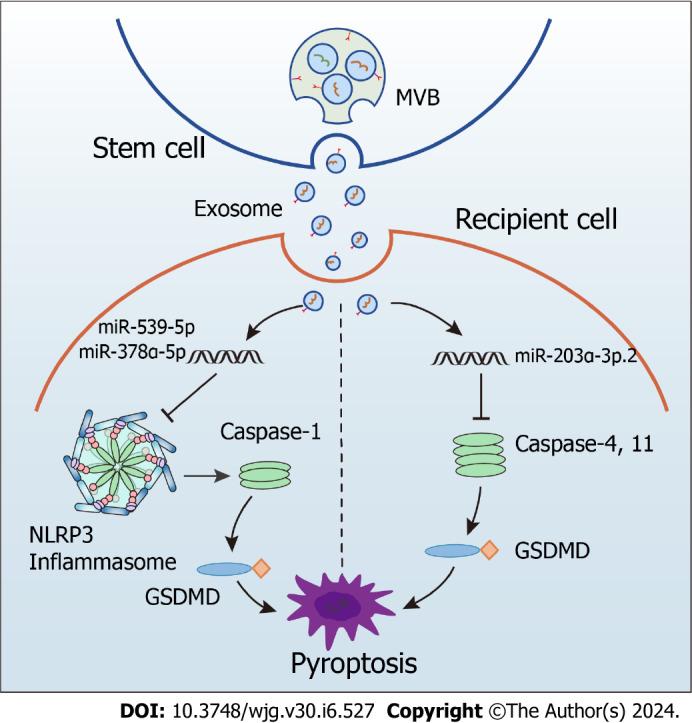
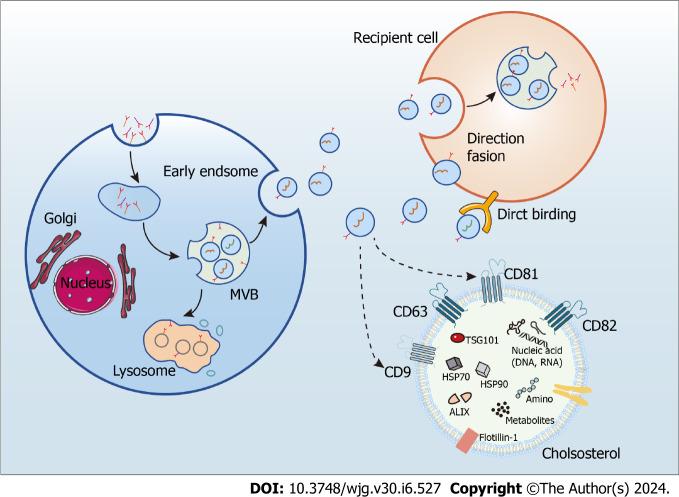
Ulcerative colitis (UC) is a chronic recurrent inflammatory bowel disease. Despite ongoing advances in our understanding of UC, its pathogenesis is yet unelucidated, underscoring the urgent need for novel treatment strategies for patients with UC. Exosomes are nanoscale membrane particles that mediate intercellular communication by carrying various bioactive molecules, such as proteins, RNAs, DNA, and metabolites. The NOD-like receptor family pyrin domain containing 3 (NLRP3) inflammasome is a cytosolic tripartite protein complex whose activation induces the maturation and secretion of proinflammatory cytokines interleukin-1β (IL-1β) and IL-18, triggering the inflammatory response to a pathogenic agent or injury. Growing evidence suggests that exosomes are new modulators of the NLRP3 inflammasome, with vital roles in the pathological process of UC. Here, recent evidence is reviewed on the role of exosomes and NLRP3 inflammasome in UC. First, the dual role of exosomes on NLRP3 inflammasome and the effect of NLRP3 inflammasome on exosome secretion are summarized. Finally, an outlook on the directions of exosome-NLRP3 inflammasome crosstalk research in the context of UC is proposed and areas of further research on this topic are highlighted.
溃疡性结肠炎(UC)是一种慢性复发性炎症性肠病。尽管我们对UC的认识不断进步,但其发病机制仍未阐明,这凸显了为UC患者开发新治疗策略的迫切需求。外泌体是纳米级的膜性颗粒,通过携带各种生物活性分子(如蛋白质、RNA、DNA和代谢产物)介导细胞间通讯。含NOD样受体家族吡咯结构域3(NLRP3)炎性小体是一种胞质三方蛋白复合物,其激活可诱导促炎细胞因子白细胞介素-1β(IL-1β)和IL-18的成熟和分泌,引发对病原体或损伤的炎症反应。越来越多的证据表明,外泌体是NLRP3炎性小体的新型调节因子,在UC的病理过程中发挥重要作用。本文综述了外泌体和NLRP3炎性小体在UC中作用的最新证据。首先,总结了外泌体对NLRP3炎性小体的双重作用以及NLRP3炎性小体对外泌体分泌的影响。最后,对UC背景下外泌体-NLRP3炎性小体相互作用研究的方向提出展望,并强调了该主题的进一步研究领域。

 Zotero 插件