
利用光谱计算机断层扫描成像和机器学习对胃癌中淋巴管和神经周围侵犯进行术前预测。
Preoperative prediction of lymphovascular and perineural invasion in gastric cancer using spectral computed tomography imaging and machine learning.
作者信息
Ge Hui-Ting, Chen Jian-Wu, Wang Li-Li, Zou Tian-Xiu, Zheng Bin, Liu Yuan-Fen, Xue Yun-Jing, Lin Wei-Wen
机构信息
Department of Radiology, Fujian Medical University Union Hospital, Fuzhou 350001, Fujian Province, China.
Fujian Key Laboratory of Intelligent Imaging and Precision Radiotherapy for Tumors, Fujian Medical University, Fuzhou 350001, Fujian Province, China.
出版信息
World J Gastroenterol. 2024 Feb 14;30(6):542-555. doi: 10.3748/wjg.v30.i6.542.
BACKGROUND
Lymphovascular invasion (LVI) and perineural invasion (PNI) are important prognostic factors for gastric cancer (GC) that indicate an increased risk of metastasis and poor outcomes. Accurate preoperative prediction of LVI/PNI status could help clinicians identify high-risk patients and guide treatment decisions. However, prior models using conventional computed tomography (CT) images to predict LVI or PNI separately have had limited accuracy. Spectral CT provides quantitative enhancement parameters that may better capture tumor invasion. We hypothesized that a predictive model combining clinical and spectral CT parameters would accurately preoperatively predict LVI/PNI status in GC patients.
AIM
To develop and test a machine learning model that fuses spectral CT parameters and clinical indicators to predict LVI/PNI status accurately.
METHODS
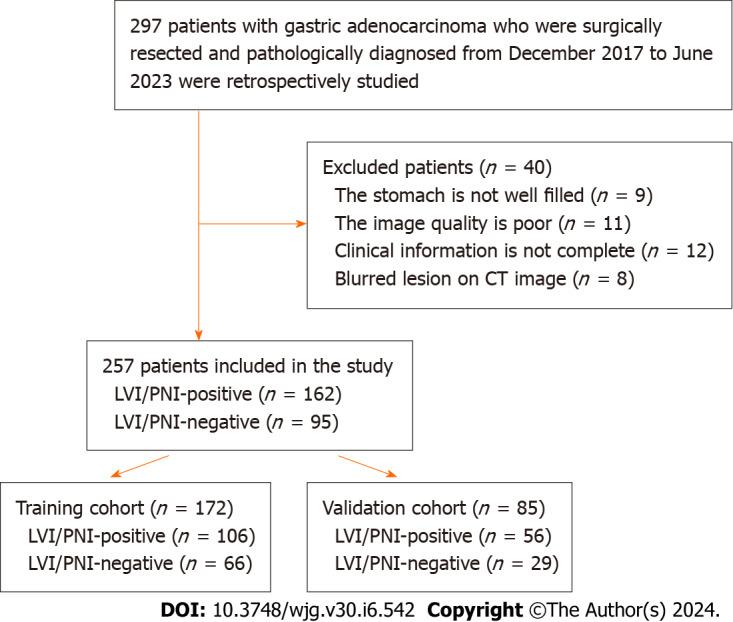
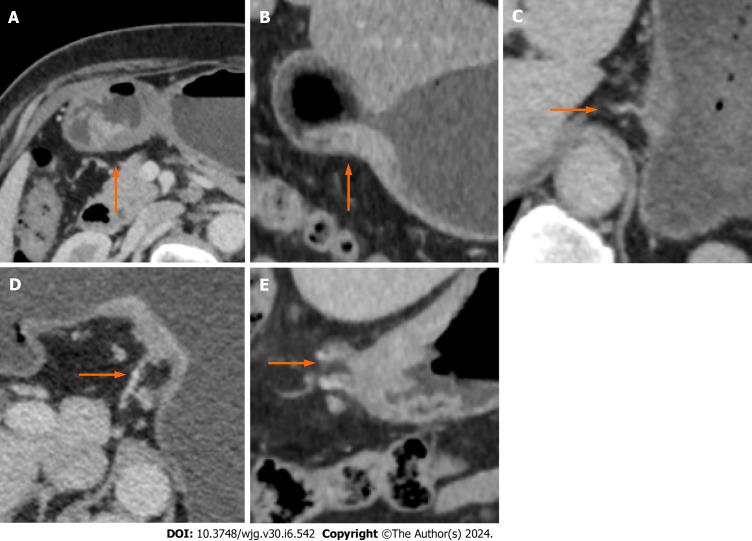
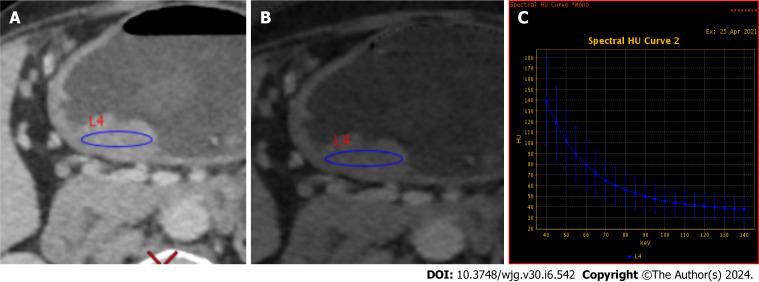
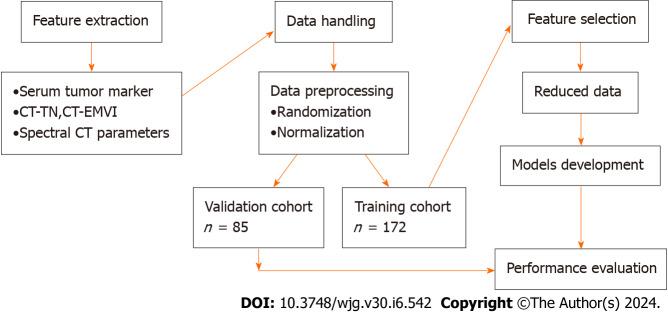
This study used a retrospective dataset involving 257 GC patients (training cohort, = 172; validation cohort, = 85). First, several clinical indicators, including serum tumor markers, CT-TN stages and CT-detected extramural vein invasion (CT-EMVI), were extracted, as were quantitative spectral CT parameters from the delineated tumor regions. Next, a two-step feature selection approach using correlation-based methods and information gain ranking inside a 10-fold cross-validation loop was utilized to select informative clinical and spectral CT parameters. A logistic regression (LR)-based nomogram model was subsequently constructed to predict LVI/PNI status, and its performance was evaluated using the area under the receiver operating characteristic curve (AUC).
RESULTS
In both the training and validation cohorts, CT T3-4 stage, CT-N positive status, and CT-EMVI positive status are more prevalent in the LVI/PNI-positive group and these differences are statistically significant ( < 0.05). LR analysis of the training group showed preoperative CT-T stage, CT-EMVI, single-energy CT values of 70 keV of venous phase (VP-70 keV), and the ratio of standardized iodine concentration of equilibrium phase (EP-NIC) were independent influencing factors. The AUCs of VP-70 keV and EP-NIC were 0.888 and 0.824, respectively, which were slightly greater than those of CT-T and CT-EMVI (AUC = 0.793, 0.762). The nomogram combining CT-T stage, CT-EMVI, VP-70 keV and EP-NIC yielded AUCs of 0.918 (0.866-0.954) and 0.874 (0.784-0.936) in the training and validation cohorts, which are significantly higher than using each of single independent factors ( < 0.05).
CONCLUSION
The study found that using portal venous and EP spectral CT parameters allows effective preoperative detection of LVI/PNI in GC, with accuracy boosted by integrating clinical markers.
背景
淋巴管侵犯(LVI)和神经周围侵犯(PNI)是胃癌(GC)的重要预后因素,提示转移风险增加和预后不良。术前准确预测LVI/PNI状态有助于临床医生识别高危患者并指导治疗决策。然而,以往使用传统计算机断层扫描(CT)图像分别预测LVI或PNI的模型准确性有限。光谱CT提供的定量增强参数可能能更好地捕捉肿瘤侵犯情况。我们假设,结合临床和光谱CT参数的预测模型能够在术前准确预测GC患者的LVI/PNI状态。
目的
开发并测试一种融合光谱CT参数和临床指标以准确预测LVI/PNI状态的机器学习模型。
方法
本研究使用了一个回顾性数据集,涉及257例GC患者(训练队列,n = 172;验证队列,n = 85)。首先,提取了几个临床指标,包括血清肿瘤标志物、CT-TN分期和CT检测到的壁外静脉侵犯(CT-EMVI),以及从划定的肿瘤区域提取的定量光谱CT参数。接下来,采用基于相关性方法和10倍交叉验证循环内信息增益排序的两步特征选择方法,选择有信息价值的临床和光谱CT参数。随后构建基于逻辑回归(LR)的列线图模型来预测LVI/PNI状态,并使用受试者操作特征曲线下面积(AUC)评估其性能。
结果
在训练队列和验证队列中,CT T3-4期、CT-N阳性状态和CT-EMVI阳性状态在LVI/PNI阳性组中更为普遍,且这些差异具有统计学意义(P < 0.05)。训练组的LR分析显示,术前CT-T分期、CT-EMVI、静脉期70 keV的单能量CT值(VP-70 keV)和平衡期标准化碘浓度比值(EP-NIC)是独立影响因素。VP-70 keV和EP-NIC的AUC分别为0.888和0.824,略大于CT-T和CT-EMVI的AUC(AUC = 0.793,0.762)。结合CT-T分期、CT-EMVI、VP-70 keV和EP-NIC的列线图在训练队列和验证队列中的AUC分别为0.918(0.866 - 0.954)和0.874(0.784 - 0.936),显著高于使用单个独立因素时的AUC(P < 0.05)。
结论
该研究发现,使用门静脉期和平衡期光谱CT参数可有效在术前检测GC中的LVI/PNI,通过整合临床标志物可提高准确性。

 Zotero 插件