
人鼻病毒A89感染性cDNA克隆的构建与鉴定
Construction and characterization of an infectious cDNA clone of human rhinovirus A89.
作者信息
Yang Hongwei, Zhu Rui, Zhou Zhenhong, Chen Hao, Wu Yuanyuan, Zhang Dongqing, Liu Che, Xia Ningshao, Xu Longfa, Cheng Tong
机构信息
State Key Laboratory of Molecular Vaccinology and Molecular Diagnostics, National Institute of Diagnostics and Vaccine Development in Infectious Diseases, School of Life Sciences, School of Public Health, Xiamen University, Xiamen, 361102, PR China.
出版信息
Heliyon. 2024 Feb 28;10(5):e27214. doi: 10.1016/j.heliyon.2024.e27214. eCollection 2024 Mar 15.
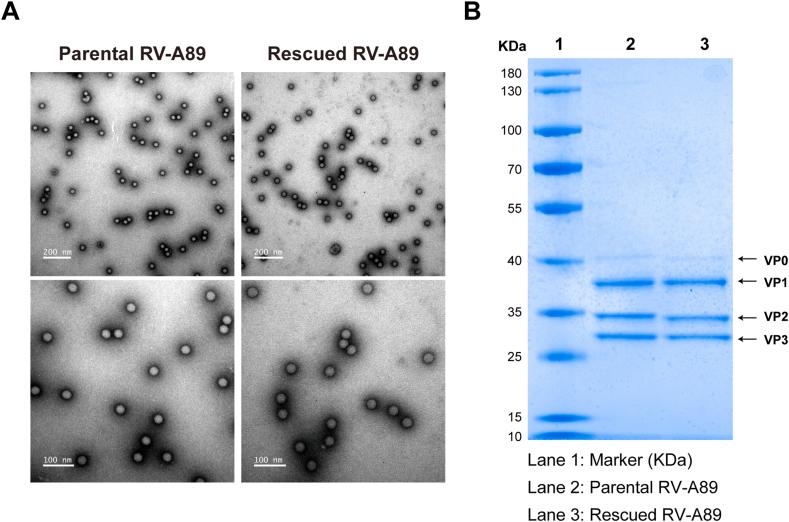
Rhinoviruses (RVs) are major causes of the common cold and are related to severe respiratory tract diseases, leading to a considerable economic burden and impacts on public health. Available and stable viral resources of rhinoviruses for laboratory use are important for promoting studies on rhinoviruses and further vaccine or therapeutic drug development. Reverse genetic technology can be useful to produce rhinoviruses and will help to promote studies on their pathogenesis and virulence. In this study, rhinovirus A89, an RV-A species that has been found to be highly involved in hospitalization triggered by RV infections, was selected to construct an infectious clone based on its sequence as a representative. The viral mRNA produced by a T7 RNA transcript system was transfected into H1-HeLa cells, and the rescued RV-A89 viruses were harvested and confirmed by sequencing. The rescued RV-A89 induced a similar cytopathic effect (CPE) and shared almost identical growth kinetics curves with parental RV-A89. Moreover, 9A7, a prescreened monoclonal antibody against the parental RV-A89, had a good and specific reaction with the rescued RV-A89, and further characterization showed almost the same morphology and protein composition of both viruses; thus, recombinant RV-A89 with similar biological characterization and virulence to the parental virus was obtained. In summary, the infectious clone of RV-A89 was successfully established, and the development of reverse genetic technology for rhinovirus will provide a framework for further studies on rhinoviruses.
鼻病毒(RVs)是普通感冒的主要病因,且与严重呼吸道疾病相关,会导致相当大的经济负担并影响公众健康。可用于实验室研究的稳定鼻病毒病毒资源对于推动鼻病毒研究以及进一步的疫苗或治疗药物开发至关重要。反向遗传技术可用于生产鼻病毒,并将有助于促进对其发病机制和毒力的研究。在本研究中,选择了鼻病毒A89(一种已被发现高度参与由RV感染引发的住院病例的RV - A型病毒),根据其序列构建一个感染性克隆作为代表。通过T7 RNA转录系统产生的病毒mRNA被转染到H1 - HeLa细胞中,收获拯救出的RV - A89病毒并通过测序进行确认。拯救出的RV - A89诱导出类似的细胞病变效应(CPE),并且与亲本RV - A89具有几乎相同的生长动力学曲线。此外,一种针对亲本RV - A89预先筛选的单克隆抗体9A7与拯救出的RV - A89具有良好的特异性反应,进一步的特性分析表明两种病毒的形态和蛋白质组成几乎相同;因此,获得了与亲本病毒具有相似生物学特性和毒力的重组RV - A89。总之,成功建立了RV - A89的感染性克隆,鼻病毒反向遗传技术的发展将为进一步研究鼻病毒提供一个框架。


 Zotero 插件