
在晚期皮肤鳞状细胞癌中,西米普利单抗延长给药具有高缓解率。
High response rate with extended dosing of cemiplimab in advanced cutaneous squamous cell carcinoma.
作者信息
Rischin Danny, Hughes Brett G M, Basset-Séguin Nicole, Schadendorf Dirk, Bowyer Samantha, Trabelsi Messai Sabiha, Meier Friedegund, Eigentler Thomas K, Casado Echarren Victoria, Stein Brian, Beylot-Barry Marie, Dalac Sophie, Dréno Brigitte, Migden Michael R, Hauschild Axel, Schmults Chrysalyne D, Lim Annette M, Yoo Suk-Young, Paccaly Anne J, Papachristos Apostolos, Nguyen Jenny-Hoa, Okoye Emmanuel, Seebach Frank, Booth Jocelyn, Lowy Israel, Fury Matthew G, Guminski Alexander
机构信息
Department of Medical Oncology, Peter MacCallum Cancer Centre, Melbourne, Victoria, Australia
Royal Brisbane and Women's Hospital and University of Queensland, Brisbane, Queensland, Australia.
出版信息
J Immunother Cancer. 2024 Mar 11;12(3):e008325. doi: 10.1136/jitc-2023-008325.
BACKGROUND
Cemiplimab (Libtayo), a human monoclonal immunoglobulin G4 antibody to the programmed cell death-1 receptor, is approved for the treatment of patients with advanced cutaneous squamous cell carcinoma (CSCC), who are not candidates for curative surgery or curative radiation, using an every-3-weeks (Q3W) dosing interval. Pharmacokinetic modeling indicated that C of extended intravenous dosing of 600 mg every 4 weeks (Q4W) would be comparable to the approved intravenous dosage of 350 mg Q3W. We examined the efficacy, pharmacokinetics, and safety of cemiplimab dosed Q4W.
METHODS
In this open-label, phase II trial (ClinicalTrials.gov identifier NCT02760498), the cohort of patients ≥18 years old with advanced CSCC received cemiplimab 600 mg intravenously Q4W for up to 48 weeks. Tumor measurements were recorded every 8 weeks. The primary endpoint was objective response rate by independent central review.
RESULTS
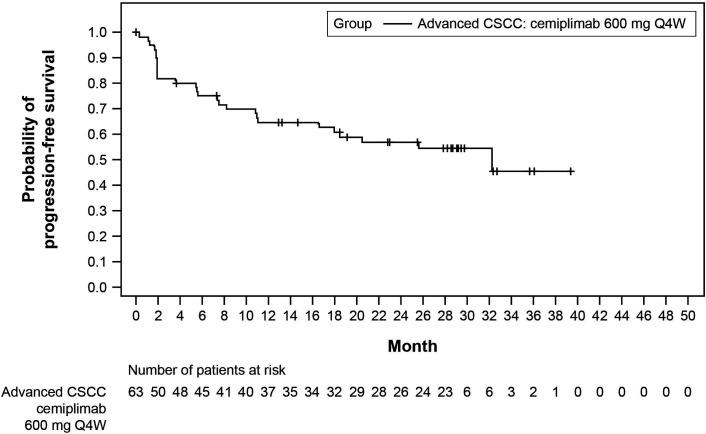
Sixty-three patients with advanced CSCC were treated with cemiplimab. The median duration of follow-up was 22.4 months (range: 1.0-39.8). An objective response was observed in 39 patients (62%; 95% CI: 48.8% to 73.9%), with 22% of patients (n14) achieving complete response and 40% (n25) achieving partial response. The most common treatment-emergent adverse events were diarrhea, pruritus, and fatigue.
CONCLUSIONS
Extended dosing of cemiplimab 600 mg intravenously Q4W exhibited substantial antitumor activity, rapid and durable responses, and an acceptable safety profile in patients with advanced CSCC. These results confirm that cemiplimab is a highly active therapy for advanced CSCC. Additional data would help ascertain the benefit-risk profile for the 600 mg intravenous dosing regimen compared with the approved regimen.
背景
西米普利单抗(Libtayo)是一种针对程序性细胞死亡-1受体的人源单克隆免疫球蛋白G4抗体,被批准用于治疗无法进行根治性手术或根治性放疗的晚期皮肤鳞状细胞癌(CSCC)患者,给药间隔为每3周一次(Q3W)。药代动力学模型表明,每4周一次(Q4W)静脉输注600mg的延长给药方案的血药浓度(C)将与批准的350mg Q3W静脉给药方案相当。我们研究了Q4W给药的西米普利单抗的疗效、药代动力学和安全性。
方法
在这项开放标签的II期试验(ClinicalTrials.gov标识符NCT02760498)中,年龄≥18岁的晚期CSCC患者队列接受静脉注射600mg西米普利单抗Q4W,最长持续48周。每8周记录一次肿瘤测量结果。主要终点是独立中心审查的客观缓解率。
结果
63例晚期CSCC患者接受了西米普利单抗治疗。中位随访时间为22.4个月(范围:1.0 - 39.8个月)。39例患者(62%;95%置信区间:48.8%至73.9%)观察到客观缓解,22%的患者(n = 14)达到完全缓解,40%(n = 25)达到部分缓解。最常见的治疗中出现的不良事件是腹泻、瘙痒和疲劳。
结论
每4周一次静脉注射600mg西米普利单抗的延长给药方案在晚期CSCC患者中表现出显著的抗肿瘤活性、快速且持久的反应以及可接受的安全性。这些结果证实西米普利单抗是晚期CSCC的一种高活性治疗方法。更多数据将有助于确定600mg静脉给药方案与批准方案相比的获益-风险情况。
 Zotero 插件