
膀胱癌中肿瘤易感性合子后染色体改变——来自组织学正常尿路上皮的见解
Tumor Predisposing Post-Zygotic Chromosomal Alterations in Bladder Cancer-Insights from Histologically Normal Urothelium.
作者信息
Stańkowska Wiktoria, Sarkisyan Daniil, Bruhn-Olszewska Bożena, Duzowska Katarzyna, Bieńkowski Michał, Jąkalski Marcin, Wójcik-Zalewska Magdalena, Davies Hanna, Drężek-Chyła Kinga, Pęksa Rafał, Harazin-Lechowska Agnieszka, Ambicka Aleksandra, Przewoźnik Marcin, Adamczyk Agnieszka, Sasim Karol, Makarewicz Wojciech, Matuszewski Marcin, Biernat Wojciech, Järhult Josef D, Lipcsey Miklós, Hultström Michael, Frithiof Robert, Jaszczyński Janusz, Ryś Janusz, Genovese Giulio, Piotrowski Arkadiusz, Filipowicz Natalia, Dumanski Jan P
机构信息
3P-Medicine Laboratory, Medical University of Gdańsk, M. Sklodowskiej-Curie 3A, 80-210 Gdańsk, Poland.
Department of Immunology, Genetics and Pathology and Science for Life Laboratory, Uppsala University, BMC, Husargatan 3, 751 08 Uppsala, Sweden.
出版信息
Cancers (Basel). 2024 Feb 27;16(5):961. doi: 10.3390/cancers16050961.
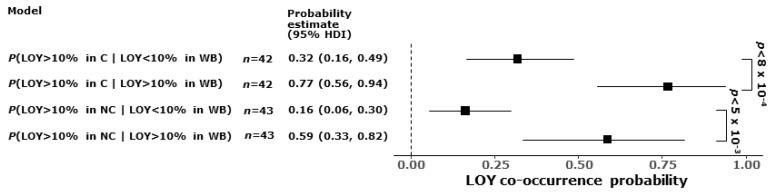
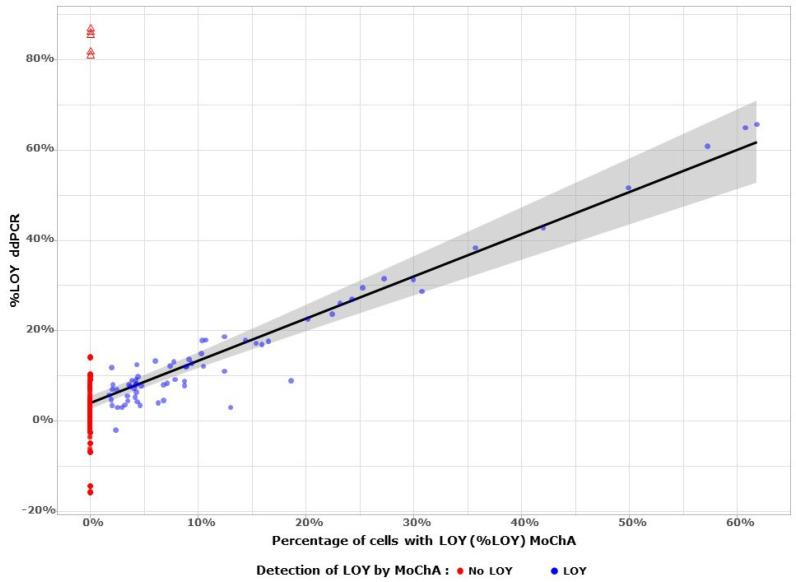
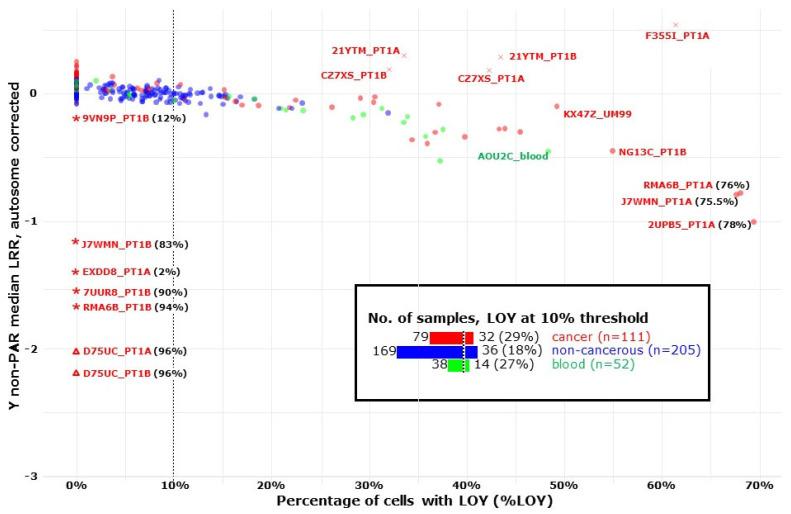
Bladder urothelial carcinoma (BLCA) is the 10th most common cancer with a low survival rate and strong male bias. We studied the field cancerization in BLCA using multi-sample- and multi-tissue-per-patient protocol for sensitive detection of autosomal post-zygotic chromosomal alterations and loss of chromosome Y (LOY). We analysed 277 samples of histologically normal urothelium, 145 tumors and 63 blood samples from 52 males and 15 females, using the in-house adapted Mosaic Chromosomal Alterations (MoChA) pipeline. This approach allows identification of the early aberrations in urothelium from BLCA patients. Overall, 45% of patients exhibited at least one alteration in at least one normal urothelium sample. Recurrence analysis resulted in 16 hotspots composed of either gains and copy number neutral loss of heterozygosity (CN-LOH) or deletions and CN-LOH, encompassing well-known and new BLCA cancer driver genes. Conservative assessment of LOY showed 29%, 27% and 18% of LOY-cells in tumors, blood and normal urothelium, respectively. We provide a proof of principle that our approach can characterize the earliest alterations preconditioning normal urothelium to BLCA development. Frequent LOY in blood and urothelium-derived tissues suggest its involvement in BLCA.
膀胱尿路上皮癌(BLCA)是第10大常见癌症,生存率低且具有明显的男性偏向性。我们采用每位患者多个样本和多种组织的方案,对BLCA中的场癌化进行了研究,以灵敏检测常染色体合子后染色体改变和Y染色体丢失(LOY)。我们使用内部改良的镶嵌染色体改变(MoChA)流程,分析了来自52名男性和15名女性的277份组织学正常的尿路上皮样本、145份肿瘤样本和63份血液样本。这种方法能够识别BLCA患者尿路上皮中的早期畸变。总体而言,45%的患者在至少一份正常尿路上皮样本中表现出至少一种改变。复发分析产生了16个热点,由杂合性增加和拷贝数中性杂合性丢失(CN-LOH)或缺失和CN-LOH组成,涵盖了已知和新的BLCA癌症驱动基因。对LOY的保守评估显示,肿瘤、血液和正常尿路上皮中LOY细胞的比例分别为29%、27%和18%。我们提供了一项原理证明,即我们的方法能够表征使正常尿路上皮发展为BLCA的最早改变。血液和尿路上皮来源组织中频繁出现的LOY表明其与BLCA有关。


 Zotero 插件