
初潮年龄相关基因决定胎儿生长受限风险。
Maternal Age at Menarche Genes Determines Fetal Growth Restriction Risk.
作者信息
Reshetnikov Evgeny, Churnosova Maria, Reshetnikova Yuliya, Stepanov Vadim, Bocharova Anna, Serebrova Victoria, Trifonova Ekaterina, Ponomarenko Irina, Sorokina Inna, Efremova Olga, Orlova Valentina, Batlutskaya Irina, Ponomarenko Marina, Churnosov Vladimir, Aristova Inna, Polonikov Alexey, Churnosov Mikhail
机构信息
Department of Medical Biological Disciplines, Belgorod State National Research University, 308015 Belgorod, Russia.
Research Institute for Medical Genetics, Tomsk National Research Medical Center of the Russian Academy of Sciences, 634050 Tomsk, Russia.
出版信息
Int J Mol Sci. 2024 Feb 24;25(5):2647. doi: 10.3390/ijms25052647.
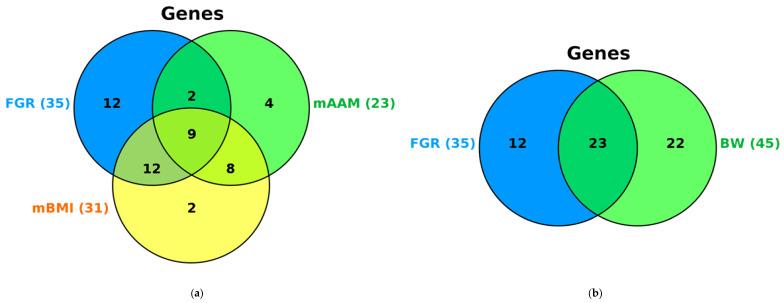
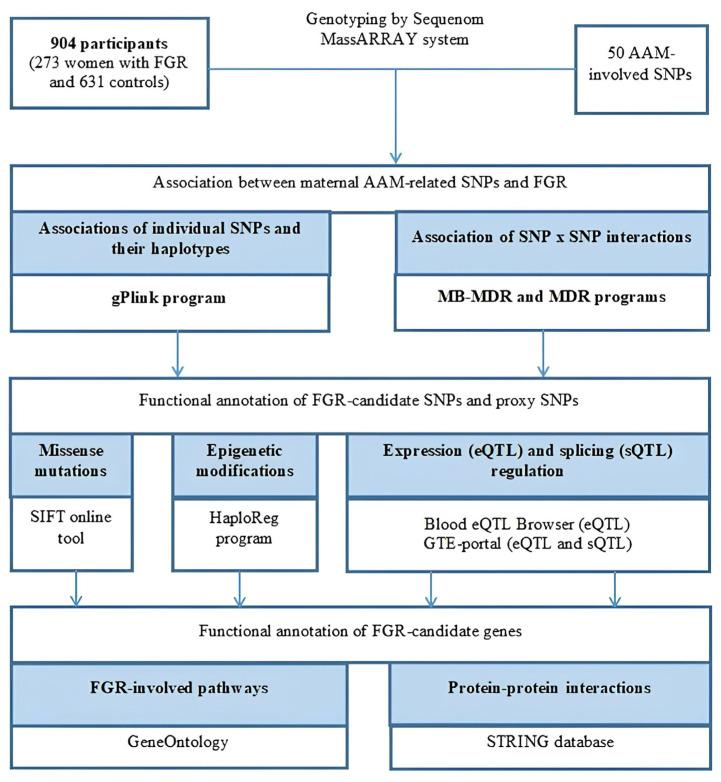
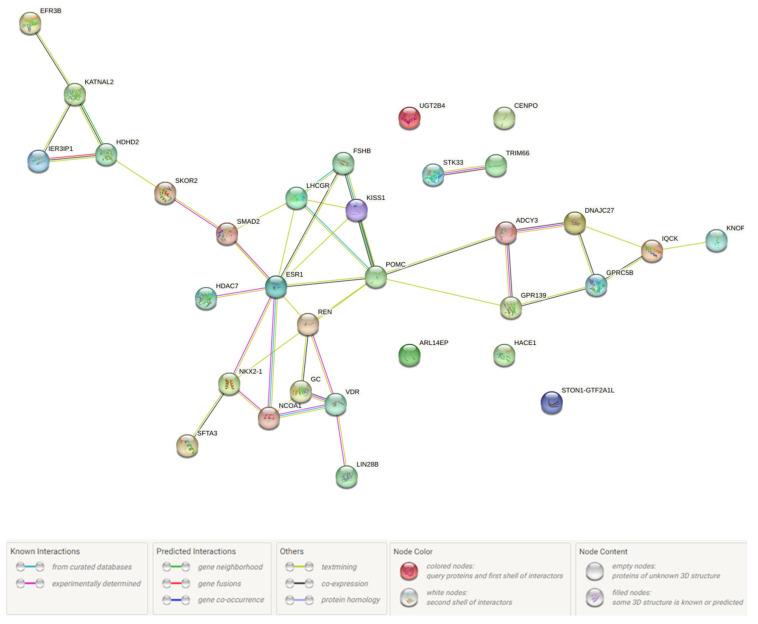
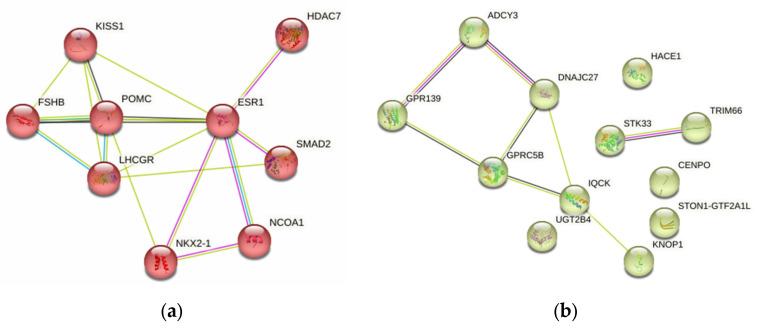
We aimed to explore the potential link of maternal age at menarche (mAAM) gene polymorphisms with risk of the fetal growth restriction (FGR). This case (FGR)-control (FGR free) study included 904 women (273 FGR and 631 control) in the third trimester of gestation examined/treated in the Departments of Obstetrics. For single nucleotide polymorphism (SNP) multiplex genotyping, 50 candidate loci of mAAM were chosen. The relationship of mAAM SNPs and FGR was appreciated by regression procedures (logistic/model-based multifactor dimensionality reduction [MB-MDR]) with subsequent in silico assessment of the assumed functionality pithy of FGR-related loci. Three mAAM-appertain loci were FGR-linked to genes such as (rs7538038) (effect allele G-odds ratio (OR) = 0.63/p = 0.0003; OR = 0.61/p = 0.001; OR = 0.56/p = 0.001), (rs999460) (effect allele A-OR = 1.37/p = 0.003; OR = 1.45/p = 0.002; OR = 2.41/p = 0.0002), (rs12444979) (effect allele T-OR = 1.67/p = 0.0003; OR = 1.59/p = 0.011; OR = 1.56/p = 0.009). The haplotype ACA gene (rs555621rs11031010rs1782507) was FRG-correlated (OR = 0.71/p = 0.05). Ten FGR-implicated interworking models were founded for 13 SNPs (p ≤ 0.001). The rs999460 and rs12444979 interplays significantly influenced the FGR risk (these SNPs were present in 50% of models). FGR-related mAAM-appertain 15 polymorphic variants and 350 linked SNPs were functionally momentous in relation to 39 genes participating in the regulation of hormone levels, the ovulation cycle process, male gonad development and vitamin D metabolism. Thus, this study showed, for the first time, that the mAAM-appertain genes determine FGR risk.
我们旨在探讨初潮时母亲年龄(mAAM)基因多态性与胎儿生长受限(FGR)风险之间的潜在联系。这项病例(FGR)对照(无FGR)研究纳入了904名在妊娠晚期于产科接受检查/治疗的女性(273例FGR患者和631例对照)。对于单核苷酸多态性(SNP)多重基因分型,选择了50个mAAM候选位点。通过回归程序(逻辑回归/基于模型的多因素降维法[MB - MDR])评估mAAM SNPs与FGR的关系,随后对假定的FGR相关位点的功能重要性进行计算机模拟评估。三个与mAAM相关的位点与FGR相关基因相连,如(rs7538038)(效应等位基因G - 比值比(OR)= 0.63/p = 0.0003;OR = 0.61/p = 0.001;OR = 0.56/p = 0.001),(rs999460)(效应等位基因A - OR = 1.37/p = 0.003;OR = 1.45/p = 0.002;OR = 2.41/p = 0.0002),(rs12444979)(效应等位基因T - OR = 1.67/p = 0.0003;OR = 1.59/p = 0.011;OR = 1.56/p = 0.009)。单倍型ACA基因(rs555621rs11031010rs1782507)与FRG相关(OR = 0.71/p = 0.05)。针对13个SNP建立了10个与FGR相关的相互作用模型(p≤0.001)。rs999460和rs12444979的相互作用显著影响FGR风险(这些SNP存在于50%的模型中)。与FGR相关的mAAM相关的15个多态性变体和350个连锁SNP在功能上对于参与激素水平调节、排卵周期过程、男性性腺发育和维生素D代谢的39个基因具有重要意义。因此,本研究首次表明,与mAAM相关的基因决定FGR风险。


 Zotero 插件