
超重/肥胖男大学生能量消耗和底物代谢的比较分析:Tabata 与 HIIT 和 MICT。
A comparative analysis of energy expenditure and substrate metabolism in male university students with overweight/obesity: Tabata vs HIIT and MICT.
机构信息
College of Physical Education and Health, Guangxi Normal University, Guilin, China.
Department of Physical Education, Hebei University of Environmental Engineering, Qinhuangdao, China.
出版信息
Front Endocrinol (Lausanne). 2024 Feb 27;15:1323093. doi: 10.3389/fendo.2024.1323093. eCollection 2024.
INTRODUCTION
Exploring the energy expenditure and substrate metabolism data during exercise, 10-minute recovery, and 20-minute recovery phases in Tabata, HIIT(High-Intensity Interval Training), and MICT(Moderate-Intensity Continuous Training). This study explores the scientific aspects of weight reduction strategies, examining energy expenditure and substrate metabolism from various training perspectives. The aim is to establish a theoretical foundation for tailoring targeted exercise plans for individuals within the population with overweight/obesity.
METHODS
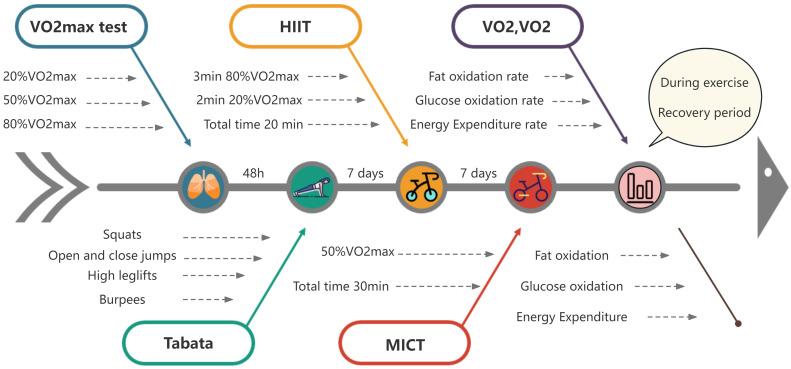
This study used an experimental design with fifteen male university students with overweight/obesity. Participants underwent random testing with Tabata, HIIT, and MICT. Tabata involved eight sets of 20 seconds exercise and 10 seconds rest, totaling 4 minutes. HIIT included four sets of power cycling: 3 minutes at 80% VO intensity followed by 2 minutes at 20% VO. MICT comprised 30 minutes of exercise at 50% VO intensity. Gas metabolism indices were continuously measured. Subsequently, fat and glucose oxidation rates, along with energy expenditure, were calculated for each exercise type.
RESULTS
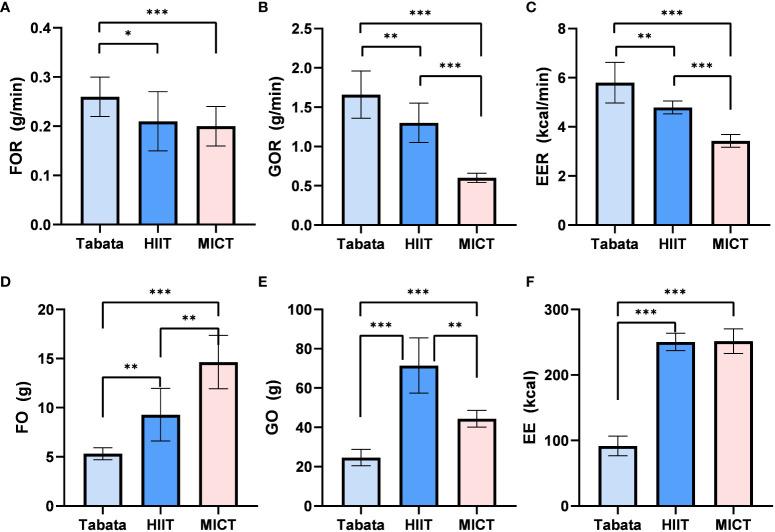
During both the exercise and recovery phases, the Tabata group exhibited a significantly higher fat oxidation rate of (0.27 ± 0.03 g/min) compared to the HIIT group (0.20 ± 0.04 g/min, p<0.05) and the MICT group (0.20 ± 0.03g/min, p<0.001). No significant difference was observed between the HIIT and MICT groups (p=0.854). In terms of energy expenditure rate, the Tabata group maintained a substantially elevated level at 5.76 ± 0.74kcal/min compared to the HIIT group (4.81 ± 0.25kcal/min, p<0.01) and the MICT group (3.45 ± 0.25kcal/min, p<0.001). Additionally, the energy expenditure rate of the HIIT group surpassed that of the MICT group significantly (p<0.001).
CONCLUSION
The study finds that male college students with overweight/obesity in both exercise and recovery, Tabata group has lower fat and glucose oxidation rates, and energy expenditure compared to HIIT and MICT groups. However, over the entire process, Tabata still exhibits significantly higher rates in these aspects than HIIT and MICT. Despite a shorter exercise duration, Tabata shows a noticeable "time-efficiency" advantage. Tabata can be used as an efficient short-term weight loss exercise program for male college students with overweight/obesity.
简介
本研究旨在探索 Tabata、HIIT(高强度间歇训练)和 MICT(中等强度持续训练)运动过程中 10 分钟恢复期和 20 分钟恢复期的能量消耗和底物代谢数据,从不同的训练角度探讨减肥策略的科学方面,为超重/肥胖人群制定有针对性的运动计划奠定理论基础。
方法
本研究采用 15 名超重/肥胖男大学生的实验设计,进行随机测试,包括 Tabata、HIIT 和 MICT。Tabata 包括 8 组 20 秒运动和 10 秒休息,总时长 4 分钟。HIIT 包括 4 组功率循环:3 分钟 80% VO 强度,随后 2 分钟 20% VO。MICT 包括 30 分钟 50% VO 强度运动。连续测量气体代谢指数。随后,计算每种运动类型的脂肪和葡萄糖氧化率以及能量消耗。
结果
在运动和恢复期,Tabata 组的脂肪氧化率(0.27±0.03g/min)明显高于 HIIT 组(0.20±0.04g/min,p<0.05)和 MICT 组(0.20±0.03g/min,p<0.001)。HIIT 组和 MICT 组之间无显著差异(p=0.854)。在能量消耗率方面,Tabata 组保持在 5.76±0.74kcal/min 的高水平,明显高于 HIIT 组(4.81±0.25kcal/min,p<0.01)和 MICT 组(3.45±0.25kcal/min,p<0.001)。此外,HIIT 组的能量消耗率明显高于 MICT 组(p<0.001)。
结论
研究发现,超重/肥胖男大学生在运动和恢复期,Tabata 组的脂肪和葡萄糖氧化率以及能量消耗均低于 HIIT 和 MICT 组。然而,在整个过程中,Tabata 在这些方面的表现仍明显高于 HIIT 和 MICT。Tabata 虽然运动时间较短,但具有明显的“时间效率”优势。Tabata 可以作为超重/肥胖男大学生高效的短期减肥运动方案。


 Zotero 插件