
利用供体来源的游离DNA指导肾移植受者免疫抑制治疗的减药:一项观察性研究。
Use of Donor-derived Cell-free DNA to Inform Tapering of Immunosuppression Therapy in Kidney Transplant Recipients: An Observational Study.
作者信息
Osuchukwu George, Trevino Alexa, McCormick Sarah, Kaur Navchetan, Prigmore Brittany, Al Haj Baddar Nour, Bloom Michelle S, Demko Zachary, Gauthier Philippe
机构信息
Victoria Kidney and Dialysis Associates, Victoria, TX.
Natera Inc, Austin, TX.
出版信息
Transplant Direct. 2024 Mar 12;10(4):e1610. doi: 10.1097/TXD.0000000000001610. eCollection 2024 Apr.
BACKGROUND
Immunosuppression therapy (IST) is required for allograft survival but can cause significant adverse effects. Donor-derived cell-free DNA (dd-cfDNA) is a validated noninvasive biomarker for active rejection in kidney transplant (KTx). Evidence supporting dd-cfDNA testing use in IST management is limited.
METHODS
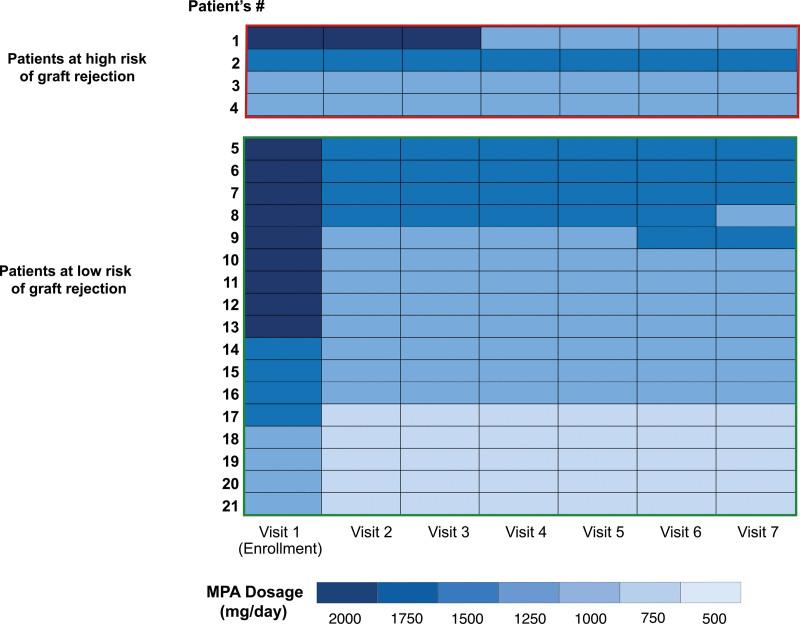
In this single-center observational study, dd-cfDNA testing was performed in 21 KTx patients considered good candidates for mycophenolic acid (MPA) reduction. Patients with dd-cfDNA <1% at the first visit (enrollment) had their MPA dosage reduced; those with dd-cfDNA ≥1% had their MPA dosage maintained. Patients were monitored with dd-cfDNA for 6 additional visits.
RESULTS
Of 21 patients enrolled in the study, 17 were considered low risk for rejection by dd-cfDNA and underwent MPA reduction; 4 patients were considered high risk for rejection by dd-cfDNA and had their initial MPA dosage maintained. Of the 4 patients considered high risk for rejection by dd-cfDNA, 1 experienced chronic allograft nephropathy and graft loss, and another received an indication biopsy that showed no evidence of rejection. Of the 17 patients considered low risk for rejection by dd-cfDNA, none experienced allograft rejection. dd-cfDNA was used for surveillance in a 6-mo period following MPA reduction; no untoward results were noted.
CONCLUSIONS
This proof-of-concept study reports the use of dd-cfDNA to directly inform IST management in a cohort of KTx who were candidates for IST reduction.
背景
免疫抑制疗法(IST)是同种异体移植存活所必需的,但可能会引起显著的不良反应。供体来源的游离DNA(dd-cfDNA)是肾移植(KTx)中活动性排斥反应的一种经过验证的非侵入性生物标志物。支持在IST管理中使用dd-cfDNA检测的证据有限。
方法
在这项单中心观察性研究中,对21例被认为是霉酚酸(MPA)减量的合适候选者的KTx患者进行了dd-cfDNA检测。首次就诊(入组)时dd-cfDNA<1%的患者减少MPA剂量;dd-cfDNA≥1%的患者维持MPA剂量。患者通过dd-cfDNA进行另外6次随访监测。
结果
在该研究纳入的21例患者中,17例被dd-cfDNA判定为排斥反应低风险,进行了MPA减量;4例被dd-cfDNA判定为排斥反应高风险,维持初始MPA剂量。在4例被dd-cfDNA判定为排斥反应高风险的患者中,1例发生慢性移植肾肾病和移植肾丢失,另1例接受指征性活检,未发现排斥反应证据。在17例被dd-cfDNA判定为排斥反应低风险的患者中,无1例发生移植肾排斥反应。在MPA减量后的6个月期间,使用dd-cfDNA进行监测;未观察到不良结果。
结论
这项概念验证研究报告了在一组适合进行IST减量的KTx患者中使用dd-cfDNA直接指导IST管理。
 Zotero 插件