
术前使用阿片类药物与出院后结局的关联:密歇根外科质量协作组的一项队列研究
The Association of Preoperative Opioid Use with Post-Discharge Outcomes: A Cohort Study of the Michigan Surgical Quality Collaborative.
作者信息
Frangakis Stephan G, Kavalakatt Bethany, Gunaseelan Vidhya, Lai Yenling, Waljee Jennifer, Englesbe Michael, Brummett Chad M, Bicket Mark C
机构信息
Department of Anesthesiology, University of Michigan Medical School, Ann Arbor, Michigan.
Lake Erie College of Osteopathic Medicine, Bradenton, Florida.
出版信息
Ann Surg. 2024 Mar 14. doi: 10.1097/SLA.0000000000006265.
OBJECTIVE
To examine the association of prescription opioid fills over the year prior to surgery with postoperative outcomes.
BACKGROUND
Nearly one third of patients report opioid use in the year preceding surgery, yet an understanding of how opioid exposure influences patient-reported outcomes after surgery remains incomplete. Therefore, this study was designed to test the hypothesis that preoperative opioid exposure may impede recovery in the postoperative period.
METHODS
This retrospective cohort study used a statewide clinical registry from 70 hospitals linked to opioid fulfillment data from the state's prescription drug monitoring program to categorize patients' preoperative opioid exposure as none (naïve), minimal, intermittent, or chronic. Outcomes were patient-reported pain intensity (primary), as well as 30-day clinical and patient-reported outcomes (secondary).
RESULTS
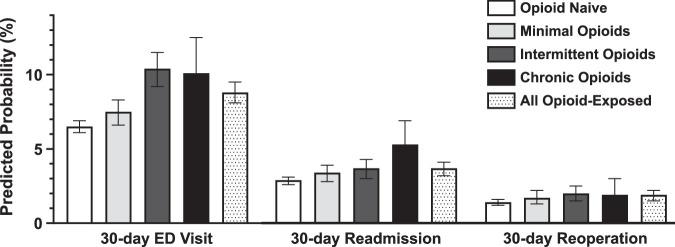
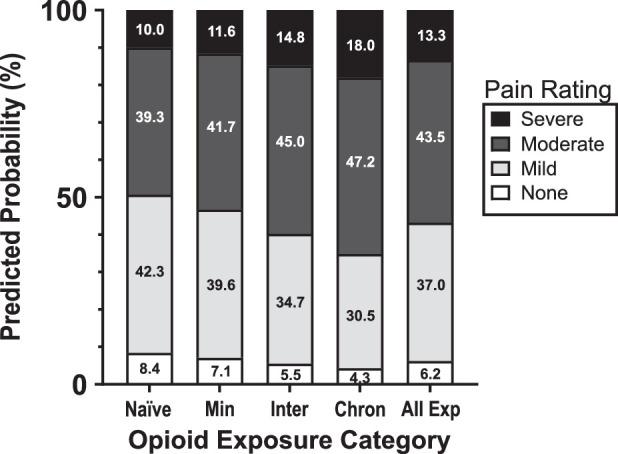
Compared to opioid-naïve patients, opioid exposure was associated with higher reported pain scores at 30 days after surgery. Predicted probabilities was higher among the opioid exposed versus naive group for reporting moderate pain (43.5% [95% CI 42.6 - 44.4%] vs 39.3% [95% CI 38.5 - 40.1%]) and severe pain (13.% [95% CI 12.5 - 14.0%] vs 10.0% [95% CI 9.5 - 10.5%]), and increasing probability was associated increased opioid exposure for both outcomes. Clinical outcomes (incidence of ED visits, readmissions, and reoperation within 30-days) and patient-reported outcomes (reported satisfaction, regret, and quality of life) were also worse with increasing preoperative opioid exposure for most outcomes.
CONCLUSIONS
This study is the first to examine the effect of presurgical opioid exposure on both clinical and non-clinical outcomes in a broad cohort of patients, and shows that exposure is associated with worse postsurgical outcomes. A key question to be addressed is whether and to what extent opioid tapering before surgery mitigates these risks after surgery.
目的
研究手术前一年的处方阿片类药物使用量与术后结果之间的关联。
背景
近三分之一的患者报告在手术前一年使用过阿片类药物,但对于阿片类药物暴露如何影响术后患者报告的结果,目前仍了解不足。因此,本研究旨在检验术前阿片类药物暴露可能会阻碍术后恢复这一假设。
方法
这项回顾性队列研究使用了来自70家医院的全州临床登记数据,并与该州处方药监测计划中的阿片类药物配给数据相关联,将患者术前阿片类药物暴露情况分为无(未用过)、极少、间断或慢性。结果指标为患者报告的疼痛强度(主要指标)以及30天的临床和患者报告结果(次要指标)。
结果
与未用过阿片类药物的患者相比,阿片类药物暴露与术后30天报告的较高疼痛评分相关。在报告中度疼痛(43.5% [95% CI 42.6 - 44.4%] 对39.3% [95% CI 38.5 - 40.1%])和重度疼痛(13.% [95% CI 12.5 - 14.0%] 对10.0% [95% CI 9.5 - 10.5%])方面,阿片类药物暴露组的预测概率高于未用过阿片类药物的组,并且两种结果的概率增加都与阿片类药物暴露增加有关。对于大多数结果,随着术前阿片类药物暴露增加,临床结果(30天内急诊就诊、再入院和再次手术的发生率)和患者报告结果(报告的满意度、后悔程度和生活质量)也更差。
结论
本研究首次在广泛的患者队列中研究了术前阿片类药物暴露对临床和非临床结果的影响,结果表明暴露与更差的术后结果相关。一个需要解决的关键问题是术前阿片类药物减量是否以及在多大程度上能降低术后这些风险。

 Zotero 插件