
炎症和蛋白质丢失的非侵入性标志物可增强对小儿乳糜泻的诊断。
Noninvasive Markers of Inflammation and Protein Loss Augment Diagnosis of Pediatric Celiac Disease.
机构信息
Department of Pediatrics, Washington University School of Medicine, St. Louis, Missouri, USA.
Department of Pathology & Immunology, Washington University School of Medicine, St. Louis, Missouri, USA.
出版信息
Clin Transl Gastroenterol. 2024 May 1;15(5):e00695. doi: 10.14309/ctg.0000000000000695.
INTRODUCTION
Circulating tissue transglutaminase immunoglobulin A concentration is a sensitive and specific indicator of celiac disease, but discrepancies between serologic and histologic findings occur. We hypothesized that fecal markers of inflammation and protein loss would be greater in patients with untreated celiac disease than in healthy controls. Our study aims to evaluate multiple fecal and plasma markers in celiac disease and correlate these findings with serologic and histologic findings as noninvasive means of evaluating disease activity.
METHODS
Participants with positive celiac serologies and controls with negative celiac serologies were prospectively enrolled before upper endoscopy. Blood, stool, and duodenal biopsies were collected. Concentrations of fecal lipocalin-2, calprotectin, and alpha-1-antitrypsin and plasma lipocalin-2 were determined. Biopsies underwent modified Marsh scoring. Significance was tested between cases and controls, modified Marsh score and tissue transglutaminase immunoglobulin A concentration.
RESULTS
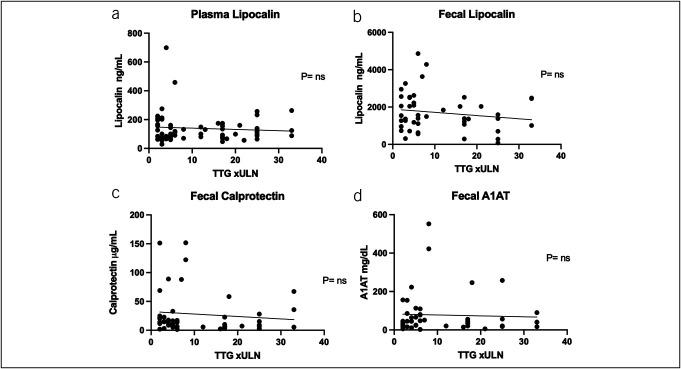
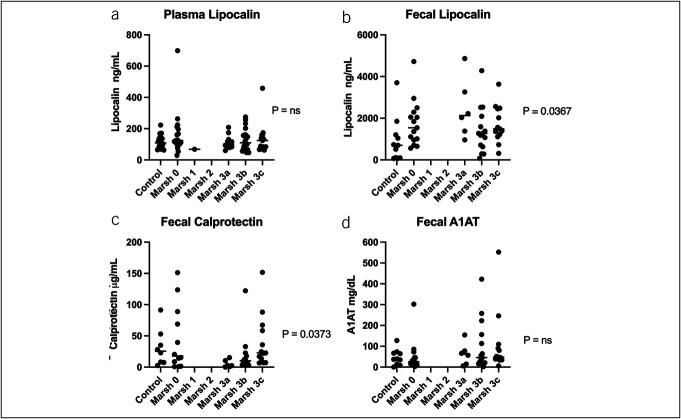
Lipocalin-2 was significantly elevated in the stool ( P = 0.006) but not the plasma of participants with positive celiac serologies. There was no significant difference in fecal calprotectin or alpha-1 antitrypsin between participants with positive celiac serologies and controls. Fecal alpha-1 antitrypsin >100 mg/dL was specific, but not sensitive for biopsy-proven celiac disease.
DISCUSSION
Lipocalin-2 is elevated in the stool but not the plasma of patients with celiac disease suggesting a role of local inflammatory response. Calprotectin was not a useful marker in the diagnosis of celiac disease. While random fecal alpha-1 antitrypsin was not significantly elevated in cases compared with controls, an elevation of greater than 100 mg/dL was 90% specific for biopsy-proven celiac disease.
简介
循环组织转谷氨酰胺酶免疫球蛋白 A 浓度是乳糜泻的敏感和特异性指标,但血清学和组织学发现之间存在差异。我们假设未经治疗的乳糜泻患者的粪便炎症和蛋白质丢失标志物将高于健康对照组。我们的研究旨在评估乳糜泻患者的多种粪便和血浆标志物,并将这些发现与血清学和组织学发现相关联,作为评估疾病活动的非侵入性方法。
方法
在上消化道内镜检查前前瞻性招募了乳糜泻血清学阳性和乳糜泻血清学阴性的参与者。采集血液、粪便和十二指肠活检。测定粪便中脂联素-2、钙卫蛋白和α-1-抗胰蛋白酶的浓度以及血浆脂联素-2。活检采用改良 Marsh 评分。在病例和对照组、改良 Marsh 评分和组织转谷氨酰胺酶免疫球蛋白 A 浓度之间测试了统计学意义。
结果
乳糜泻血清学阳性患者的粪便中脂联素-2显著升高(P = 0.006),而血浆中则没有。乳糜泻血清学阳性患者和对照组的粪便钙卫蛋白或α-1 抗胰蛋白酶无显著差异。粪便α-1 抗胰蛋白酶>100 mg/dL 对活检证实的乳糜泻具有特异性,但不敏感。
讨论
乳糜泻患者的粪便中脂联素-2升高而血浆中则没有,这表明局部炎症反应起作用。钙卫蛋白不是乳糜泻诊断的有用标志物。虽然病例组与对照组相比,粪便α-1 抗胰蛋白酶随机升高不显著,但大于 100 mg/dL 的升高对活检证实的乳糜泻具有 90%的特异性。

 Zotero 插件