
基于可解释人工智能的 VGG16 对 KUB X 射线图像中的肾结石进行识别。
Identification of kidney stones in KUB X-ray images using VGG16 empowered with explainable artificial intelligence.
机构信息
School of Computer Science, National College of Business Administration and Economics, Lahore, 54000, Pakistan.
Department of Computer Sciences, Bahria University, Lahore Campus, Lahore, 54000, Pakistan.
出版信息
Sci Rep. 2024 Mar 14;14(1):6173. doi: 10.1038/s41598-024-56478-4.
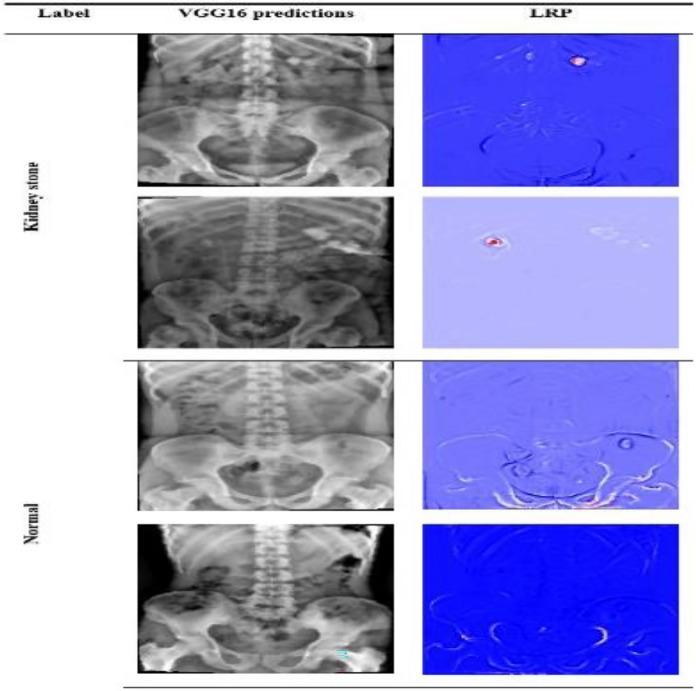
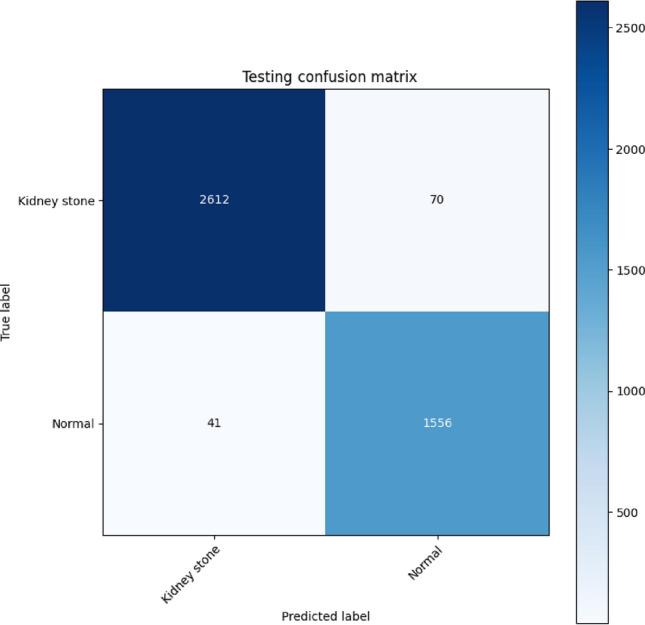
A kidney stone is a solid formation that can lead to kidney failure, severe pain, and reduced quality of life from urinary system blockages. While medical experts can interpret kidney-ureter-bladder (KUB) X-ray images, specific images pose challenges for human detection, requiring significant analysis time. Consequently, developing a detection system becomes crucial for accurately classifying KUB X-ray images. This article applies a transfer learning (TL) model with a pre-trained VGG16 empowered with explainable artificial intelligence (XAI) to establish a system that takes KUB X-ray images and accurately categorizes them as kidney stones or normal cases. The findings demonstrate that the model achieves a testing accuracy of 97.41% in identifying kidney stones or normal KUB X-rays in the dataset used. VGG16 model delivers highly accurate predictions but lacks fairness and explainability in their decision-making process. This study incorporates the Layer-Wise Relevance Propagation (LRP) technique, an explainable artificial intelligence (XAI) technique, to enhance the transparency and effectiveness of the model to address this concern. The XAI technique, specifically LRP, increases the model's fairness and transparency, facilitating human comprehension of the predictions. Consequently, XAI can play an important role in assisting doctors with the accurate identification of kidney stones, thereby facilitating the execution of effective treatment strategies.
肾结石是一种固体形成物,如果发生泌尿系统阻塞,可能导致肾衰竭、剧烈疼痛和生活质量下降。虽然医学专家可以解读肾脏输尿管膀胱(KUB)X 光片,但特定的图像对人类检测构成挑战,需要大量的分析时间。因此,开发一个检测系统对于准确分类 KUB X 光片变得至关重要。本文应用了一种带有预训练 VGG16 的迁移学习(TL)模型,并结合可解释人工智能(XAI),建立了一个系统,可以接收 KUB X 光片并准确地将其分类为肾结石或正常情况。研究结果表明,该模型在用于测试的数据集上,在识别肾结石或正常 KUB X 射线方面的准确率达到了 97.41%。VGG16 模型可以做出非常准确的预测,但在决策过程中缺乏公平性和可解释性。本研究引入了一种可解释人工智能(XAI)技术——层间相关性传播(LRP),以提高模型的透明度和有效性,解决这一问题。XAI 技术,特别是 LRP,提高了模型的公平性和透明度,有助于人类理解预测结果。因此,XAI 可以在帮助医生准确识别肾结石方面发挥重要作用,从而促进实施有效的治疗策略。


 Zotero 插件