
在真实人群中,与大麻使用障碍的发病率和复发率降低相关的司美格鲁肽:一项回顾性队列研究。
Association of semaglutide with reduced incidence and relapse of cannabis use disorder in real-world populations: a retrospective cohort study.
机构信息
Center for Science, Health, and Society, Case Western Reserve University School of Medicine, Cleveland, OH, USA.
National Institute on Drug Abuse, National Institutes of Health, Bethesda, MD, USA.
出版信息
Mol Psychiatry. 2024 Aug;29(8):2587-2598. doi: 10.1038/s41380-024-02498-5. Epub 2024 Mar 14.
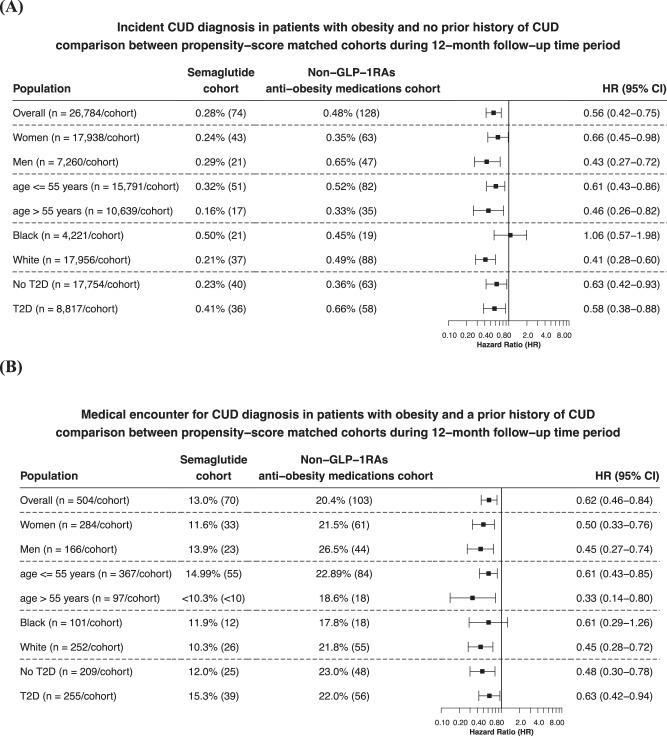
Cannabis is the most frequently used illicit drug in the United States with more than 45 million users of whom one-third suffer from a cannabis use disorder (CUD). Despite its high prevalence, there are currently no FDA-approved medications for CUD. Patients treated with semaglutide, a glucagon-like peptide-1 receptor agonist (GLP-1RA) approved for treating type 2 diabetes (T2D) and for weight management have reported reduced desire to drink and smoke. Preclinical studies have shown that semaglutide decreased nicotine and alcohol consumption. Preclinical and preliminary clinical evidence of semaglutide's potential beneficial effects on various substance use disorders led us to evaluate if it pertained to CUD. In this retrospective cohort study of electronic health records (EHRs) from the TriNetX Analytics Network, a global federated health research network of approximately 105.3 million patients from 61 large healthcare organizations in the US, we aimed to assess the associations of semaglutide with both incident and recurrent CUD diagnosis compared to non-GLP-1RA anti-obesity or anti-diabetes medications. Hazard ratio (HR) and 95% confidence intervals (CI) of incident and recurrent CUD were calculated for 12-month follow-up by comparing propensity-score matched patient cohorts. The study population included 85,223 patients with obesity who were prescribed semaglutide or non-GLP-1RA anti-obesity medications, with the findings replicated in 596,045 patients with T2D. In patients with obesity (mean age 51.3 years, 65.6% women), semaglutide compared with non-GLP-1RA anti-obesity medications was associated with lower risk for incident CUD in patients with no prior history CUD (HR: 0.56, 95% CI: 0.42-0.75), and recurrent CUD diagnosis in patients with a prior history CUD (HR: 0.62, 95% CI: 0.46-0.84). Consistent reductions were seen for patients stratified by gender, age group, race and in patients with and without T2D. Similar findings were replicated in the study population with T2D when comparing semaglutide with non-GLP-1RA anti-diabetes medications for incident CUD (HR: 0.40, 95% CI: 0.29-0.56) and recurrent CUD (HR: 0.66, 95% CI: 0.42-1.03). While these findings provide preliminary evidence of the potential benefit of semaglutide in CUD in real-world populations, further preclinical studies are warranted to understand the underlying mechanism and randomized clinical trials are needed to support its use clinically for CUD.
大麻是美国使用最广泛的非法药物,超过 4500 万使用者中有三分之一患有大麻使用障碍(CUD)。尽管大麻的使用非常普遍,但目前还没有美国食品和药物管理局(FDA)批准的用于治疗 CUD 的药物。接受司美格鲁肽治疗的患者,一种胰高血糖素样肽-1 受体激动剂(GLP-1RA),用于治疗 2 型糖尿病(T2D)和体重管理,报告说减少了对饮酒和吸烟的渴望。临床前研究表明,司美格鲁肽可减少尼古丁和酒精的摄入。临床前和初步临床证据表明,司美格鲁肽对各种物质使用障碍可能有有益的影响,这促使我们评估它是否与 CUD 有关。在这项来自 TriNetX 分析网络的电子健康记录(EHR)的回顾性队列研究中,该网络是一个由美国 61 家大型医疗保健组织组成的全球联合健康研究网络,拥有约 1.053 亿患者,我们旨在评估与非 GLP-1RA 减肥药或抗糖尿病药物相比,司美格鲁肽与新发和复发性 CUD 诊断之间的关联。通过比较倾向评分匹配的患者队列,计算了 12 个月随访时新发和复发性 CUD 的风险比(HR)和 95%置信区间(CI)。该研究人群包括 85223 名肥胖患者,他们接受了司美格鲁肽或非 GLP-1RA 减肥药治疗,在 596045 名 2 型糖尿病患者中复制了这一发现。在肥胖患者(平均年龄 51.3 岁,65.6%为女性)中,与非 GLP-1RA 减肥药相比,无既往 CUD 史的患者使用司美格鲁肽与新发 CUD 的风险较低(HR:0.56,95%CI:0.42-0.75),有既往 CUD 史的患者复发性 CUD 诊断的风险较低(HR:0.62,95%CI:0.46-0.84)。在按性别、年龄组、种族分层的患者中以及在有和没有 T2D 的患者中,均观察到一致的降低。在患有 2 型糖尿病的研究人群中,与非 GLP-1RA 抗糖尿病药物相比,司美格鲁肽在新发 CUD(HR:0.40,95%CI:0.29-0.56)和复发性 CUD(HR:0.66,95%CI:0.42-1.03)方面也有类似的发现。尽管这些发现为司美格鲁肽在真实世界人群中治疗 CUD 的潜在益处提供了初步证据,但仍需要进一步的临床前研究来了解其潜在机制,还需要随机临床试验来支持其在临床上用于治疗 CUD。


 Zotero 插件