
迈向克服II型光动力疗法的障碍:光、光敏剂和氧气的内源性产生。
Towards overcoming obstacles of type II photodynamic therapy: Endogenous production of light, photosensitizer, and oxygen.
作者信息
Yu Lin, Liu Zhen, Xu Wei, Jin Kai, Liu Jinliang, Zhu Xiaohui, Zhang Yong, Wu Yihan
机构信息
Department of Chemical and Environmental Engineering, Shanghai University, Shanghai 200433, China.
School of Medicine, Shanghai University, Shanghai 200433, China.
出版信息
Acta Pharm Sin B. 2024 Mar;14(3):1111-1131. doi: 10.1016/j.apsb.2023.11.007. Epub 2023 Nov 4.
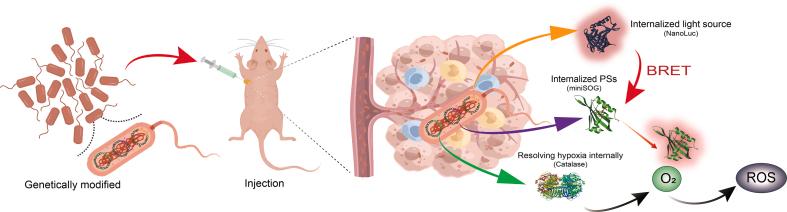
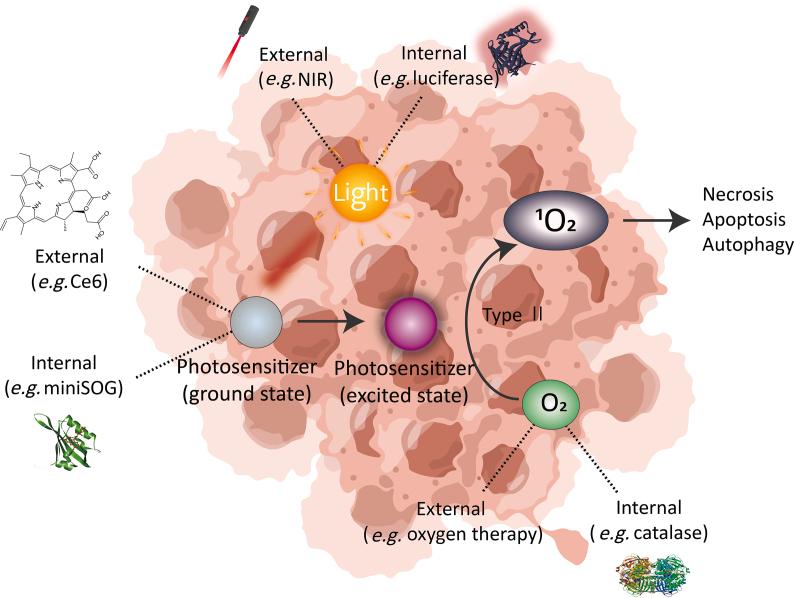
Conventional photodynamic therapy (PDT) approaches face challenges including limited light penetration, low uptake of photosensitizers by tumors, and lack of oxygen in tumor microenvironments. One promising solution is to internally generate light, photosensitizers, and oxygen. This can be accomplished through endogenous production, such as using bioluminescence as an endogenous light source, synthesizing genetically encodable photosensitizers , and modifying cells genetically to express catalase enzymes. Furthermore, these strategies have been reinforced by the recent rapid advancements in synthetic biology. In this review, we summarize and discuss the approaches to overcome PDT obstacles by means of endogenous production of excitation light, photosensitizers, and oxygen. We envision that as synthetic biology advances, genetically engineered cells could act as precise and targeted "living factories" to produce PDT components, leading to enhanced performance of PDT.
传统的光动力疗法(PDT)面临诸多挑战,包括光穿透有限、肿瘤对光敏剂摄取率低以及肿瘤微环境中缺氧。一种有前景的解决方案是在体内产生光、光敏剂和氧气。这可以通过内源性产生来实现,例如利用生物发光作为内源性光源、合成基因编码的光敏剂以及对细胞进行基因改造以表达过氧化氢酶。此外,合成生物学最近的快速发展进一步强化了这些策略。在本综述中,我们总结并讨论了通过内源性产生激发光、光敏剂和氧气来克服光动力疗法障碍的方法。我们设想,随着合成生物学的发展,基因工程细胞可以作为精确且有针对性的“活体工厂”来生产光动力疗法组件,从而提高光动力疗法的性能。


 Zotero 插件