
体力活动、运动与存在心血管疾病的个体不良心血管结局:叙述性综述。
Physical activity, exercise and adverse cardiovascular outcomes in individuals with pre-existing cardiovascular disease: a narrative review.
机构信息
Leicester Real World Evidence Unit, Diabetes Research Centre, University of Leicester, Leicester General Hospital, Leicester, UK.
Institute of Public Health and Clinical Nutrition, University of Eastern Finland, Kuopio, Finland.
出版信息
Expert Rev Cardiovasc Ther. 2024 Jan-Mar;22(1-3):91-101. doi: 10.1080/14779072.2024.2328644. Epub 2024 Mar 15.
INTRODUCTION
The evidence supporting the cardiovascular health benefits of physical activity and/or exercise training is well-established. While the role of physical activity in primary prevention is unequivocal, its significance in secondary prevention (among those with preexisting cardiovascular disease) is less definitive. Though guidelines universally recommend physical activity as part of the secondary preventive strategy, the empirical evidence underpinning these recommendations is not as robust as that for primary prevention.
AREAS COVERED
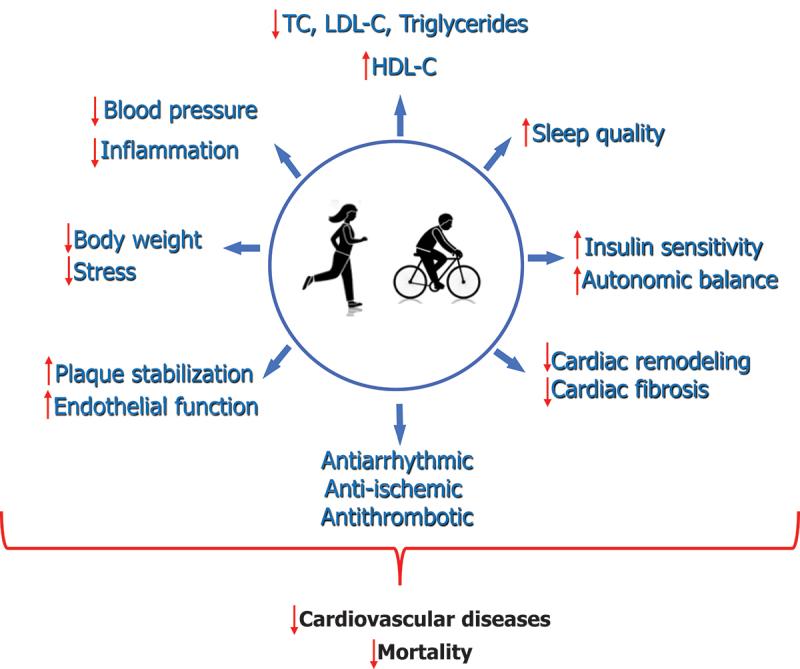
This review distills the body of available observational and interventional evidence on the relationship between physical activity, exercise, and adverse cardiovascular outcomes among those with preexisting cardiovascular disease. The postulated biologic mechanisms underlying the relationships, areas of prevailing uncertainty, and potential public health implications are also discussed.
EXPERT OPINION
A physical activity level of 500 MET-min/week (equivalent to 150 min of moderate-intensity physical activity or 75 min of vigorous-intensity physical activity or an equivalent combination) may be a minimum requirement for patients with preexisting CVD. However, to reap the maximum benefits of physical activity and also minimize adverse effects, physical activity and/or exercise regimens should be tailored to unique factors such as individual's baseline physical activity habits, cardiovascular health status and the specific nature of their cardiovascular disease.
简介
体力活动和/或运动训练对心血管健康的益处已有充分证据支持。虽然体力活动在一级预防中的作用是明确的,但在二级预防(即已有心血管疾病的人群)中的作用则不那么确定。虽然指南普遍建议将体力活动作为二级预防策略的一部分,但这些建议的实证证据不如一级预防那么可靠。
涵盖领域
本文综述了现有关于体力活动、运动与已有心血管疾病人群不良心血管结局之间关系的观察性和干预性证据。还讨论了潜在的生物学机制、普遍存在的不确定性领域以及潜在的公共卫生影响。
专家意见
对于已有 CVD 的患者,每周 500 梅脱分钟(相当于 150 分钟中等强度体力活动或 75 分钟剧烈强度体力活动或等效组合)的体力活动水平可能是最低要求。然而,为了最大限度地受益于体力活动并最小化不良反应,体力活动和/或运动方案应根据个人的基线体力活动习惯、心血管健康状况以及心血管疾病的具体性质等独特因素进行调整。
 Zotero 插件