
肺炎球菌结合疫苗对冈比亚鼻咽部肺炎球菌携带的影响:基于人群的横断面调查。
Impact of pneumococcal conjugate vaccination on pneumococcal nasopharyngeal carriage in the Gambia: Population-based cross-sectional surveys.
机构信息
Medical Research Council Unit The Gambia at London School of Hygiene & Tropical Medicine, PO Box 273, Banjul, Gambia; Murdoch Children's Research Institute, Parkville, 3052 Melbourne, Victoria, Australia; Faculty of Infectious and Tropical Diseases, London School of Hygiene & Tropical Medicine, Keppel Street, London WC1E 7HT, UK; Department of Paediatrics, University of Melbourne, Parkville, 3052 Melbourne, Victoria, Australia.
Medical Research Council Unit The Gambia at London School of Hygiene & Tropical Medicine, PO Box 273, Banjul, Gambia.
出版信息
Vaccine. 2024 Apr 11;42(10):2680-2686. doi: 10.1016/j.vaccine.2024.02.066. Epub 2024 Mar 14.
BACKGROUND
The introduction of pneumococcal conjugate vaccines (PCV) has reduced carriage of vaccine-type (VT) pneumococci in many settings. We determined the impact of The Gambia's national PCV programme on carriage of VT pneumococci in the population.
METHODS
Seven-valent PCV (PCV7) was introduced in August 2009 without catch-up and with doses scheduled at 2, 3, 4 months of age; it was replaced by PCV13 in May 2011. We did cross-sectional carriage surveys in 2009, 2015, and 2017 in age-stratified, population-based samples. Nasopharyngeal specimens were collected and processed according to WHO guidelines. We calculated observed and adjusted prevalence ratios (PR) of VT carriage before and after PCV introduction.
FINDINGS
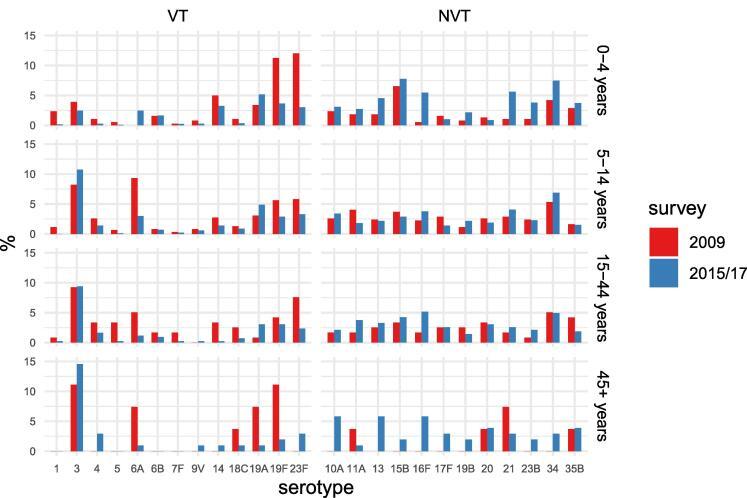
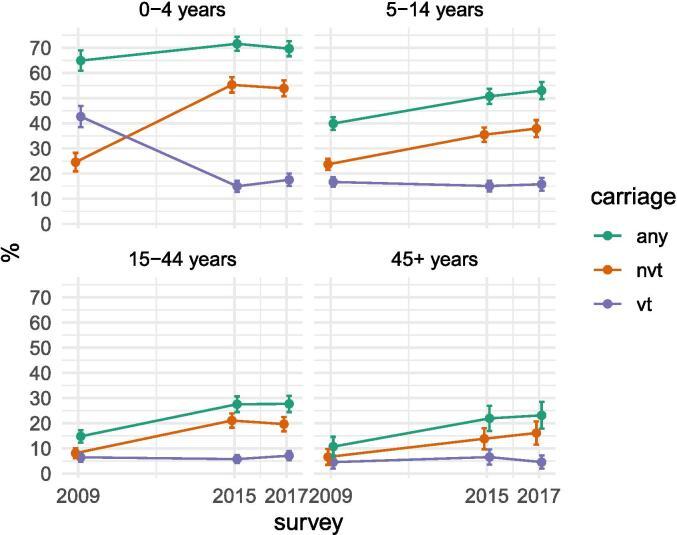
We enrolled 2988, 3162, and 2709 participants in 2009, 2015, and 2017 respectively. The baseline (2009) prevalence of VT pneumococcal carriage among children aged 0-4 years was 42.6 %, which declined to 14.9 % and 17.5 % in 2015 and 2017 respectively (adjPR 0.32 [95 % CI 0.27, 0.38] and 0.38 [0.31, 0.46] respectively). VT prevalence among children aged 5-14 years was 16.6 %, 15.1 %, and 15.8 % in the three surveys (2017 vs 2009, adjPR 0.70 [0.58, 0.83]). VT prevalence among 15-44 year-olds was 6.4 %, 5.7 %, and 7.1 % in the three surveys (2017 vs 2009, adjPR 0.59 [0.46, 0.75]), while in those aged ≥ 45 years it was 4.5 %, 6.5 %, and 4.5 % respectively. Non-VT carriage increased in all age-groups. Prevalent residual serotypes were 34 and 15B (age 0-4 years), 3 and 34 (age 5-14 years), and 3 and 16F (age ≥ 15 years).
CONCLUSIONS
Introduction of PCV was associated with reduced VT pneumococcal carriage in young, and older children, although with substantial residual prevalence. Persisting VT, and non-VT, carriage indicate significant, persistent transmission of pneumococci in the population.
背景
肺炎球菌结合疫苗(PCV)的引入降低了许多环境中疫苗型(VT)肺炎球菌的携带率。我们确定冈比亚国家 PCV 计划对人群中 VT 肺炎球菌携带率的影响。
方法
2009 年 8 月引入了 7 价 PCV(PCV7),没有进行补种且剂量安排在 2、3、4 个月龄;2011 年 5 月被 13 价 PCV(PCV13)取代。我们在 2009 年、2015 年和 2017 年进行了按年龄分层、基于人群的横断面携带率调查。按照世界卫生组织的指南收集鼻咽标本并进行处理。我们计算了 PCV 引入前后 VT 携带的观察和调整后患病率比值(PR)。
结果
我们分别于 2009 年、2015 年和 2017 年招募了 2988、3162 和 2709 名参与者。0-4 岁儿童的基线(2009 年)VT 肺炎球菌携带率为 42.6%,2015 年和 2017 年分别下降至 14.9%和 17.5%(调整后的 PR 0.32 [95%CI 0.27, 0.38]和 0.38 [0.31, 0.46])。5-14 岁儿童的 VT 患病率在三次调查中分别为 16.6%、15.1%和 15.8%(2017 年与 2009 年相比,调整后的 PR 0.70 [0.58, 0.83])。15-44 岁人群的 VT 患病率在三次调查中分别为 6.4%、5.7%和 7.1%(2017 年与 2009 年相比,调整后的 PR 0.59 [0.46, 0.75]),而≥45 岁人群的 VT 患病率分别为 4.5%、6.5%和 4.5%。所有年龄组的非 VT 携带率均有所增加。持续存在的血清型为 34 和 15B(0-4 岁年龄组)、3 和 34(5-14 岁年龄组)以及 3 和 16F(≥15 岁年龄组)。
结论
PCV 的引入与年轻和大龄儿童的 VT 肺炎球菌携带率降低有关,但仍有大量残余流行率。持续存在的 VT 和非 VT 携带表明人群中肺炎球菌的传播仍然非常显著。
 Zotero 插件