
人间质基质细胞抑制肺感染临床相关模型中的复制。
Human mesenchymal stromal cells inhibit replication in clinically relevant models of lung infection.
机构信息
Wellcome-Wolfson Institute for Experimental Medicine, Queen's University, Belfast, UK.
Wellcome-Wolfson Institute for Experimental Medicine, Queen's University, Belfast, UK
出版信息
Thorax. 2024 Jul 16;79(8):778-787. doi: 10.1136/thorax-2023-220819.
INTRODUCTION
Novel therapeutic strategies are urgently needed for complex pulmonary disease (MAC-PD). Human mesenchymal stromal cells (MSCs) can directly inhibit MAC growth, but their effect on intracellular bacilli is unknown. We investigated the ability of human MSCs to reduce bacterial replication and inflammation in MAC-infected macrophages and in a murine model of MAC-PD.
METHODS
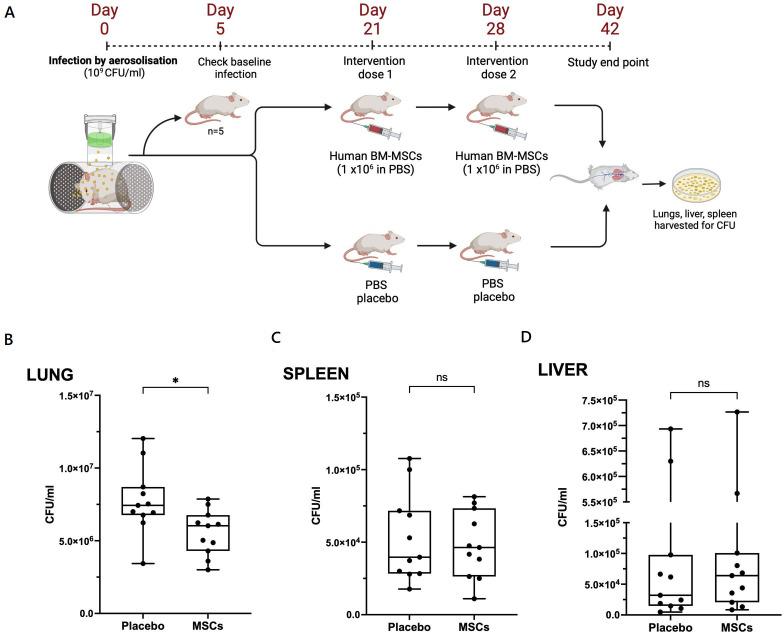
Human monocyte-derived macrophages (MDMs) were infected with Chester strain and treated with human bone marrow-derived MSCs. Intracellular and extracellular colony-forming units (CFUs) were counted at 72 hours. Six-week-old female balb/c mice were infected by nebulisation of Chester. Mice were treated with 1×10 intravenous human MSCs or saline control at 21 and 28 days post-infection. Lungs, liver and spleen were harvested 42 days post-infection for bacterial counts. Cytokines were quantified by ELISA.
RESULTS
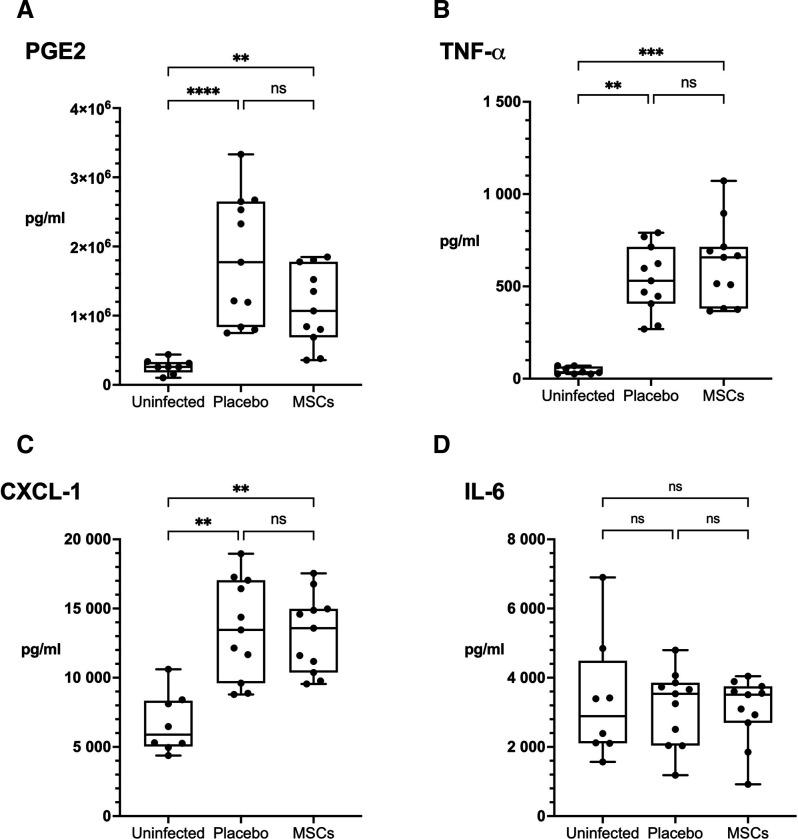
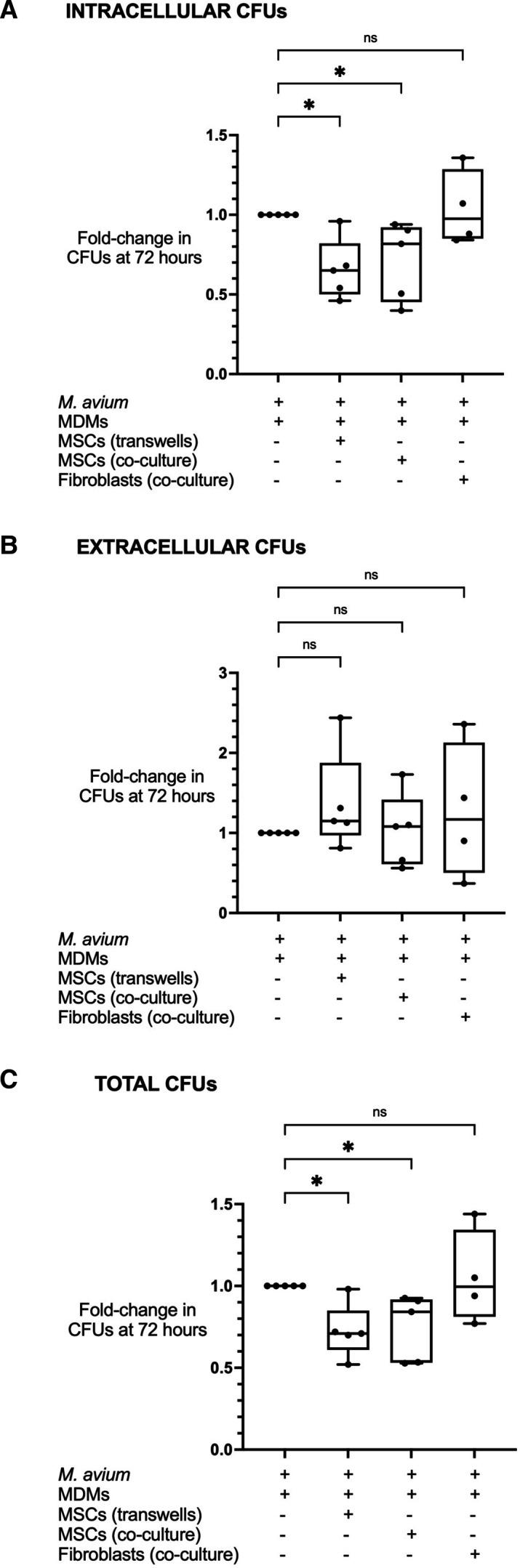
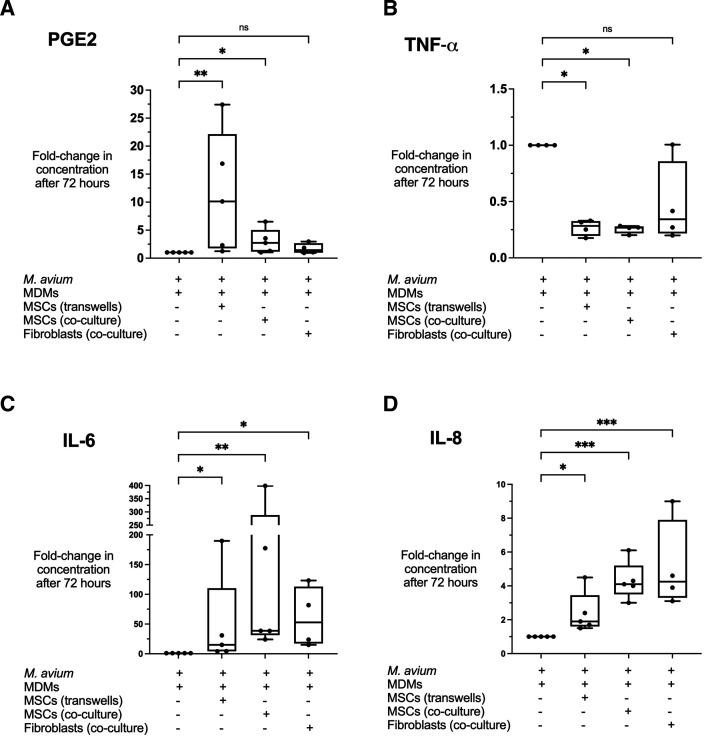
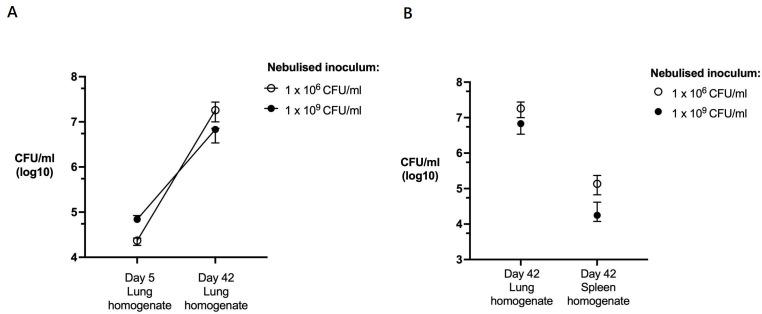
MSCs reduced intracellular bacteria in MDMs over 72 hours (median 35% reduction, p=0.027). MSC treatment increased extracellular concentrations of prostaglandin E2 (PGE2) (median 10.1-fold rise, p=0.002) and reduced tumour necrosis factor-α (median 28% reduction, p=0.025). Blocking MSC PGE2 production by cyclo-oxygenase-2 (COX-2) inhibition with celecoxib abrogated the antimicrobial effect, while this was restored by adding exogenous PGE2. MSC-treated mice had lower pulmonary CFUs (median 18% reduction, p=0.012), but no significant change in spleen or liver CFUs compared with controls.
CONCLUSION
MSCs can modulate inflammation and reduce intracellular growth in human macrophages via COX-2/PGE2 signalling and inhibit pulmonary bacterial replication in a murine model of chronic MAC-PD.
简介
复杂肺部疾病(MAC-PD)急需新的治疗策略。人骨髓间充质干细胞(MSCs)可直接抑制 MAC 的生长,但它们对细胞内细菌的作用尚不清楚。我们研究了人 MSCs 减少 MAC 感染的巨噬细胞和 MAC-PD 小鼠模型中细菌复制和炎症的能力。
方法
用切斯特菌株感染人单核细胞衍生的巨噬细胞(MDMs),并用人骨髓来源的 MSCs 处理。在 72 小时时计数细胞内和细胞外集落形成单位(CFUs)。用切斯特雾化感染 6 周龄雌性 balb/c 小鼠。感染后 21 天和 28 天,用 1×10 静脉内人 MSCs 或生理盐水对照治疗小鼠。感染后 42 天收获肺、肝和脾进行细菌计数。通过 ELISA 定量细胞因子。
结果
MSCs 在 72 小时内减少了 MDM 中的细胞内细菌(中位数减少 35%,p=0.027)。MSC 治疗增加了前列腺素 E2(PGE2)的细胞外浓度(中位数增加 10.1 倍,p=0.002)并减少了肿瘤坏死因子-α(中位数减少 28%,p=0.025)。用环氧化酶-2(COX-2)抑制剂塞来昔布阻断 MSC 的 PGE2 产生,消除了抗菌作用,而通过添加外源性 PGE2 则恢复了该作用。与对照组相比,MSC 治疗的小鼠肺部 CFUs 较低(中位数减少 18%,p=0.012),但脾或肝 CFUs 无明显变化。
结论
MSCs 通过 COX-2/PGE2 信号通路调节人巨噬细胞中的炎症和减少细胞内生长,并抑制慢性 MAC-PD 小鼠模型中的肺部细菌复制。


 Zotero 插件