
利用发光二极管开发微生物紫外线敏感性的标准评估方法。
Development of a standard evaluation method for microbial UV sensitivity using light-emitting diodes.
作者信息
Ishida Kai, Onoda Yushi, Kadomura-Ishikawa Yasuko, Nagahashi Miharu, Yamashita Michiyo, Fukushima Shiho, Aizawa Toshihiko, Yamauchi Shigeharu, Fujikawa Yasuo, Tanaka Tomotake, Uebanso Takashi, Akutagawa Masatake, Mawatari Kazuaki, Takahashi Akira
机构信息
Department of Microbial Control, Institute of Biomedical Sciences, Tokushima University Graduate School, Tokushima, Japan.
Nichia Corporation, Tokushima, Japan.
出版信息
Heliyon. 2024 Mar 8;10(6):e27456. doi: 10.1016/j.heliyon.2024.e27456. eCollection 2024 Mar 30.
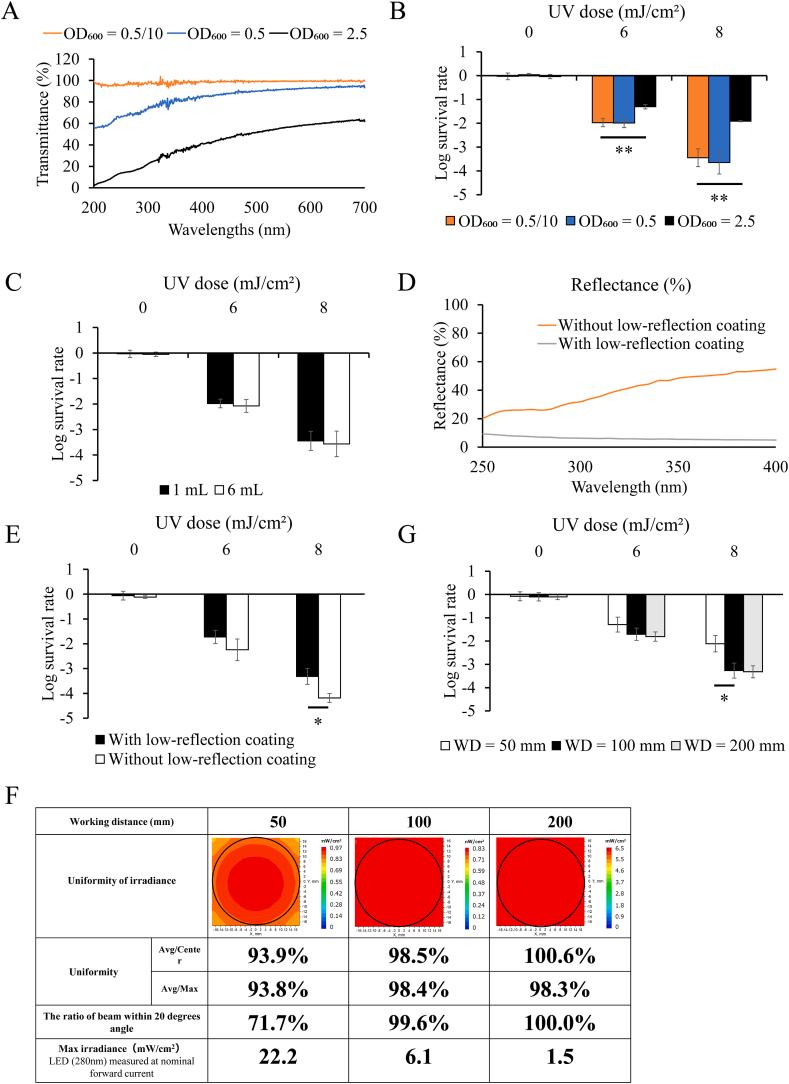
Ultraviolet (UV) light is an effective disinfection method. In particular, UV light-emitting diodes (UV-LEDs) are expected to have many applications as light sources owing to their compact form factor and wide range of choices of wavelengths. However, the UV sensitivity of microorganisms for each UV wavelength has not been evaluated comprehensively because standard experimental conditions based on LED characteristics have not been established. Therefore, it is necessary to establish a standard evaluation method based on LED characteristics. Here, we developed a new UV-LED device based on strictly controlled irradiation conditions using LEDs for each wavelength (250-365 nm), checked the validity of the device characteristics and evaluated the UV sensitivity of using this new evaluation method. For this new device, we considered accurate irradiance, accurate spectra, irradiance uniformity, accurate dose, beam angle, surrounding material reflections, and sample condition. From our results, the following UV irradiation conditions were established as standard: 1 mW/cm irradiance, bacterial solution with absorbance value of A = 0.5 diluted 10 times solution, solution volume of 1 mL, working distance (WD) of 100 mm. In order to compare the effects of irradiation under uniform conditions on inactivation of microorganisms, we assessed inactivation effect of by LED irradiation at each wavelength using the U280 LED as a standard wavelength. The inactivation effect for U280 LED irradiation was -0.95 ± 0.21 log at a dose of 4 mJ/cm. Under this condition of dose, our results showed a high wavelength dependence of the inactivation effect at each UV wavelength peaking at 267 nm. Our study showed that this irradiation system was validated for the standard UV irradiation system and could be contributed to the establishment of food and water hygiene control methods and the development of equipment for the prevention of infectious diseases.
紫外线(UV)是一种有效的消毒方法。特别是,发光二极管(UV-LED)由于其紧凑的外形和广泛的波长选择,有望作为光源有许多应用。然而,由于基于LED特性的标准实验条件尚未建立,每种UV波长下微生物的UV敏感性尚未得到全面评估。因此,有必要建立一种基于LED特性的标准评估方法。在此,我们开发了一种新的UV-LED装置,该装置基于对每个波长(250-365nm)的LED进行严格控制的照射条件,检查了装置特性的有效性,并使用这种新的评估方法评估了其UV敏感性。对于这种新装置,我们考虑了准确的辐照度、准确的光谱、辐照度均匀性、准确的剂量、光束角、周围材料反射和样品条件。根据我们的结果,确定了以下UV照射条件作为标准:辐照度为1mW/cm,吸光度值A = 0.5的细菌溶液稀释10倍后的溶液,溶液体积为1mL,工作距离(WD)为100mm。为了比较均匀条件下照射对微生物灭活的影响,我们以U280 LED作为标准波长,评估了每个波长下LED照射对其的灭活效果。在剂量为4mJ/cm时,U280 LED照射的灭活效果为-0.95±0.21对数。在该剂量条件下,我们的结果表明,每个UV波长下的灭活效果对波长有高度依赖性,在267nm处达到峰值。我们的研究表明,该照射系统对于标准UV照射系统是有效的,并且有助于建立食品和水卫生控制方法以及开发预防传染病的设备。



 Zotero 插件