
使用偏振阈值评估印度人群的黄斑色素:饮食对黄斑色素密度的影响。
Macular Pigment Assessment in Indian Population Using Degree of Polarization Threshold: Impact of Diet on Macular Pigment Density.
机构信息
Indian Health Outcomes, Public Health, and Economics Research Centre (IHOPE), LV Prasad Eye Institute, Hyderabad, India.
School of Optometry, Aston University, Birmingham, United Kingdom.
出版信息
Transl Vis Sci Technol. 2024 Mar 1;13(3):20. doi: 10.1167/tvst.13.3.20.
PURPOSE
To determine macular pigment (MP) density scores in healthy Indians and examine correlations with demographic and lifestyle variables.
METHODS
We observed 484 Indians without an ocular pathology. Body mass index (BMI) and self-reported lifestyle factors (sunglasses usage, physical activity, and smoking) were noted. MP density was assessed as the threshold of perception of the shadow of their macular pigments on their retina using a new MP assessment tool (MP-eye). Lutein and zeaxanthin intake was assessed using a prevalidated questionnaire regionally designed for the Indian diet. Clusters of participants were created for statistical analysis based on MP-eye scores secondarily to detect any relevant effects in very low, low, medium, and high ranges of MPs.
RESULTS
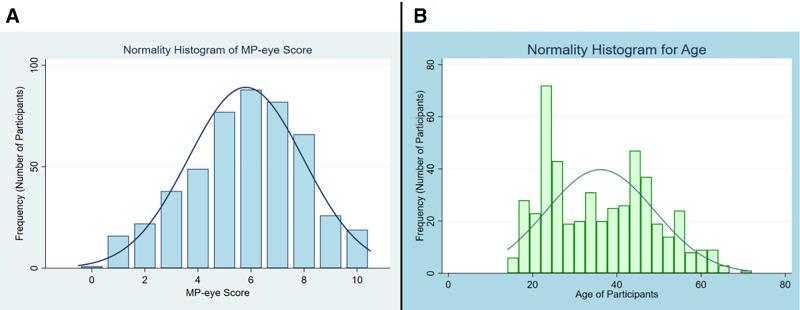
Data analyzed included 235 males and 249 females with mean age of 36.1 ± 12.9 years (range, 14-72). The median MP-eye score was 6 (range, 0-10, with 10 being high). Most were non-smokers (413, 85.3%) and did not use sunglasses (438, 90.5%), and 314 (64.9%) had low physical activity. Diabetes was present in 62 participants (12.8%) and hypertension in 53 (10.9%). Advancing age (r = -0.209; P < 0.000) and BMI (r = -0.094; P = 0.038) had weak negative correlation with MP-eye scores. Hypertension was less prevalent (7/88) in the cluster with the highest median MP-eye score (P = 0.033). Dietary intake of MPs and other lifestyle factors did not correlate significantly with MP-eye score overall or when analyzed in clusters.
CONCLUSIONS
MP-eye scores of an Indian population were normally distributed. Higher age, high BMI, and presence of hypertension were weakly associated with lower MP-eye scores. The impact of diet on MPs requires further evaluation.
TRANSLATIONAL RELEVANCE
This normative regional database enables risk stratification of macular degeneration.
目的
确定健康印度人的黄斑色素(MP)密度评分,并研究其与人口统计学和生活方式变量的相关性。
方法
我们观察了 484 名没有眼部疾病的印度人。记录了体重指数(BMI)和自我报告的生活方式因素(太阳镜使用、身体活动和吸烟)。使用一种新的 MP 评估工具(MP-eye)评估视网膜上 MP 阴影的感知阈值来评估 MP 密度。使用针对印度饮食量身定制的预先验证问卷评估叶黄素和玉米黄质的摄入量。根据 MP-eye 评分创建参与者聚类进行统计分析,以便在 MP 的极低、低、中、高范围内检测到任何相关影响。
结果
分析的数据包括 235 名男性和 249 名女性,平均年龄为 36.1±12.9 岁(范围 14-72 岁)。中位数 MP-eye 评分为 6(范围 0-10,10 为高)。大多数是非吸烟者(413 人,85.3%),不使用太阳镜(438 人,90.5%),314 人(64.9%)身体活动量低。62 名参与者(12.8%)患有糖尿病,53 名参与者(10.9%)患有高血压。年龄增长(r=-0.209;P<0.000)和 BMI(r=-0.094;P=0.038)与 MP-eye 评分呈弱负相关。高血压在 MP-eye 评分中位数最高的聚类中发病率较低(7/88)(P=0.033)。整体饮食中 MPs 和其他生活方式因素的摄入量与 MP-eye 评分无显著相关性,聚类分析时也无相关性。
结论
印度人群的 MP-eye 评分呈正态分布。较高的年龄、较高的 BMI 和高血压与较低的 MP-eye 评分弱相关。饮食对 MPs 的影响需要进一步评估。
翻译结果仅供参考,如果你有其他的翻译需求,请随时告诉我。


 Zotero 插件