
一针一线地编织针织材料中的编程机制。
Programming mechanics in knitted materials, stitch by stitch.
作者信息
Singal Krishma, Dimitriyev Michael S, Gonzalez Sarah E, Cachine A Patrick, Quinn Sam, Matsumoto Elisabetta A
机构信息
School of Physics, Georgia Institute of Technology, Atlanta, GA, 30332, USA.
Department of Polymer Science and Engineering, University of Massachusetts, Amherst, MA, 01003, USA.
出版信息
Nat Commun. 2024 Mar 23;15(1):2622. doi: 10.1038/s41467-024-46498-z.
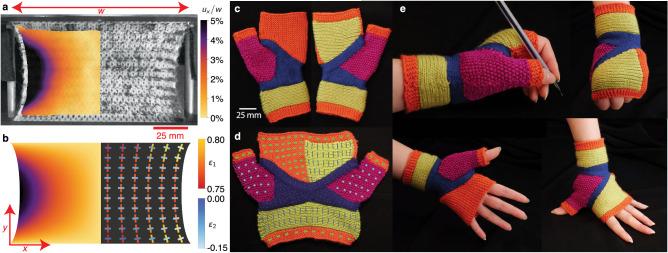
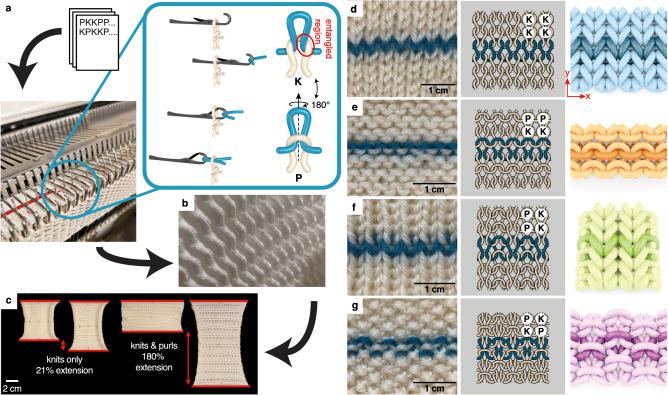
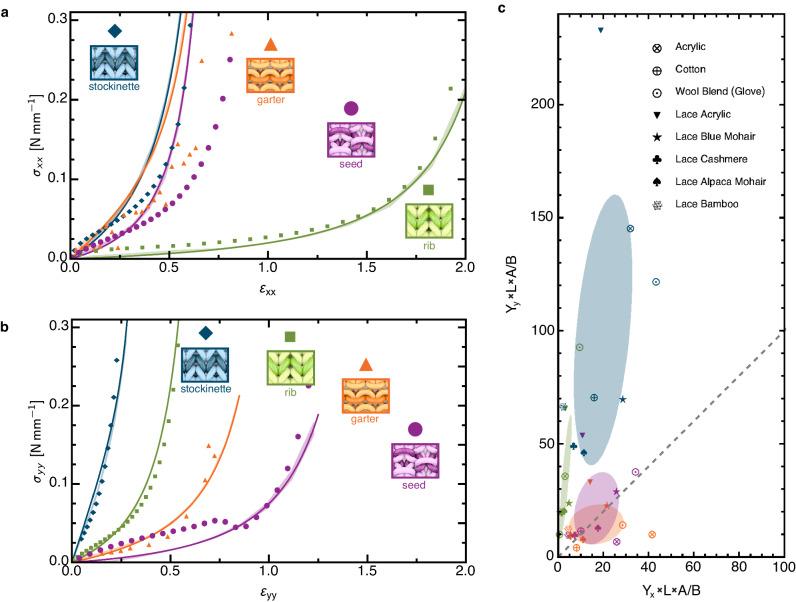
Knitting turns yarn, a 1D material, into a 2D fabric that is flexible, durable, and can be patterned to adopt a wide range of 3D geometries. Like other mechanical metamaterials, the elasticity of knitted fabrics is an emergent property of the local stitch topology and pattern that cannot solely be attributed to the yarn itself. Thus, knitting can be viewed as an additive manufacturing technique that allows for stitch-by-stitch programming of elastic properties and has applications in many fields ranging from soft robotics and wearable electronics to engineered tissue and architected materials. However, predicting these mechanical properties based on the stitch type remains elusive. Here we untangle the relationship between changes in stitch topology and emergent elasticity in several types of knitted fabrics. We combine experiment and simulation to construct a constitutive model for the nonlinear bulk response of these fabrics. This model serves as a basis for composite fabrics with bespoke mechanical properties, which crucially do not depend on the constituent yarn.
编织将一维材料纱线转变为二维织物,这种织物具有柔韧性、耐用性,并且可以通过图案设计采用多种三维几何形状。与其他机械超材料一样,针织物的弹性是局部针脚拓扑结构和图案的一种涌现特性,不能仅仅归因于纱线本身。因此,编织可被视为一种增材制造技术,它允许逐针编程弹性特性,并在从软机器人技术、可穿戴电子设备到工程组织和结构化材料等许多领域都有应用。然而,基于针脚类型预测这些机械性能仍然很困难。在这里,我们梳理了几种针织物中针脚拓扑结构变化与涌现弹性之间的关系。我们结合实验和模拟,构建了这些织物非线性整体响应的本构模型。该模型为具有定制机械性能的复合织物提供了基础,而这些性能至关重要地不依赖于组成纱线。

 Zotero 插件