
传染病对老年人主观幸福感和社会阶层认同之间关系的影响:自我评估健康的中介作用。
The impact of epidemic infectious diseases on the relationship between subjective well-being and social class identity in older adults: The mediating role of Self-rated health.
机构信息
School of Public Health, Chongqing Medical University, Chongqing, China.
Research Center for Medical and Social Development, School of Public Health, Chongqing Medical University, Chongqing, China.
出版信息
PLoS One. 2024 Mar 26;19(3):e0301289. doi: 10.1371/journal.pone.0301289. eCollection 2024.
BACKGROUND
The purpose of this paper is to explore the relationship between subjective well-being, social class identity, and Self-rated health among older persons,. Focusing on the mediating role of health and the impact of epidemic infectious diseases on these relationships.
METHODS
Based on the 2018 and 2021 China General Social Survey (CGSS) databases, the data were screened, and processed. Using Stata17, we employed ordered probit regression to examine the relationships among variables and Bootstrap methods to assess mediation effects, and the CGSS data for 2018 and 2021 were compared and analyzed.
RESULTS
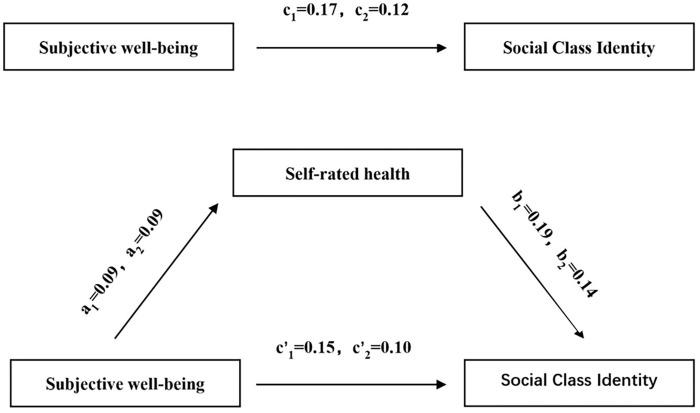
Our results revealed that factors such as social class identity, health status, and personal income significantly positively impact older persons' subjective well-being (P<0.01). Notably, there was a partial mediating effect of health status between the subjective well-being of the elderly and social class identity. And findings showed that when older adults were affected by epidemic diseases, their subjective well-being, social class identity, and Self-rated health remained significantly positively correlated. Subjective well-being, social class identity. What is more noteworthy is that when affected by epidemic infectious diseases, older adults' subjective well-being, social class identity, and Self-rated health remained significantly positively correlated. The mediating role of self-rated health in older adults' subjective well-being and social class identity increased from 9.6% to 12.4%.
CONCLUSIONS
In the face of epidemic infectious diseases, we need to pay more attention to the Self-rated health of the elderly, and the Chinese government should take effective measures to improve their health level, which will in turn improve the subjective well-being of the elderly and realize the goal of healthy aging.
背景
本文旨在探讨老年人主观幸福感、社会阶层认同与自评健康之间的关系,关注健康在其中的中介作用以及传染病疫情对这些关系的影响。
方法
基于 2018 年和 2021 年中国综合社会调查(CGSS)数据库,筛选并处理数据。采用 Stata17 软件,运用有序 Probit 回归检验变量间关系,运用 Bootstrap 方法评估中介效应,并对 2018 年和 2021 年的 CGSS 数据进行对比分析。
结果
结果表明,社会阶层认同、健康状况和个人收入等因素对老年人主观幸福感有显著正向影响(P<0.01)。健康状况在老年人主观幸福感和社会阶层认同之间存在部分中介效应。此外,研究还发现,当老年人受到传染病疫情影响时,他们的主观幸福感、社会阶层认同和自评健康仍然呈显著正相关。值得注意的是,当老年人受到传染病疫情影响时,自评健康在老年人主观幸福感和社会阶层认同之间的中介作用从 9.6%增加到 12.4%。
结论
在面对传染病疫情时,我们需要更加关注老年人的自评健康,中国政府应采取有效措施提高老年人的健康水平,这将有助于提高老年人的主观幸福感,实现健康老龄化的目标。
 Zotero 插件