
中国一项贝洛索利单抗治疗二线及以上系统性治疗失败的慢性移植物抗宿主病患者的 II 期临床研究。
A phase II study of belumosudil for chronic graft-versus-host disease in patients who failed at least one line of systemic therapy in China.
机构信息
The First Affiliated Hospital of Soochow University, No.188, Shizi Street, Gusu District, Suzhou, 215006, China.
Zhujiang Hospital, Southern Medical University, Guangzhou, China.
出版信息
BMC Med. 2024 Mar 26;22(1):142. doi: 10.1186/s12916-024-03348-5.
BACKGROUND
Chronic graft-versus-host disease (cGVHD) is an immune-related disorder that is the most common complication post-allogenic hematopoietic stem cell transplant. Corticosteroids with or without calcineurin inhibitors (CNIs) remain the mainstay of cGVHD treatment for first-line therapy. However, for many patients, cGVHD symptoms cannot be effectively managed and thus require second-line therapy. Currently, there is no approved treatment for second-line cGVHD treatment in China. In this study, belumosudil, a highly selective and potent rho-associated coiled-coil-containing protein kinase-2 inhibitor demonstrated to be effective for cGVHD in the United States and other Western countries, is investigated in patients with cGVHD in China for its overall benefit-risk balance.
METHODS
This multicenter, open-label phase II study evaluated the safety, efficacy, and pharmacokinetics of oral belumosudil 200 mg once daily in cGVHD patients who had been treated with at least one line of systemic therapy in China. The primary endpoint was overall response rate (ORR); each individual patient's response was assessed by the investigator using the 2014 National Institutes of Health consensus criteria. Secondary endpoints were duration of response (DOR), time to response (TTR), changes in Lee Symptom Scale (LSS) score, organ response rate, corticosteroid dose change, CNI dose change, failure-free survival, time-to-next-treatment, overall survival, and safety.
RESULTS
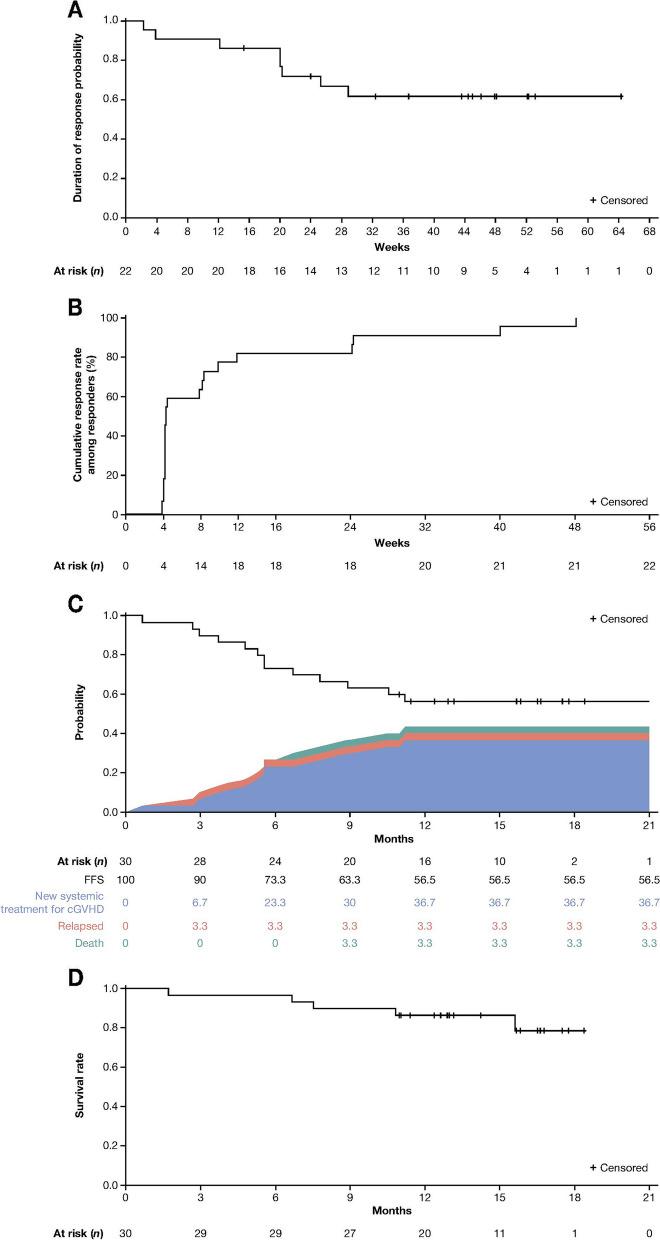
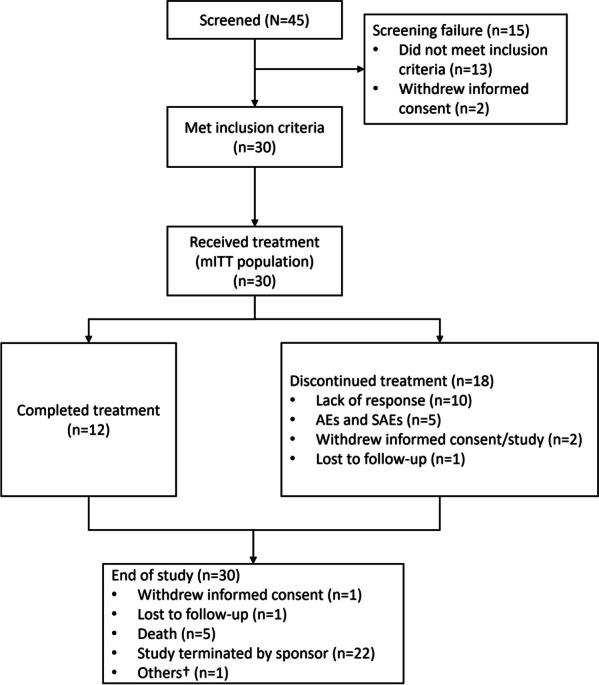
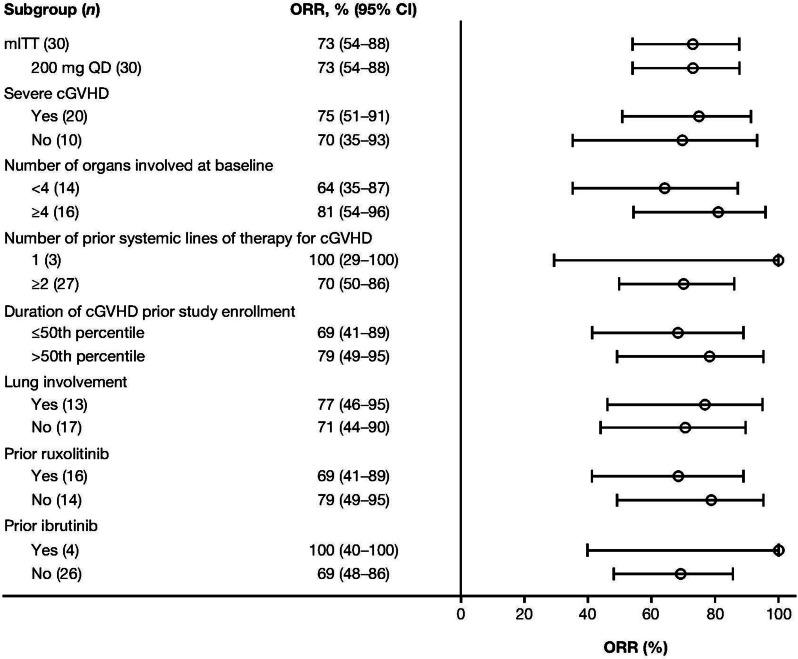
Thirty patients were enrolled in the study with a median follow-up time of 12.9 months. ORR was 73.3% (95% confidence interval: 54.1-87.7%) and all responders achieved partial response. Median DOR among responders was not reached and median TTR was 4.3 weeks (range: 3.9-48.1). Fifteen patients (50.0%) achieved clinically meaningful response in terms of reduction in LSS score by ≥ 7 points from baseline. Corticosteroid and CNI dose reductions were reported in 56.7% (17/30) and 35.0% (7/20) of patients, respectively. Most treatment-emergent adverse events (TEAEs) were mild to moderate in severity, with 11 patients (36.7%) experiencing grade ≥ 3 TEAEs. The most common grade ≥ 3 TEAE was pneumonia (n = 5, 16.7%).
CONCLUSIONS
Belumosudil treatment demonstrated a favorable benefit-risk balance in treating cGVHD patients who previously have had standard corticosteroid therapy in China where approved second-line setting is absent.
TRIAL REGISTRATION
ClinicalTrials.gov identifier NCT04930562.
背景
慢性移植物抗宿主病(cGVHD)是一种与免疫相关的疾病,是同种异体造血干细胞移植后最常见的并发症。皮质类固醇联合或不联合钙调神经磷酸酶抑制剂(CNI)仍然是 cGVHD 一线治疗的主要方法。然而,对于许多患者来说,cGVHD 的症状无法得到有效控制,因此需要二线治疗。目前,中国尚无批准用于二线 cGVHD 治疗的药物。在这项研究中,belumosudil 是一种高度选择性和有效的 rho 相关卷曲螺旋蛋白激酶-2 抑制剂,已被证明对美国和其他西方国家的 cGVHD 有效,在中国 cGVHD 患者中进行了评估,以评估其整体获益-风险平衡。
方法
这是一项多中心、开放性、二期研究,评估了在中国接受至少一线系统治疗的 cGVHD 患者中,每日口服 200mg belumosudil 的安全性、疗效和药代动力学。主要终点为总体缓解率(ORR);每个患者的反应均由研究者根据 2014 年 NIH 共识标准进行评估。次要终点为缓解持续时间(DOR)、反应时间(TTR)、Lee 症状量表(LSS)评分变化、器官反应率、皮质类固醇剂量变化、CNI 剂量变化、无进展生存期、下次治疗时间、总生存期和安全性。
结果
研究共纳入 30 例患者,中位随访时间为 12.9 个月。ORR 为 73.3%(95%置信区间:54.1-87.7%),所有缓解者均达到部分缓解。缓解者的中位 DOR 未达到,中位 TTR 为 4.3 周(范围:3.9-48.1)。15 例患者(50.0%)的 LSS 评分较基线下降≥7 分,具有临床意义的缓解。分别有 17 例(56.7%)和 7 例(35.0%)患者报告了皮质类固醇和 CNI 剂量减少。大多数治疗相关不良事件(TEAEs)的严重程度为轻度至中度,11 例患者(36.7%)发生了≥3 级 TEAEs。最常见的≥3 级 TEAE 是肺炎(n=5,16.7%)。
结论
belumosudil 在中国治疗 cGVHD 患者中具有良好的获益-风险平衡,这些患者之前接受了标准的皮质类固醇治疗,而中国尚无批准的二线治疗方案。
试验注册
ClinicalTrials.gov 标识符 NCT04930562。
 Zotero 插件