
初潮、青春期时间和大脑:年龄相关发育之外的女性特有的大脑成熟模式。
Menarche, pubertal timing and the brain: female-specific patterns of brain maturation beyond age-related development.
机构信息
Department of Psychiatry and Psychotherapy, Tübingen Center for Mental Health, University of Tübingen, Tübingen, Germany.
Max Planck School of Cognition, Max Planck Institute for Human Cognitive and Brain Sciences, Leipzig, Germany.
出版信息
Biol Sex Differ. 2024 Mar 26;15(1):25. doi: 10.1186/s13293-024-00604-4.
BACKGROUND
Puberty depicts a period of profound and multifactorial changes ranging from social to biological factors. While brain development in youths has been studied mostly from an age perspective, recent evidence suggests that pubertal measures may be more sensitive to study adolescent neurodevelopment, however, studies on pubertal timing in relation to brain development are still scarce.
METHODS
We investigated if pre- vs. post-menarche status can be classified using machine learning on cortical and subcortical structural magnetic resonance imaging (MRI) data from strictly age-matched adolescent females from the Adolescent Brain Cognitive Development (ABCD) cohort. For comparison of the identified menarche-related patterns to age-related patterns of neurodevelopment, we trained a brain age prediction model on data from the Philadelphia Neurodevelopmental Cohort and applied it to the same ABCD data, yielding differences between predicted and chronological age referred to as brain age gaps. We tested the sensitivity of both these frameworks to measures of pubertal maturation, specifically age at menarche and puberty status.
RESULTS
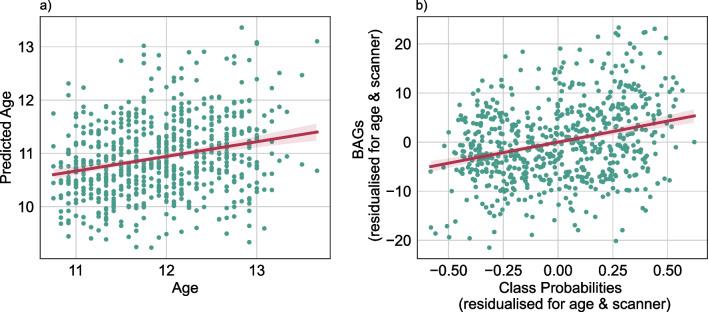
The machine learning model achieved moderate but statistically significant accuracy in the menarche classification task, yielding for each subject a class probability ranging from 0 (pre-) to 1 (post- menarche). Comparison to brain age predictions revealed shared and distinct patterns of neurodevelopment captured by both approaches. Continuous menarche class probabilities were positively associated with brain age gaps, but only the menarche class probabilities-not the brain age gaps-were associated with age at menarche.
CONCLUSIONS
This study demonstrates the use of a machine learning model to classify menarche status from structural MRI data while accounting for age-related neurodevelopment. Given its sensitivity towards measures of puberty timing, our work suggests that menarche class probabilities may be developed toward an objective brain-based marker of pubertal development.
背景
青春期描绘了一个从社会因素到生物因素的深刻而多因素变化的时期。虽然年轻人的大脑发育主要从年龄角度进行研究,但最近的证据表明,青春期指标可能更能敏感地研究青少年神经发育,但关于青春期时间与大脑发育关系的研究仍然很少。
方法
我们研究了是否可以使用机器学习对来自严格年龄匹配的青春期女性的皮质和皮质下结构磁共振成像(MRI)数据进行分类,这些女性来自青少年大脑认知发育(ABCD)队列。为了将识别出的与月经初潮相关的模式与与年龄相关的神经发育模式进行比较,我们在费城神经发育队列的数据上训练了大脑年龄预测模型,并将其应用于相同的 ABCD 数据,从而产生了预测年龄与实际年龄之间的差异,称为大脑年龄差距。我们测试了这两种框架对青春期成熟度指标(特别是初潮年龄和青春期状态)的敏感性。
结果
机器学习模型在月经初潮分类任务中取得了中等但具有统计学意义的准确性,为每个受试者提供了一个从 0(初潮前)到 1(初潮后)的分类概率。与大脑年龄预测的比较揭示了两种方法都捕捉到的共享和独特的神经发育模式。连续的月经初潮分类概率与大脑年龄差距呈正相关,但只有月经初潮分类概率而不是大脑年龄差距与初潮年龄相关。
结论
本研究展示了使用机器学习模型从结构 MRI 数据中分类月经初潮状态,同时考虑与年龄相关的神经发育。鉴于其对青春期时间测量的敏感性,我们的工作表明,月经初潮分类概率可能朝着基于大脑的青春期发育的客观标志物发展。


 Zotero 插件