
术前视频分散注意力对接受七氟烷麻醉下斜视手术的学龄前儿童苏醒期谵妄的影响:一项随机对照试验
The Use of Preoperative Video Distraction on Emergence Delirium in Preschool Children Undergoing Strabismus Surgery Under Anesthesia with Sevoflurane: A Randomized Controlled Trial.
作者信息
Wang Yue, Chu Liyan, Li He, Du Yingjie, Wang Shanshan, Liu Ying, Wang Guyan
机构信息
Department of Anesthesiology, Beijing Tongren Hospital, Capital Medical University, Beijing, 100730, People's Republic of China.
出版信息
Ther Clin Risk Manag. 2024 Mar 22;20:217-225. doi: 10.2147/TCRM.S447419. eCollection 2024.
PURPOSE
The aim of this study was to determine whether preoperative video distraction reduces the incidence of emergence delirium in preschool children under general anesthesia with sevoflurane.
PATIENTS AND METHODS
In this prospective randomized controlled study, children aged 3-6 years were randomized to receive either video distraction (Group V) or common clinical practice (Group C) from arrival at the holding area to induction of anesthesia. The primary outcome was the incidence of emergence delirium. Preoperative anxiety scores, assessed by the simple modified Yale Perioperative Anxiety Scale, were also collected.
RESULTS
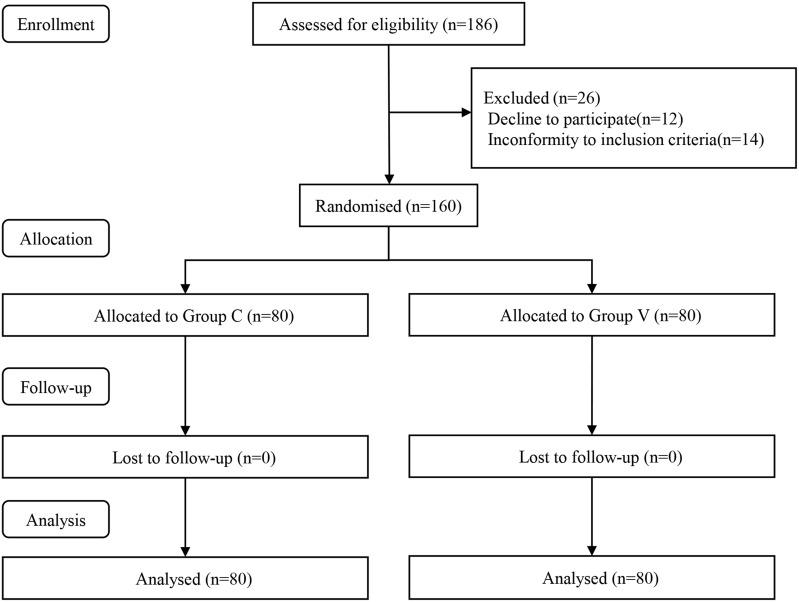
A total of 160 patients were included in our study. The children in Group V (n=80) exhibited a significantly lower incidence of emergence delirium than did those in Group C (n=80) (12.5% vs 35.0%; RR 0.36, 95% CI 0.19, 0.69; =0.0008). The maximum Pediatric Anesthesia Emergence Delirium score in Group V was significantly lower than that in Group C (3.0 vs 5.0; mean difference -2.64, 95% CI: -4.12, -1.16; =0.0003). The simple modified Yale Perioperative Anxiety Scale scores at separation from parents and the onset of inhalation induction in Group V were significantly lower than those in Group C (36.4 ± 9.9 vs 48.2 ± 16.7; mean difference 11.92, 95% CI 7.25, 16.59; <0.0001 and 41.5 ± 15.9 vs 59.7 ± 21.5; mean difference 18.11, 95% CI 11.76, 24.47; <0.0001).
CONCLUSION
Preoperative video distraction reduces the incidence of emergence delirium in preschool children who undergo strabismus surgery under general anesthesia with sevoflurane.
目的
本研究旨在确定术前视频分心是否能降低接受七氟醚全身麻醉的学龄前儿童出现谵妄的发生率。
患者与方法
在这项前瞻性随机对照研究中,3至6岁的儿童从进入等候区到麻醉诱导期间被随机分为接受视频分心组(V组)或常规临床操作组(C组)。主要结局是出现谵妄的发生率。还收集了通过简单改良耶鲁围手术期焦虑量表评估的术前焦虑评分。
结果
本研究共纳入160例患者。V组(n = 80)儿童出现谵妄的发生率显著低于C组(n = 80)(12.5% 对35.0%;相对危险度0.36,95%可信区间0.19,0.69;P = 0.0008)。V组的最大小儿麻醉苏醒期谵妄评分显著低于C组(3.0对5.0;平均差值 -2.64,95%可信区间:-4.12,-1.16;P = 0.0003)。V组在与父母分离时和吸入诱导开始时的简单改良耶鲁围手术期焦虑量表评分显著低于C组(36.4 ± 9.9对48.2 ± 16.7;平均差值11.92,95%可信区间7.25,16.59;P < 0.0001以及41.5 ± 15.9对59.7 ± 21.5;平均差值18.11,95%可信区间11.76,24.47;P < 0.0001)。
结论
术前视频分心可降低接受七氟醚全身麻醉下斜视手术的学龄前儿童出现谵妄的发生率。
 Zotero 插件