
推进颅底软骨肉瘤的管理:靶向治疗的系统评价
Advancing the Management of Skull Base Chondrosarcomas: A Systematic Review of Targeted Therapies.
作者信息
Agosti Edoardo, Zeppieri Marco, Antonietti Sara, Ius Tamara, Fontanella Marco Maria, Panciani Pier Paolo
机构信息
Division of Neurosurgery, Department of Medical and Surgical Specialties, Radiological Sciences and Public Health, University of Brescia, Piazza Spedali Civili 1, 25123 Brescia, Italy.
Department of Ophthalmology, University Hospital of Udine, p.le S. Maria della Misericordia 15, 33100 Udine, Italy.
出版信息
J Pers Med. 2024 Feb 28;14(3):261. doi: 10.3390/jpm14030261.
BACKGROUND
Chondrosarcomas rank as the second most common primary bone malignancy. Characterized by the production of a cartilaginous matrix, these tumors typically exhibit resistance to both radiotherapy (RT) and chemotherapy (CT), resulting in overall poor outcomes: a high rate of mortality, especially among children and adolescents. Due to the considerable resistance to current conventional therapies such as surgery, CT, and RT, there is an urgent need to identify factors contributing to resistance and discover new strategies for optimal treatment. Over the past decade, researchers have delved into the dysregulation of genes associated with tumor development and therapy resistance to identify potential therapeutic targets for overcoming resistance. Recent studies have suggested several promising biomarkers and therapeutic targets for chondrosarcoma, including isocitrate dehydrogenase (IDH1/2) and COL2A1. Molecule-targeting agents and immunotherapies have demonstrated favorable antitumor activity in clinical studies involving patients with advanced chondrosarcomas. In this systematic review, we delineate the clinical features of chondrosarcoma and provide a summary of gene dysregulation and mutation associated with tumor development, as well as targeted therapies as a promising molecular approach. Finally, we analyze the probable role of the tumor microenvironment in chondrosarcoma drug resistance.
METHODS
A systematic search was conducted across major medical databases (PubMed, Embase, and Cochrane Library) up to 10 November 2023. The search strategy utilized relevant Medical Subject Heading (MeSH) terms and keywords related to "chondrosarcomas", "target therapies", "immunotherapies", and "outcomes". The studies included in this review consist of randomized controlled trials, non-randomized controlled trials, and cohort studies reporting on the use of target therapies for the treatment of chondrosarcoma in human subjects.
RESULTS
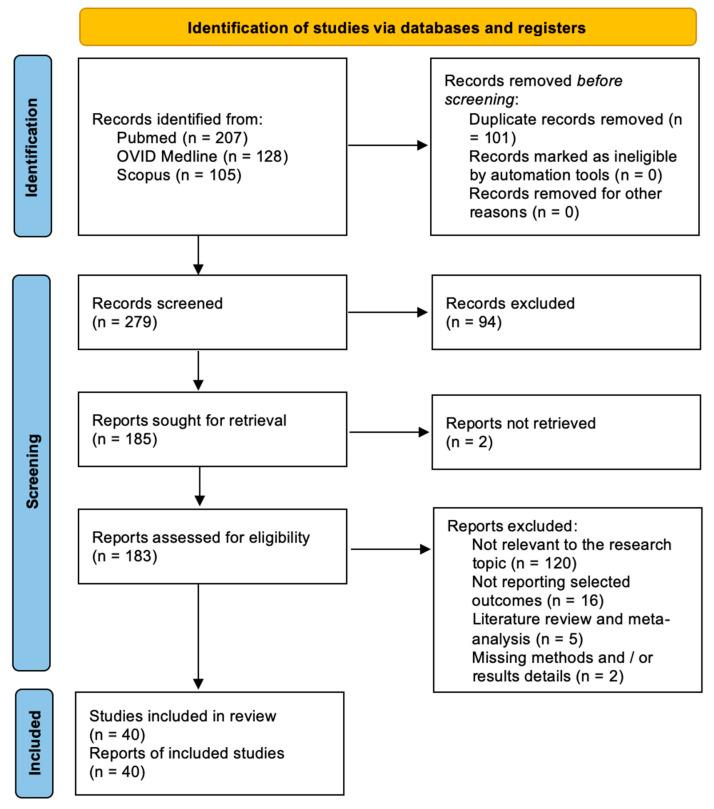
Of the initial 279 articles identified, 40 articles were included in the article. The exclusion of 140 articles was due to reasons such as irrelevance, non-reporting of selected results, systematic literature review or meta-analysis, and lack of details on the method/results. Three tables highlighted clinical studies, preclinical studies, and ongoing clinical trials, encompassing 13, 7, and 20 studies, respectively. For the clinical study, a range of molecular targets, such as death receptors 4/5 (DR4 and DR5) (15%), platelet-derived growth factor receptor-alpha or -beta (PDGFR-α, PDGFR-β) (31%), were investigated. Adverse events were mainly constitutional symptoms emphasizing that to improve therapy tolerance, careful observation and tailored management are essential. Preclinical studies analyzed various molecular targets such as DR4/5 (28.6%) and COX-2 (28.6%). The prevalent indicator of antitumoral activity was the apoptotic rate of both a single agent (tumor necrosis factor-related apoptosis-inducing ligand: TRAIL) and double agents (TRAIL-DOX, TRAIL-MG132). Ongoing clinical trials, the majority in Phase II (53.9%), highlighted possible therapeutic strategies such as IDH1 inhibitors and PD-1/PD-L1 inhibitors (30.8%).
CONCLUSIONS
The present review offers a comprehensive analysis of targeted therapeutics for skull base chondrosarcomas, highlighting a complex landscape characterized by a range of treatment approaches and new opportunities for tailored interventions. The combination of results from molecular research and clinical trials emphasizes the necessity for specialized treatment strategies and the complexity of chondrosarcoma biology.
背景
软骨肉瘤是第二常见的原发性骨恶性肿瘤。这些肿瘤以产生软骨基质为特征,通常对放疗(RT)和化疗(CT)均具有抗性,导致总体预后较差:死亡率很高,尤其是在儿童和青少年中。由于对当前常规疗法(如手术、CT和RT)具有相当大的抗性,迫切需要确定导致抗性的因素并发现最佳治疗的新策略。在过去十年中,研究人员深入研究了与肿瘤发展和治疗抗性相关的基因失调,以确定克服抗性的潜在治疗靶点。最近的研究提出了几种有前景的软骨肉瘤生物标志物和治疗靶点,包括异柠檬酸脱氢酶(IDH1/2)和COL2A1。分子靶向药物和免疫疗法在涉及晚期软骨肉瘤患者的临床研究中已显示出良好的抗肿瘤活性。在本系统评价中,我们描述了软骨肉瘤的临床特征,总结了与肿瘤发展相关的基因失调和突变,以及作为一种有前景的分子方法的靶向治疗。最后,我们分析了肿瘤微环境在软骨肉瘤耐药性中的可能作用。
方法
截至2023年11月10日,在主要医学数据库(PubMed、Embase和Cochrane图书馆)中进行了系统检索。检索策略使用了与“软骨肉瘤”、“靶向治疗”、“免疫治疗”和“结果”相关的医学主题词(MeSH)和关键词。本综述纳入的研究包括随机对照试验、非随机对照试验和队列研究,这些研究报告了在人类受试者中使用靶向治疗治疗软骨肉瘤的情况。
结果
在最初识别的279篇文章中,40篇文章被纳入。排除140篇文章的原因包括不相关、未报告选定结果、系统文献综述或荟萃分析以及方法/结果缺乏细节。三个表格突出了临床研究、临床前研究和正在进行的临床试验,分别涵盖13项、7项和20项研究。对于临床研究,研究了一系列分子靶点,如死亡受体4/5(DR4和DR5)(15%)、血小板衍生生长因子受体α或β(PDGFR-α、PDGFR-β)(31%)。不良事件主要是全身性症状,强调为了提高治疗耐受性,仔细观察和个性化管理至关重要。临床前研究分析了各种分子靶点,如DR4/5(28.6%)和COX-2(28.6%)。抗肿瘤活性的普遍指标是单一药物(肿瘤坏死因子相关凋亡诱导配体:TRAIL)和双药(TRAIL-DOX、TRAIL-MG132)的凋亡率。正在进行的临床试验中,大多数处于II期(53.9%),突出了可能的治疗策略,如IDH1抑制剂和PD-1/PD-L1抑制剂(30.8%)。
结论
本综述对颅底软骨肉瘤的靶向治疗进行了全面分析,突出了以一系列治疗方法和个性化干预新机会为特征的复杂情况。分子研究和临床试验的结果相结合强调了专门治疗策略的必要性以及软骨肉瘤生物学的复杂性。
 Zotero 插件