
基于污水的病毒监测流行病学:来自流行地区的证据和挑战。
Wastewater-Based Epidemiology for Viral Surveillance from an Endemic Perspective: Evidence and Challenges.
机构信息
Laboratory of Hygiene and Environmental Virology, Department of Biology, University of Pisa, Via S. Zeno 35/39, 56123 Pisa, Italy.
出版信息
Viruses. 2024 Mar 20;16(3):482. doi: 10.3390/v16030482.
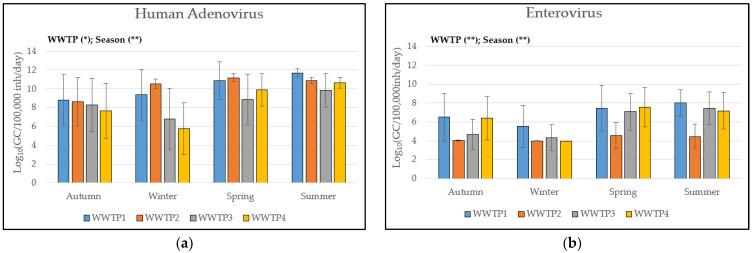
Wastewater-based epidemiology (WBE) is currently used to monitor not only the spread of the viral SARS-CoV-2 pandemic but also that of other viruses in endemic conditions, particularly in the absence of syndromic surveillance. The continuous monitoring of sewage requires high expenditure and significant time investments, highlighting the need for standardized methods and structured monitoring strategies. In this context, we conducted weekly wastewater monitoring in northwestern Tuscany (Italy) and targeted human adenovirus (HAdV), norovirus genogroup II (NoVggII), enterovirus (EV), and SARS-CoV-2. Samples were collected at the entrances of treatment plants and concentrated using PEG/NaCl precipitation, and viral nucleic acids were extracted and detected through real-time reverse transcription qPCR. NoVggII was the most identified target (84.4%), followed by HAdV, SARS-CoV-2, and EV. Only HAdV and EV exhibited seasonal peaks in spring and summer. Compared with data that were previously collected in the same study area (from February 2021 to September 2021), the results for SARS-CoV-2 revealed a shift from an epidemic to an endemic pattern, at least in the region under investigation, which was likely due to viral mutations that led to the spreading of new variants with increased resistance to summer environmental conditions. In conclusion, using standardized methods and an efficient monitoring strategy, WBE proves valuable for viral surveillance in pandemic and epidemic scenarios, enabling the identification of temporal-local distribution patterns that are useful for making informed public health decisions.
基于污水的流行病学(WBE)目前不仅用于监测病毒 SARS-CoV-2 大流行的传播,还用于监测地方性流行条件下的其他病毒,特别是在缺乏综合征监测的情况下。对污水的持续监测需要大量的支出和时间投入,这突出了标准化方法和结构化监测策略的必要性。在这种情况下,我们在意大利托斯卡纳西北部进行了每周的污水监测,目标是人类腺病毒(HAdV)、诺如病毒基因群 II(NoVggII)、肠道病毒(EV)和 SARS-CoV-2。样品在处理厂入口处采集,并使用 PEG/NaCl 沉淀进行浓缩,然后提取病毒核酸,并通过实时逆转录 qPCR 进行检测。NoVggII 是最常识别的目标(84.4%),其次是 HAdV、SARS-CoV-2 和 EV。只有 HAdV 和 EV 在春季和夏季表现出季节性高峰。与之前在同一研究区域(2021 年 2 月至 2021 年 9 月)收集的数据相比,SARS-CoV-2 的结果表明,至少在调查区域,该病毒已从流行模式转变为地方流行模式,这可能是由于病毒突变导致新变种的传播,这些新变种对夏季环境条件的抵抗力增强。总之,使用标准化方法和有效的监测策略,WBE 可用于大流行和流行情况下的病毒监测,有助于确定有用的时间-地点分布模式,为做出明智的公共卫生决策提供依据。

 Zotero 插件