
高级别卵巢癌中BRCA1/2改变及PARP抑制剂领域的回复突变:现状与未来挑战
BRCA1/2 alterations and reversion mutations in the area of PARP inhibitors in high grade ovarian cancer: state of the art and forthcoming challenges.
作者信息
Collet Laetitia, Hanvic Brunhilde, Turinetto Margherita, Treilleux Isabelle, Chopin Nicolas, Le Saux Olivia, Ray-Coquard Isabelle
机构信息
Breast Cancer Translational Research Laboratory, Institut Jules Bordet, Hôpital Universitaire de Bruxelles (H.U.B), Université Libre de Bruxelles (ULB), Brussels, Belgium.
Medical Oncology Department, Centre Léon Bérard, Lyon, France.
出版信息
Front Oncol. 2024 Mar 13;14:1354427. doi: 10.3389/fonc.2024.1354427. eCollection 2024.
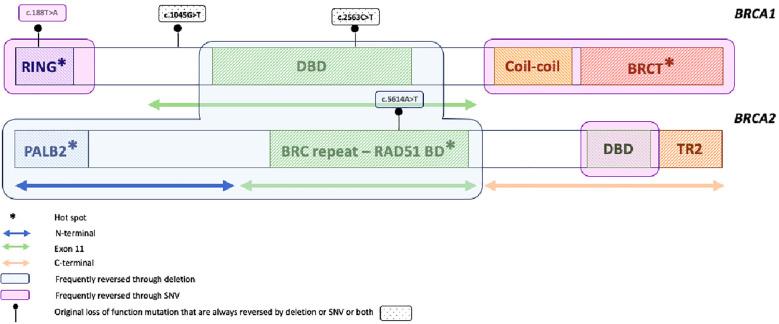
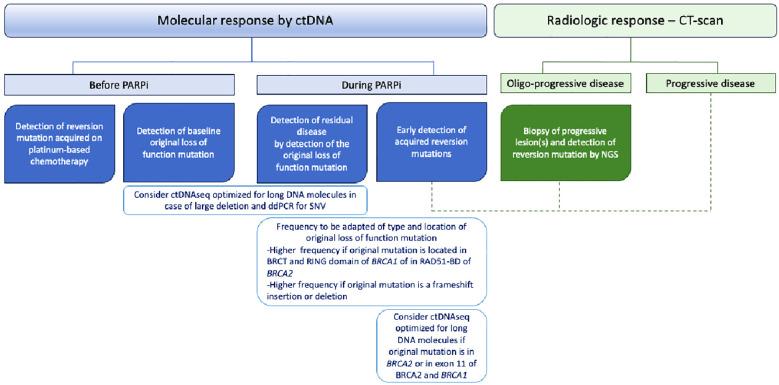
genes are part of homologous recombination (HR) DNA repair pathways in charge of error-free double-strand break (DSB) repair. Loss-of-function mutations of genes have been associated for a long time with breast and ovarian cancer hereditary syndrome. Recently, polyadenosine diphosphate-ribose polymerase inhibitors (PARPi) have revolutionized the therapeutic landscape of -mutated tumors, especially of high-grade serous ovarian cancer (HGSC), taking advantage of HR deficiency through the synthetic lethality concept. However, PARPi efficiency differs among patients, and most of them will develop resistance, particularly in the relapse setting. In the current proposal, we aim to review primary and secondary resistance to PARPi in HGSC owing to alterations. Of note, as several mechanisms of primary or secondary resistance to PARPi have been described, reversion mutations that restore HR pathways are by far the most reported. First, the type and location of the primary mutation have been associated with PARPi and platinum-salt sensitivity and impact the probability of the occurrence and the type of secondary reversion mutation. Furthermore, the presence of multiple reversion mutations and the variation of allelic frequency under treatment underline the role of intratumor heterogeneity (ITH) in treatment resistance. Of note, circulating tumor DNA might help us to detect and characterize reversion mutations and ITH to finally refine the treatment strategy. Importantly, forthcoming therapeutic strategies, including combination with antiangiogenics or with targeted therapies, may help us delay and overcome PARPi resistance secondary to reversion mutations. Also, progression despite PARPi therapy does not preclude PARPi rechallenge in selected patients.
基因是同源重组(HR)DNA修复途径的一部分,负责无差错双链断裂(DSB)修复。基因功能缺失突变长期以来一直与乳腺癌和卵巢癌遗传性综合征相关。最近,聚腺苷二磷酸核糖聚合酶抑制剂(PARPi)彻底改变了基因发生突变的肿瘤的治疗格局,尤其是高级别浆液性卵巢癌(HGSC),它利用合成致死概念利用HR缺陷。然而,PARPi在患者中的疗效各不相同,大多数患者会产生耐药性,尤其是在复发情况下。在本提议中,我们旨在综述由于基因改变导致的HGSC对PARPi的原发性和继发性耐药性。值得注意的是,由于已经描述了几种对PARPi的原发性或继发性耐药机制,恢复HR途径的回复突变是迄今为止报道最多的。首先,原发性突变的类型和位置与PARPi和铂盐敏感性相关,并影响继发性回复突变的发生概率和类型。此外,多个回复突变的存在以及治疗过程中等位基因频率的变化突显了肿瘤内异质性(ITH)在治疗耐药性中的作用。值得注意的是,循环肿瘤DNA可能有助于我们检测和表征回复突变及ITH,从而最终优化治疗策略。重要的是,即将出现的治疗策略,包括与抗血管生成药物或靶向治疗联合使用,可能有助于我们延迟并克服因基因回复突变导致的PARPi耐药性。此外,尽管接受PARPi治疗仍有进展,但在选定的患者中并不排除再次使用PARPi。

 Zotero 插件