
从传统风险分层转向口咽癌的适应性风险分层。
Moving from conventional to adaptive risk stratification for oropharyngeal cancer.
作者信息
Sandulache Vlad C, Kirby R Parker, Lai Stephen Y
机构信息
Bobby R. Alford Department of Otolaryngology- Head and Neck Surgery, Baylor College of Medicine, Houston, TX, United States.
Ear Nose and Throat Section (ENT), Operative Care Line, Michael E. DeBakey Veterans Affairs Medical Center, Houston, TX, United States.
出版信息
Front Oncol. 2024 Mar 14;14:1287010. doi: 10.3389/fonc.2024.1287010. eCollection 2024.
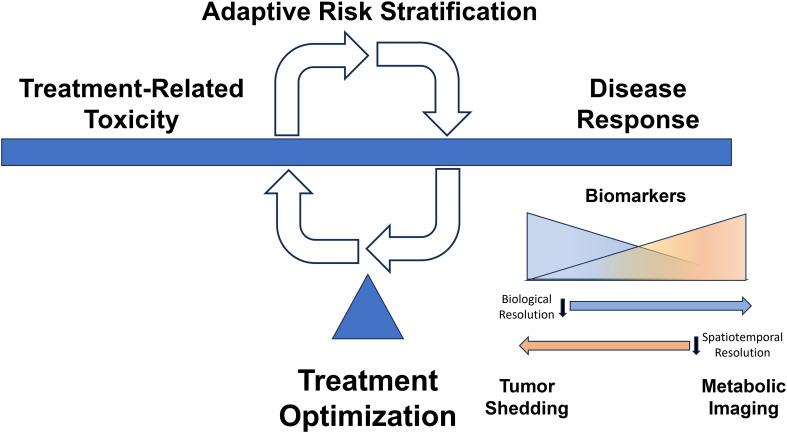
Oropharyngeal cancer (OPC) poses a complex therapeutic dilemma for patients and oncologists alike, made worse by the epidemic increase in new cases associated with the oncogenic human papillomavirus (HPV). In a counterintuitive manner, the very thing which gives patients hope, the high response rate of HPV-associated OPC to conventional chemo-radiation strategies, has become one of the biggest challenges for the field as a whole. It has now become clear that for ~30-40% of patients, treatment intensity could be reduced without losing therapeutic efficacy, yet substantially diminishing the acute and lifelong morbidity resulting from conventional chemotherapy and radiation. At the same time, conventional approaches to de-escalation at a population (selected or unselected) level are hampered by a simple fact: we lack patient-specific information from individual tumors that can predict responsiveness. This results in a problematic tradeoff between the deleterious impact of de-escalation on patients with aggressive, treatment-refractory disease and the beneficial reduction in treatment-related morbidity for patients with treatment-responsive disease. True precision oncology approaches require a constant, iterative interrogation of solid tumors prior to and especially during cancer treatment in order to tailor treatment intensity to tumor biology. Whereas this approach can be deployed in hematologic diseases with some success, our ability to extend it to solid cancers with regional metastasis has been extremely limited in the curative intent setting. New developments in metabolic imaging and quantitative interrogation of circulating DNA, tumor exosomes and whole circulating tumor cells, however, provide renewed opportunities to adapt and individualize even conventional chemo-radiation strategies to diseases with highly variable biology such as OPC. In this review, we discuss opportunities to deploy developing technologies in the context of institutional and cooperative group clinical trials over the coming decade.
口咽癌(OPC)给患者和肿瘤学家都带来了复杂的治疗难题,与致癌性人乳头瘤病毒(HPV)相关的新病例呈流行趋势增加,这使得情况更加糟糕。以一种违反直觉的方式,HPV相关OPC对传统放化疗策略的高缓解率,这本是给患者带来希望的因素,却成为了整个领域最大的挑战之一。现在已经清楚的是,对于约30%-40%的患者,可以降低治疗强度而不损失治疗效果,同时能大幅减少传统化疗和放疗导致的急性和终身发病率。与此同时,在人群(选定或未选定)层面进行降阶梯治疗的传统方法受到一个简单事实的阻碍:我们缺乏来自个体肿瘤的、能够预测反应性的患者特异性信息。这导致了在降阶梯治疗对侵袭性、难治性疾病患者的有害影响与对反应性疾病患者治疗相关发病率的有益降低之间存在有问题的权衡。真正的精准肿瘤学方法需要在癌症治疗之前,尤其是在治疗期间,对实体瘤进行持续的、反复的研究,以便根据肿瘤生物学特性调整治疗强度。虽然这种方法在血液系统疾病中应用取得了一些成功,但在根治性治疗的情况下,我们将其扩展到有区域转移的实体癌的能力极其有限。然而,代谢成像以及对循环DNA、肿瘤外泌体和全循环肿瘤细胞的定量研究方面的新进展,为使甚至传统的放化疗策略适应和个体化于生物学特性高度可变的疾病(如OPC)提供了新的机会。在这篇综述中,我们讨论了在未来十年的机构和合作组临床试验背景下应用新兴技术的机会。
 Zotero 插件