
饮食炎症指数与美国成年人中代谢功能障碍相关脂肪性肝病有关。
Dietary inflammatory index is associated with metabolic dysfunction-associated fatty liver disease among United States adults.
作者信息
Yan Jing, Zhou Jun, Ding Yuanyuan, Tu Chuantao
机构信息
Shanghai Health Development Research Center (Shanghai Medical Information Center), Shanghai, China.
School of Public Health, Fudan University, Shanghai, China.
出版信息
Front Nutr. 2024 Mar 15;11:1340453. doi: 10.3389/fnut.2024.1340453. eCollection 2024.
BACKGROUND
Metabolic dysfunction-associated fatty liver disease (MAFLD) is presently the most prevalent chronic liver disorder globally that is closely linked to obesity, dyslipidemia metabolic syndrome, and type 2 diabetes mellitus (T2DM). Its pathogenesis is strongly associated with inflammation, and diet is a major factor in reducing inflammation. However, current research has focused primarily on exploring the relationship between diet and NAFLD, with less research on its link to MAFLD.
METHODS
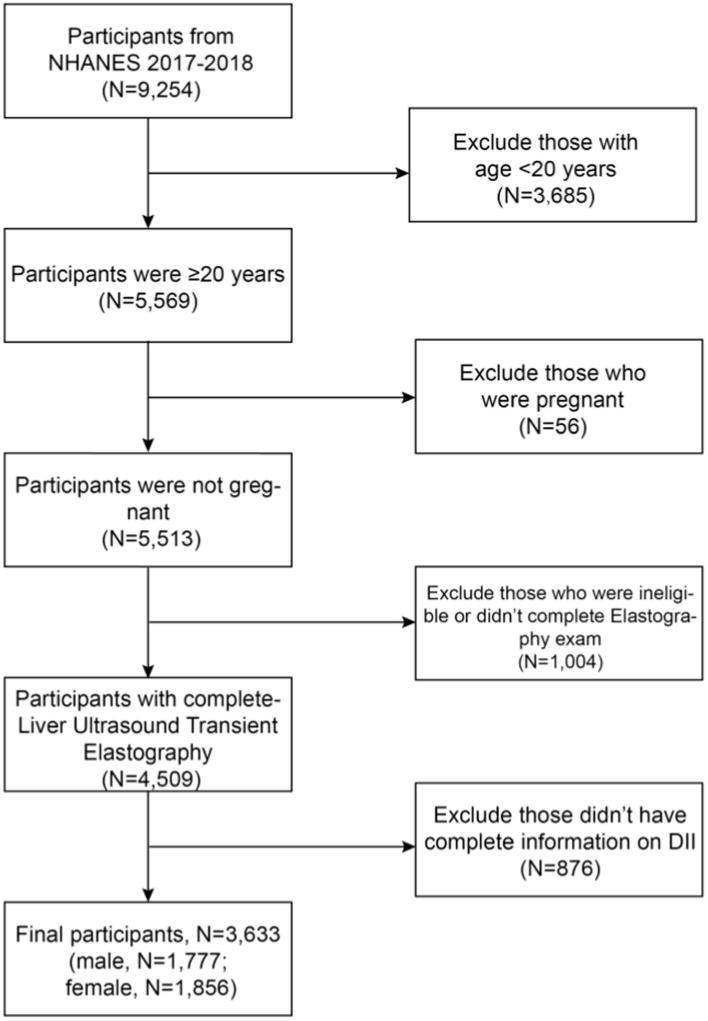
In this research, using dietary inflammatory index (DII) as a measure to assess dietary quality, we analyzed the relationship between diet and MAFLD. Data from the National Health and Nutrition Examination Survey (NHANES) 2017-2018, including 3,633 adults with complete DII and MAFLD, were used to develop cross-sectional analyses. Logistic regression analysis was adapted for investigating the relationship between DII and MAFLD development. Additionally, subgroup analysis and threshold effect analysis were carried out.
RESULTS
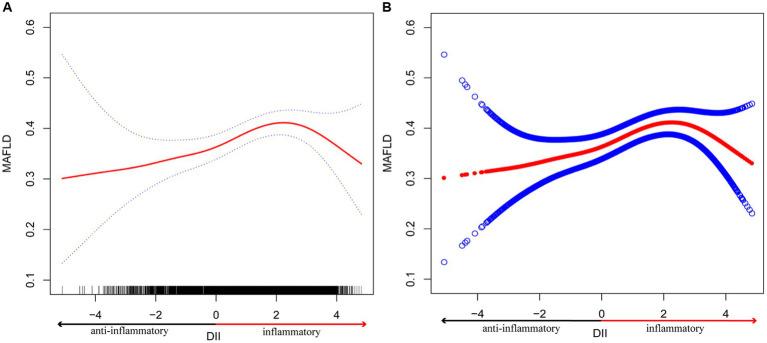
A positive link between DII and MAFLD was found in the fully adjusted model (OR = 1.05; 95%CI, 1.00-1.11, < 0.05). Subgroup analysis indicated that there was no significant dependence for the connection between DII and MAFLD except for the subgroup stratified by age. Compared with other age groups, people with MAFLD had 20% higher DII scores than non-MAFLD participants in those aged 20-41 years old (OR = 1.20; 95%CI, 1.08-1.33, < 0.001). Furthermore, we found a U-shaped curve with an inflection point of 3.06 illustrating the non-linear connection between DII and MAFLD.
CONCLUSION
As a result, our research indicates that pro-inflammatory diet may increase the chance of MAFLD development, thus improved dietary patterns as a lifestyle intervention is an important strategy to decrease the incidence of MAFLD.
背景
代谢功能障碍相关脂肪性肝病(MAFLD)是目前全球最普遍的慢性肝脏疾病,与肥胖、血脂异常代谢综合征和2型糖尿病(T2DM)密切相关。其发病机制与炎症密切相关,而饮食是减轻炎症的主要因素。然而,目前的研究主要集中在探索饮食与非酒精性脂肪性肝病(NAFLD)之间的关系,而对其与MAFLD的联系研究较少。
方法
在本研究中,我们以饮食炎症指数(DII)作为评估饮食质量的指标,分析饮食与MAFLD之间的关系。使用2017 - 2018年美国国家健康与营养检查调查(NHANES)的数据,包括3633名有完整DII和MAFLD数据的成年人,进行横断面分析。采用逻辑回归分析来研究DII与MAFLD发生之间的关系。此外,还进行了亚组分析和阈值效应分析。
结果
在完全调整模型中发现DII与MAFLD之间存在正相关(OR = 1.05;95%CI,1.00 - 1.11,P < 0.05)。亚组分析表明,除按年龄分层的亚组外,DII与MAFLD之间的关联无显著依赖性。与其他年龄组相比,20 - 41岁患有MAFLD的人群的DII得分比未患MAFLD的参与者高20%(OR = 1.20;95%CI,1.08 - 1.33,P < 0.001)。此外,我们发现了一条拐点为3.06的U形曲线,说明了DII与MAFLD之间的非线性关系。
结论
因此,我们的研究表明,促炎性饮食可能会增加MAFLD发生的几率,因此,作为一种生活方式干预措施改善饮食模式是降低MAFLD发病率的重要策略。
 Zotero 插件