
肠易激综合征患者的心理困扰:身体意象和自我批评的作用。
Psychological distress in individuals with irritable bowel syndrome: the roles of body image and self-criticism.
作者信息
Geller Shulamit, Levy Sigal, Avitsur Ronit
机构信息
School of Behavioral Sciences, The Academic College of Tel Aviv-Yaffo, Tel Aviv, Israel.
Statistics Education Unit, The Academic College of Tel Aviv-Yaffo, Tel Aviv, Israel.
出版信息
Health Psychol Behav Med. 2024 Mar 28;12(1):2334466. doi: 10.1080/21642850.2024.2334466. eCollection 2024.
OBJECTIVE
Irritable bowel syndrome (IBS) is a prevalent gastrointestinal disorder associated with reduced quality of life and psychological distress (PD) including anxiety and depression. The mechanisms linking IBS to PD are unclear. Previous studies showed that body image and self-criticism may be contributory factors. Thus, the objective of this study was to test the potential mediating roles of these factors in the relationship between IBS and PD.
METHOD
507 adults participated, including 142 with IBS (Mean age = 31.9, SD = 11.7), and 365 healthy peers (Mean age = 26.2, SD = 6.4), ranging in age from 18 to 75. The majority of participants were women (78%). Self-report measures assessed IBS status, body appreciation, body dissatisfaction, self-criticism, sociodemographic status, depression, and anxiety. Path analysis tested the hypothesized mediation model.
RESULTS
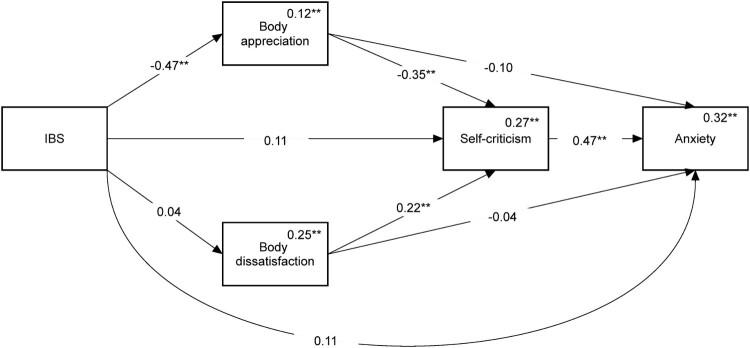
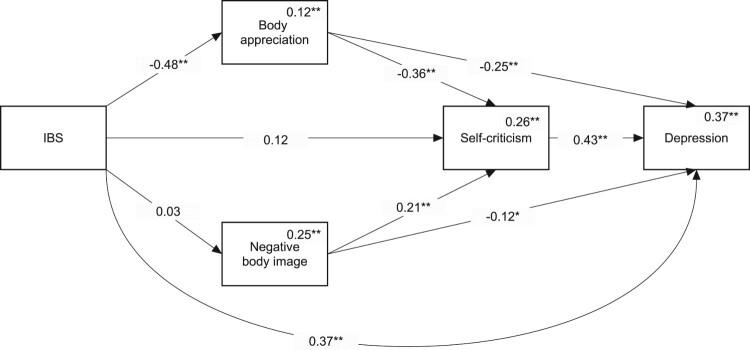
IBS participants reported greater PD, lower body appreciation, higher body dissatisfaction, and higher self-criticism than controls. Body appreciation and self-criticism sequentially mediated the link between IBS status and both depression and anxiety. IBS was associated with reduced body appreciation, which in turn was linked to heightened self-criticism, thereby leading to elevated psychological distress.
CONCLUSION
Results suggest IBS negatively impacts body image appreciation, fostering self-critical judgments that exacerbate psychological symptoms. This study is the first to demonstrate a significant association between body appreciation and IBS, specifically highlighting this relationship. Findings clarify the psychosocial pathways at play in the comorbidity of mental health issues in IBS. Physicians and other health professionals are advised to detect women with IBS who are distressed, and to offer them appropriate intervention to prevent downstream consequences.
目的
肠易激综合征(IBS)是一种常见的胃肠道疾病,与生活质量下降及包括焦虑和抑郁在内的心理困扰(PD)相关。IBS与PD之间的关联机制尚不清楚。既往研究表明身体意象和自我批评可能是促成因素。因此,本研究的目的是检验这些因素在IBS与PD关系中的潜在中介作用。
方法
507名成年人参与了研究,其中包括142名IBS患者(平均年龄 = 31.9岁,标准差 = 11.7)和365名健康同龄人(平均年龄 = 26.2岁,标准差 = 6.4),年龄范围为18至75岁。大多数参与者为女性(78%)。通过自我报告测量评估IBS状态、身体欣赏、身体不满、自我批评、社会人口学状态、抑郁和焦虑。路径分析检验了假设的中介模型。
结果
与对照组相比,IBS患者报告有更高的心理困扰、更低的身体欣赏、更高的身体不满和更高的自我批评。身体欣赏和自我批评依次介导了IBS状态与抑郁和焦虑之间的联系。IBS与身体欣赏降低相关,而身体欣赏降低又与自我批评增强相关,从而导致心理困扰加剧。
结论
结果表明IBS对身体意象欣赏有负面影响,促进了自我批评性判断,进而加剧心理症状。本研究首次证明了身体欣赏与IBS之间存在显著关联,特别突出了这种关系。研究结果阐明了IBS中心理社会因素在心理健康问题共病中所起作用的途径。建议医生和其他卫生专业人员识别出有心理困扰的IBS女性患者,并为她们提供适当干预以预防后续后果。

 Zotero 插件