
2010 - 2017年中国江苏省极端气象因素对手足口病感染的短期影响:分布滞后非线性分析
Short-Term Effects of Extreme Meteorological Factors on Hand, Foot, and Mouth Disease Infection During 2010-2017 in Jiangsu, China: A Distributed Lag Non-Linear Analysis.
作者信息
Yang Xu, Wang Junshu, Zhang Guoming, Yu Zhaoyuan
机构信息
Key Laboratory of Virtual Geographic Environment Nanjing Normal University Ministry of Education Nanjing China.
Jiangsu Center for Collaborative Innovation in Geographical Information Resource Development and Application Nanjing China.
出版信息
Geohealth. 2024 Mar 31;8(4):e2023GH000942. doi: 10.1029/2023GH000942. eCollection 2024 Apr.
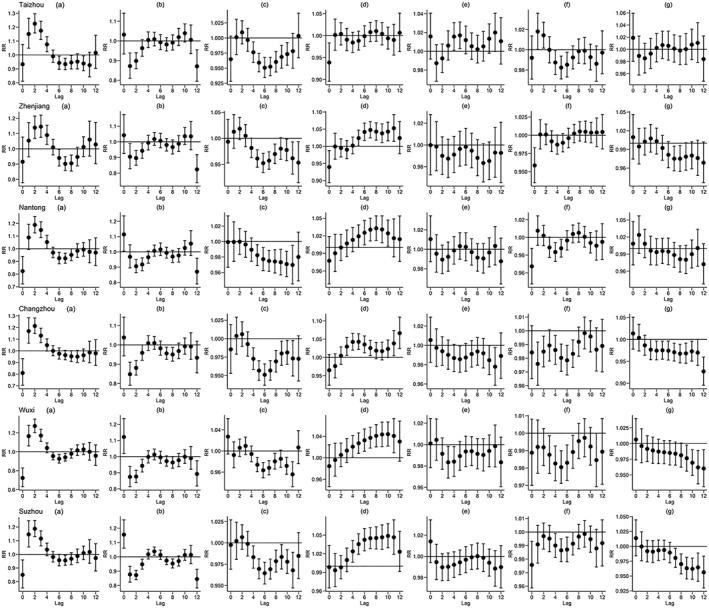
Hand, Foot, and Mouth Disease (HFMD) is an infectious disease that primarily affects young children. In densely populated Jiangsu Province in China, the impact of extreme meteorological factors on HFMD is a concern. We aimed to examine the association between extreme meteorological variables and HFMD infection risk using daily HFMD infections and meteorological data from 2010 to 2017 in Jiangsu Province. We used distributed lag non-linear model (DLNM) to analyze the data, which can effectively capture the nuanced non-linear dynamics and lag effects in the relationship between HFMD and extreme meteorological factors. Comparing the 10th and 90th percentiles of meteorological variables with their respective median values, our results showed that extremely low temperatures and high humidity were significantly associated with increased HFMD infection risk. The greatest effect of extremely low temperatures was observed at a lag of 1-2 days, elevating the risk by 18 ∼ 33% (RR = 1.18 ∼ 1.33). Extremely high humidity was found to increase the risk of infection, starting at a lag of 4 days. In contrast, extremely high temperatures, low humidity, and high wind speed were associated with reduced risk of infection at lag of 0-12 days, with the range of RR values being 0.60-0.98 for extremely high temperatures, 0.69-0.89 for extremely low humidity, and 0.84-0.98 for extremely high wind speed respectively. Our findings suggest that extreme meteorological factors can significantly impact the incidence of HFMD in Jiangsu Province, and highlight the need for effective public health protection measures during the periods of extreme meteorological condition, particularly for vulnerable populations.
手足口病(HFMD)是一种主要影响幼儿的传染病。在中国人口密集的江苏省,极端气象因素对手足口病的影响备受关注。我们旨在利用江苏省2010年至2017年的每日手足口病感染情况和气象数据,研究极端气象变量与手足口病感染风险之间的关联。我们使用分布滞后非线性模型(DLNM)来分析数据,该模型能够有效捕捉手足口病与极端气象因素之间关系中的细微非线性动态和滞后效应。将气象变量的第10和第90百分位数与其各自的中位数进行比较,我们的结果表明,极低温度和高湿度与手足口病感染风险增加显著相关。极低温度的最大影响在滞后1 - 2天观察到,风险升高18%至33%(相对风险RR = 1.18至1.33)。发现极高湿度从滞后4天开始增加感染风险。相比之下,极高温度、低湿度和高风速在滞后0 - 12天与感染风险降低相关,极高温度的RR值范围为0.60 - 0.98,极低湿度为0.69 - 0.89,极高风速为0.84 - 0.98。我们的研究结果表明,极端气象因素可显著影响江苏省手足口病的发病率,并突出了在极端气象条件期间采取有效公共卫生保护措施的必要性,特别是针对弱势群体。

 Zotero 插件