
外显子组全基因组分析提示罕见的蛋白改变变异与人类利手性有关。
Exome-wide analysis implicates rare protein-altering variants in human handedness.
机构信息
Language & Genetics Department, Max Planck Institute for Psycholinguistics, Nijmegen, The Netherlands.
Donders Institute for Brain, Cognition and Behaviour, Radboud University, Nijmegen, The Netherlands.
出版信息
Nat Commun. 2024 Apr 2;15(1):2632. doi: 10.1038/s41467-024-46277-w.
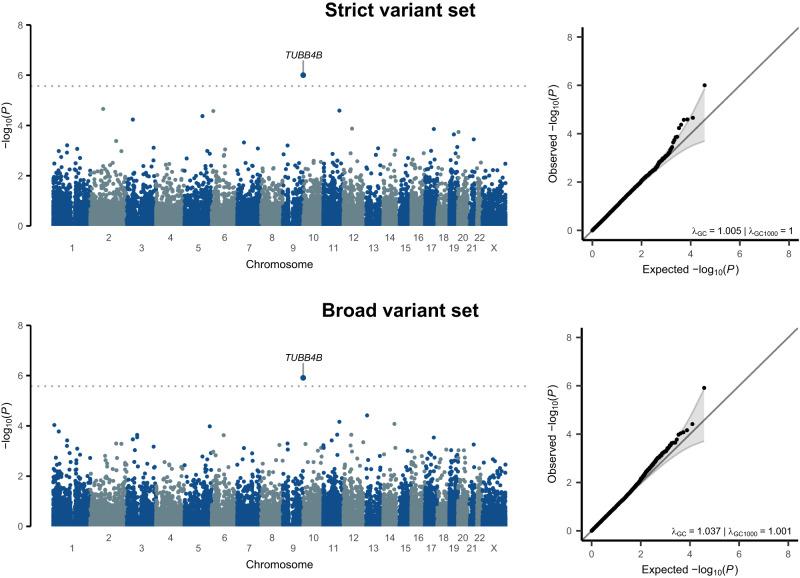
Handedness is a manifestation of brain hemispheric specialization. Left-handedness occurs at increased rates in neurodevelopmental disorders. Genome-wide association studies have identified common genetic effects on handedness or brain asymmetry, which mostly involve variants outside protein-coding regions and may affect gene expression. Implicated genes include several that encode tubulins (microtubule components) or microtubule-associated proteins. Here we examine whether left-handedness is also influenced by rare coding variants (frequencies ≤ 1%), using exome data from 38,043 left-handed and 313,271 right-handed individuals from the UK Biobank. The beta-tubulin gene TUBB4B shows exome-wide significant association, with a rate of rare coding variants 2.7 times higher in left-handers than right-handers. The TUBB4B variants are mostly heterozygous missense changes, but include two frameshifts found only in left-handers. Other TUBB4B variants have been linked to sensorineural and/or ciliopathic disorders, but not the variants found here. Among genes previously implicated in autism or schizophrenia by exome screening, DSCAM and FOXP1 show evidence for rare coding variant association with left-handedness. The exome-wide heritability of left-handedness due to rare coding variants was 0.91%. This study reveals a role for rare, protein-altering variants in left-handedness, providing further evidence for the involvement of microtubules and disorder-relevant genes.
用手习惯是大脑半球特化的一种表现。在神经发育障碍中,左撇子的发生率增加。全基因组关联研究已经确定了常见的遗传因素对手习惯或大脑不对称性的影响,这些因素主要涉及编码区以外的变异,可能影响基因表达。涉及的基因包括几个编码微管蛋白(微管成分)或微管相关蛋白的基因。在这里,我们使用英国生物库中 38043 名左撇子和 313271 名右撇子个体的外显子组数据,研究罕见编码变异(频率≤1%)是否也会影响左撇子。β-微管蛋白基因 TUBB4B 在外显子组范围内表现出显著的关联,左撇子中罕见编码变异的发生率比右撇子高 2.7 倍。TUBB4B 变体大多为杂合错义变化,但包括仅在左撇子中发现的两个移码突变。其他 TUBB4B 变体与感觉神经性和/或纤毛疾病有关,但与这里发现的变体不同。在通过外显子组筛选与自闭症或精神分裂症相关的基因中,DSCAM 和 FOXP1 显示出与左撇子相关的罕见编码变异关联的证据。由于罕见的编码变异,左撇子的外显子组遗传率为 0.91%。这项研究揭示了罕见的、改变蛋白质的变异在左撇子中的作用,为微管和与疾病相关的基因的参与提供了进一步的证据。

 Zotero 插件