
全球 204 个国家和地区及 811 个亚级行政区 1990 年至 2021 年 288 种死因及预期寿命的归因分析:全球疾病负担研究 2021 系统分析。
Global burden of 288 causes of death and life expectancy decomposition in 204 countries and territories and 811 subnational locations, 1990-2021: a systematic analysis for the Global Burden of Disease Study 2021.
出版信息
Lancet. 2024 May 18;403(10440):2100-2132. doi: 10.1016/S0140-6736(24)00367-2. Epub 2024 Apr 3.
BACKGROUND
Regular, detailed reporting on population health by underlying cause of death is fundamental for public health decision making. Cause-specific estimates of mortality and the subsequent effects on life expectancy worldwide are valuable metrics to gauge progress in reducing mortality rates. These estimates are particularly important following large-scale mortality spikes, such as the COVID-19 pandemic. When systematically analysed, mortality rates and life expectancy allow comparisons of the consequences of causes of death globally and over time, providing a nuanced understanding of the effect of these causes on global populations.
METHODS
The Global Burden of Diseases, Injuries, and Risk Factors Study (GBD) 2021 cause-of-death analysis estimated mortality and years of life lost (YLLs) from 288 causes of death by age-sex-location-year in 204 countries and territories and 811 subnational locations for each year from 1990 until 2021. The analysis used 56 604 data sources, including data from vital registration and verbal autopsy as well as surveys, censuses, surveillance systems, and cancer registries, among others. As with previous GBD rounds, cause-specific death rates for most causes were estimated using the Cause of Death Ensemble model-a modelling tool developed for GBD to assess the out-of-sample predictive validity of different statistical models and covariate permutations and combine those results to produce cause-specific mortality estimates-with alternative strategies adapted to model causes with insufficient data, substantial changes in reporting over the study period, or unusual epidemiology. YLLs were computed as the product of the number of deaths for each cause-age-sex-location-year and the standard life expectancy at each age. As part of the modelling process, uncertainty intervals (UIs) were generated using the 2·5th and 97·5th percentiles from a 1000-draw distribution for each metric. We decomposed life expectancy by cause of death, location, and year to show cause-specific effects on life expectancy from 1990 to 2021. We also used the coefficient of variation and the fraction of population affected by 90% of deaths to highlight concentrations of mortality. Findings are reported in counts and age-standardised rates. Methodological improvements for cause-of-death estimates in GBD 2021 include the expansion of under-5-years age group to include four new age groups, enhanced methods to account for stochastic variation of sparse data, and the inclusion of COVID-19 and other pandemic-related mortality-which includes excess mortality associated with the pandemic, excluding COVID-19, lower respiratory infections, measles, malaria, and pertussis. For this analysis, 199 new country-years of vital registration cause-of-death data, 5 country-years of surveillance data, 21 country-years of verbal autopsy data, and 94 country-years of other data types were added to those used in previous GBD rounds.
FINDINGS
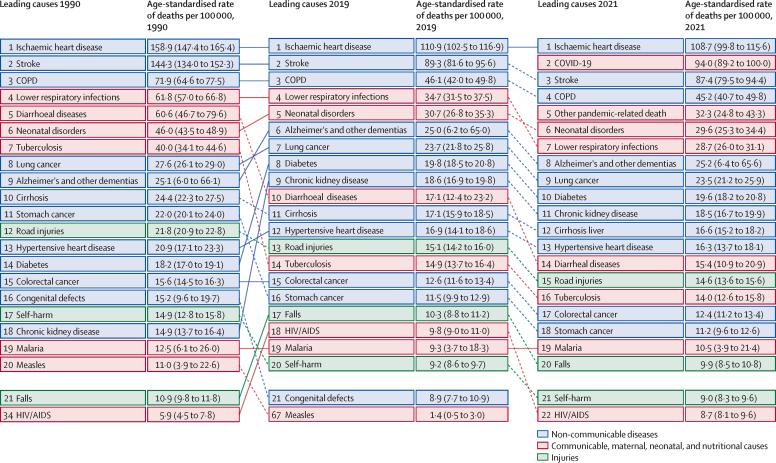
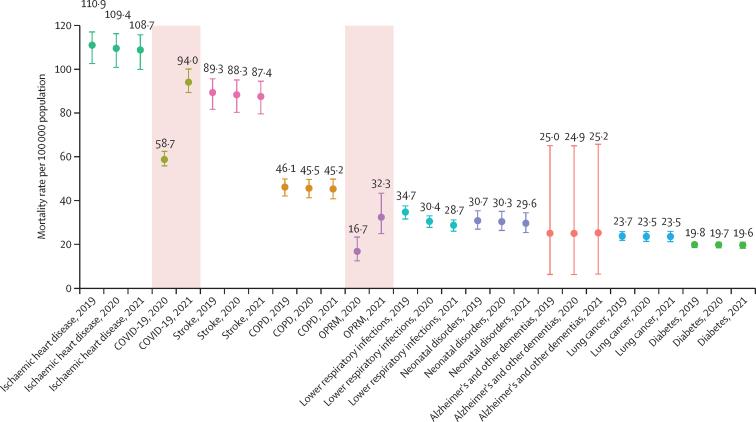
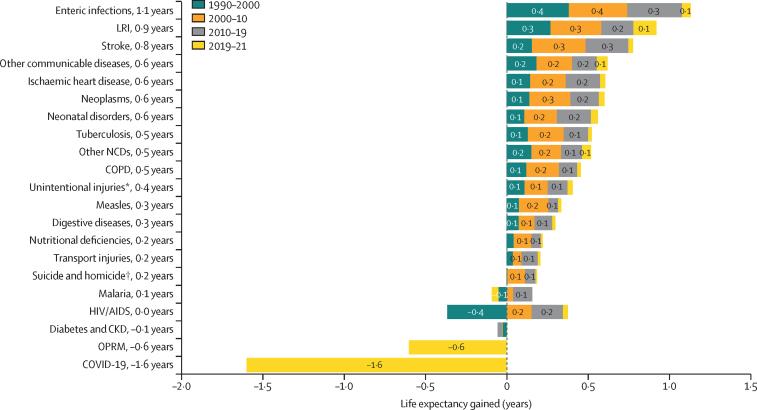
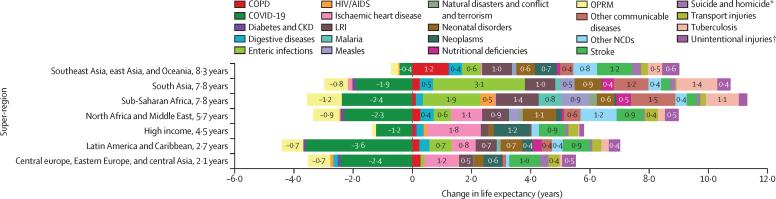
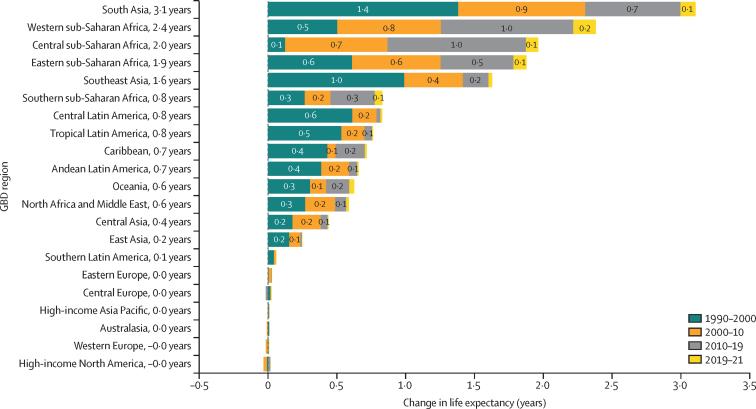
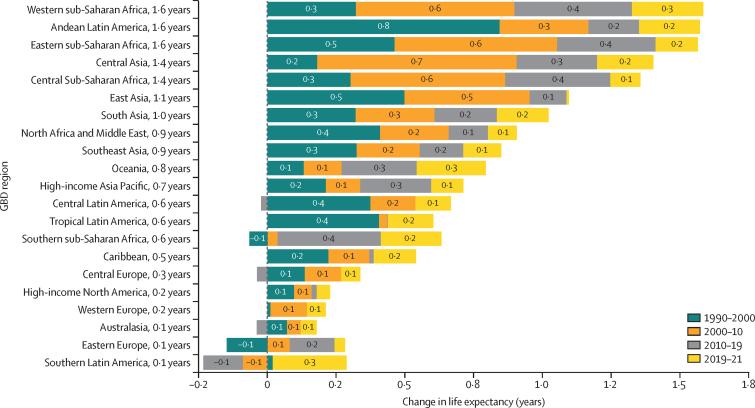
The leading causes of age-standardised deaths globally were the same in 2019 as they were in 1990; in descending order, these were, ischaemic heart disease, stroke, chronic obstructive pulmonary disease, and lower respiratory infections. In 2021, however, COVID-19 replaced stroke as the second-leading age-standardised cause of death, with 94·0 deaths (95% UI 89·2-100·0) per 100 000 population. The COVID-19 pandemic shifted the rankings of the leading five causes, lowering stroke to the third-leading and chronic obstructive pulmonary disease to the fourth-leading position. In 2021, the highest age-standardised death rates from COVID-19 occurred in sub-Saharan Africa (271·0 deaths [250·1-290·7] per 100 000 population) and Latin America and the Caribbean (195·4 deaths [182·1-211·4] per 100 000 population). The lowest age-standardised death rates from COVID-19 were in the high-income super-region (48·1 deaths [47·4-48·8] per 100 000 population) and southeast Asia, east Asia, and Oceania (23·2 deaths [16·3-37·2] per 100 000 population). Globally, life expectancy steadily improved between 1990 and 2019 for 18 of the 22 investigated causes. Decomposition of global and regional life expectancy showed the positive effect that reductions in deaths from enteric infections, lower respiratory infections, stroke, and neonatal deaths, among others have contributed to improved survival over the study period. However, a net reduction of 1·6 years occurred in global life expectancy between 2019 and 2021, primarily due to increased death rates from COVID-19 and other pandemic-related mortality. Life expectancy was highly variable between super-regions over the study period, with southeast Asia, east Asia, and Oceania gaining 8·3 years (6·7-9·9) overall, while having the smallest reduction in life expectancy due to COVID-19 (0·4 years). The largest reduction in life expectancy due to COVID-19 occurred in Latin America and the Caribbean (3·6 years). Additionally, 53 of the 288 causes of death were highly concentrated in locations with less than 50% of the global population as of 2021, and these causes of death became progressively more concentrated since 1990, when only 44 causes showed this pattern. The concentration phenomenon is discussed heuristically with respect to enteric and lower respiratory infections, malaria, HIV/AIDS, neonatal disorders, tuberculosis, and measles.
INTERPRETATION
Long-standing gains in life expectancy and reductions in many of the leading causes of death have been disrupted by the COVID-19 pandemic, the adverse effects of which were spread unevenly among populations. Despite the pandemic, there has been continued progress in combatting several notable causes of death, leading to improved global life expectancy over the study period. Each of the seven GBD super-regions showed an overall improvement from 1990 and 2021, obscuring the negative effect in the years of the pandemic. Additionally, our findings regarding regional variation in causes of death driving increases in life expectancy hold clear policy utility. Analyses of shifting mortality trends reveal that several causes, once widespread globally, are now increasingly concentrated geographically. These changes in mortality concentration, alongside further investigation of changing risks, interventions, and relevant policy, present an important opportunity to deepen our understanding of mortality-reduction strategies. Examining patterns in mortality concentration might reveal areas where successful public health interventions have been implemented. Translating these successes to locations where certain causes of death remain entrenched can inform policies that work to improve life expectancy for people everywhere.
FUNDING
Bill & Melinda Gates Foundation.
背景
定期详细报告死因是公共卫生决策的基础。特定死因的死亡率估计值以及随之而来的全球预期寿命变化是衡量降低死亡率进展的重要指标。在 COVID-19 大流行等大规模死亡率飙升之后,这些估计值特别重要。当系统地分析时,死亡率和预期寿命可以比较全球和随时间推移的死因的后果,从而更深入地了解这些死因对全球人口的影响。
方法
全球疾病、伤害和危险因素研究(GBD)2021 年死因分析估计了 204 个国家和地区以及 811 个次国家地区的 288 种死因在 1990 年至 2021 年期间按年龄、性别、地点和年份的死亡率和寿命损失年数(YLL)。该分析使用了 56604 个数据源,包括来自生命登记和死因推断以及调查、人口普查、监测系统和癌症登记等的数据。与之前的 GBD 轮次一样,大多数死因的特定死因死亡率使用死因综合模型(Cause of Death Ensemble model)进行估计,这是一种为 GBD 开发的建模工具,用于评估不同统计模型和协变量排列的样本外预测有效性,并将这些结果组合起来以产生特定死因的死亡率估计值-对于数据不足、报告期间变化较大或流行病学异常的死因,采用了替代策略。YLL 是通过每个死因-年龄-性别-地点-年份的死亡人数乘以每个年龄的标准预期寿命来计算的。作为建模过程的一部分,使用每个指标的 1000 次抽取分布的第 2.5 百分位数和第 97.5 百分位数生成不确定性区间(UI)。我们按死因、地点和年份分解了预期寿命,以显示 1990 年至 2021 年期间各种死因对预期寿命的特定影响。我们还使用变异系数和受 90%死亡影响的人口比例来突出死亡率的集中程度。结果以计数和年龄标准化率报告。GBD 2021 年死因估计方法的改进包括将 5 岁以下年龄组扩展到包括四个新的年龄组,增强了处理稀疏数据随机变化的方法,以及包括 COVID-19 和其他与大流行相关的死亡率-包括与大流行相关的超额死亡,不包括 COVID-19、下呼吸道感染、麻疹、疟疾和百日咳。对于本次分析,在之前的 GBD 轮次中使用的数据基础上,新增了 199 个国家/年的生命登记死因数据、5 个国家/年的监测数据、21 个国家/年的死因推断数据和 94 个国家/年的其他数据类型。
结果
2019 年和 1990 年全球相同的死因是年龄标准化死亡率最高的原因;按降序排列,这些原因依次为缺血性心脏病、中风、慢性阻塞性肺疾病和下呼吸道感染。然而,2021 年,COVID-19 取代中风成为第二大年龄标准化死因,每 10 万人中有 94.0 人死亡(95%UI 89.2-100.0)。COVID-19 大流行改变了前五大死因的排名,使中风降至第三位,慢性阻塞性肺疾病降至第四位。2021 年,撒哈拉以南非洲(每 10 万人中有 271.0 人死亡[250.1-290.7])和拉丁美洲和加勒比(每 10 万人中有 195.4 人死亡[182.1-211.4])的 COVID-19 年龄标准化死亡率最高。COVID-19 的年龄标准化死亡率最低的地区是高收入超级区域(每 10 万人中有 48.1 人死亡[47.4-48.8])和东南亚、东亚和大洋洲(每 10 万人中有 23.2 人死亡[16.3-37.2])。全球范围内,在 22 个研究的死因中,有 18 个死因的预期寿命在 1990 年至 2019 年间稳步提高。全球和地区预期寿命的分解表明,减少肠内感染、下呼吸道感染、中风和新生儿死亡等其他原因的死亡对研究期间的生存产生了积极影响。然而,2019 年至 2021 年期间,全球预期寿命净减少了 1.6 年,主要是由于 COVID-19 和其他与大流行相关的死亡率增加。在整个研究期间,超级区域之间的预期寿命差异很大,东南亚、东亚和大洋洲的预期寿命总体上增加了 8.3 年(6.7-9.9),而由于 COVID-19 导致的预期寿命下降最小(0.4 年)。拉丁美洲和加勒比地区由于 COVID-19 导致的预期寿命下降幅度最大(3.6 年)。此外,288 个死因中有 53 个主要集中在截至 2021 年全球人口不足 50%的地点,自 1990 年以来,这些死因的集中程度逐渐增加,当时只有 44 个死因显示出这种模式。这种集中现象与肠内和下呼吸道感染、疟疾、艾滋病毒/艾滋病、新生儿疾病、结核病和麻疹等进行了直观讨论。
解释
COVID-19 大流行扰乱了预期寿命的长期增长和许多主要死因的减少,其不利影响在全球人口中分布不均。尽管发生了大流行,但在与许多疾病作斗争方面仍取得了持续进展,导致研究期间全球预期寿命的提高。七个 GBD 超级区域中的每一个都从 1990 年和 2021 年总体上有所改善,掩盖了大流行年份的负面影响。此外,我们关于导致预期寿命增加的地区性死因的分析结果具有明确的政策实用性。对不断变化的死亡率趋势的分析表明,一些曾经在全球范围内广泛存在的死因现在正越来越集中在地理区域。这些死亡率集中程度的变化,以及对不断变化的风险、干预措施和相关政策的进一步调查,为加深我们对死亡率降低策略的理解提供了一个重要机会。分析死亡率集中程度的变化可能揭示出某些地方成功实施了公共卫生干预措施。将这些成功经验应用于某些死因仍然根深蒂固的地区,可以为改善世界各地人民的预期寿命提供信息。
资助
比尔及梅琳达·盖茨基金会。



 Zotero 插件