
融合生物技术与自然农法:通过创新干预开创农业可持续发展之路。
Synergizing biotechnology and natural farming: pioneering agricultural sustainability through innovative interventions.
作者信息
Badiyal Anila, Mahajan Rishi, Rana Ranbir Singh, Sood Ruchi, Walia Abhishek, Rana Tanuja, Manhas Shilpa, Jayswal D K
机构信息
Department of Microbiology, Chaudhary Sarwan Kumar Himachal Pradesh Krishi Vishvavidyalaya, Palampur, Himachal Pradesh, India.
Centre for Geo-Informatics Research and Training, Chaudhary Sarwan Kumar Himachal Pradesh Krishi Vishvavidyalaya, Palampur, Himachal Pradesh, India.
出版信息
Front Plant Sci. 2024 Mar 22;15:1280846. doi: 10.3389/fpls.2024.1280846. eCollection 2024.
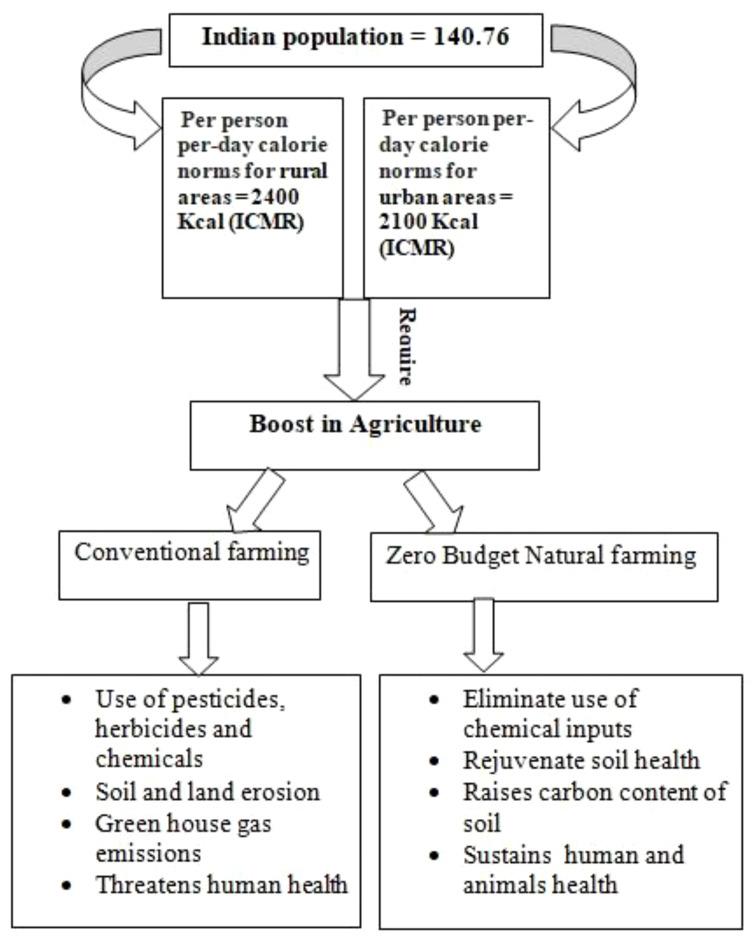
The world has undergone a remarkable transformation from the era of famines to an age of global food production that caters to an exponentially growing population. This transformation has been made possible by significant agricultural revolutions, marked by the intensification of agriculture through the infusion of mechanical, industrial, and economic inputs. However, this rapid advancement in agriculture has also brought about the proliferation of agricultural inputs such as pesticides, fertilizers, and irrigation, which have given rise to long-term environmental crises. Over the past two decades, we have witnessed a concerning plateau in crop production, the loss of arable land, and dramatic shifts in climatic conditions. These challenges have underscored the urgent need to protect our global commons, particularly the environment, through a participatory approach that involves countries worldwide, regardless of their developmental status. To achieve the goal of sustainability in agriculture, it is imperative to adopt multidisciplinary approaches that integrate fields such as biology, engineering, chemistry, economics, and community development. One noteworthy initiative in this regard is Zero Budget Natural Farming, which highlights the significance of leveraging the synergistic effects of both plant and animal products to enhance crop establishment, build soil fertility, and promote the proliferation of beneficial microorganisms. The ultimate aim is to create self-sustainable agro-ecosystems. This review advocates for the incorporation of biotechnological tools in natural farming to expedite the dynamism of such systems in an eco-friendly manner. By harnessing the power of biotechnology, we can increase the productivity of agro-ecology and generate abundant supplies of food, feed, fiber, and nutraceuticals to meet the needs of our ever-expanding global population.
世界已从饥荒时代经历了显著转变,进入了一个能满足人口呈指数级增长的全球粮食生产时代。这一转变得益于重大的农业革命,其标志是通过投入机械、工业和经济要素来强化农业。然而,农业的这种快速发展也导致了农药、化肥和灌溉等农业投入品的激增,进而引发了长期的环境危机。在过去二十年里,我们目睹了作物产量令人担忧的停滞、可耕地的流失以及气候条件的剧烈变化。这些挑战凸显了通过一种让世界各国(无论其发展状况如何)都参与进来的方式来保护我们的全球公域,尤其是保护环境的迫切需求。为实现农业可持续发展的目标,必须采用多学科方法,整合生物学、工程学、化学、经济学和社区发展等领域。在这方面,一项值得注意的举措是零预算自然农法,它强调了利用动植物产品的协同效应来促进作物生长、培育土壤肥力以及促进有益微生物繁殖的重要性。其最终目标是创建自我维持的农业生态系统。本综述主张在自然农法中纳入生物技术工具,以生态友好的方式加快此类系统的活力。通过利用生物技术的力量,我们可以提高农业生态的生产力,生产出丰富的粮食、饲料、纤维和营养保健品,以满足不断增长的全球人口的需求。

 Zotero 插件