
在健康和高血糖系统条件下,通过持续释放水杨酸来阻止种植体周围炎进展的研究:一种哥廷根小型猪模型。
Sustained Release of Salicylic Acid for Halting Peri-Implantitis Progression in Healthy and Hyperglycemic Systemic Conditions: A Gottingen Minipig Model.
机构信息
Department of Prosthodontics, NYU Dentistry, New York, New York 10010, United States.
Biomaterials Division, NYU Dentistry, New York, New York 10010, United States.
出版信息
ACS Biomater Sci Eng. 2024 May 13;10(5):3097-3107. doi: 10.1021/acsbiomaterials.4c00161. Epub 2024 Apr 9.
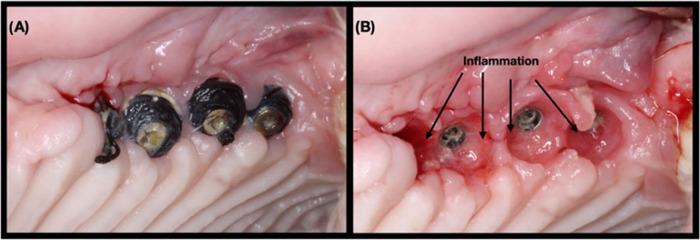
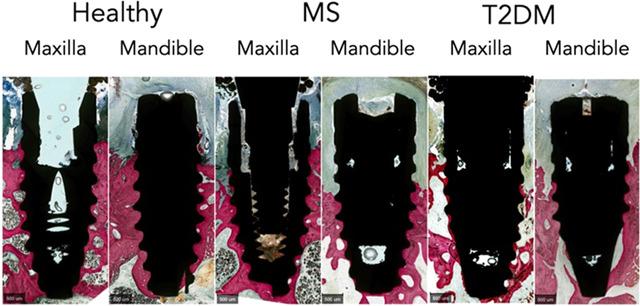
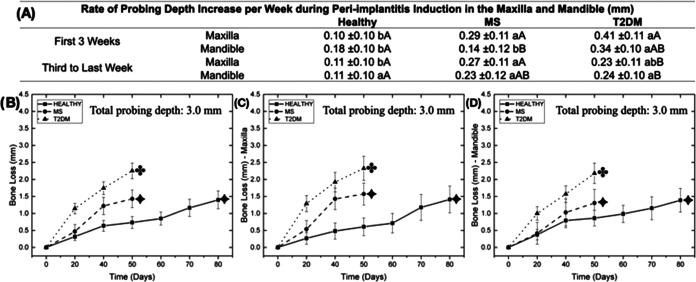
To develop a peri-implantitis model in a Gottingen minipig and evaluate the effect of local application of salicylic acid poly(anhydride-ester) (SAPAE) on peri-implantitis progression in healthy, metabolic syndrome (MS), and type-2 diabetes mellitus (T2DM) subjects. Eighteen animals were allocated to three groups: (i) control, (ii) MS (diet for obesity induction), and (iii) T2DM (diet plus streptozotocin for T2DM induction). Maxillary and mandible premolars and first molar were extracted. After 3 months of healing, four implants per side were placed in both jaws of each animal. After 2 months, peri-implantitis was induced by plaque formation using silk ligatures. SAPAE polymer was mixed with mineral oil (3.75 mg/μL) and topically applied biweekly for up to 60 days to halt peri-implantitis progression. Periodontal probing was used to assess pocket depth over time, followed by histomorphologic analysis of harvested samples. The adopted protocol resulted in the onset of peri-implantitis, with healthy minipigs taking twice as long to reach the same level of probing depth relative to MS and T2DM subjects (∼3.0 mm), irrespective of jaw. In a qualitative analysis, SAPAE therapy revealed decreased levels of inflammation in the normoglycemic, MS, and T2DM groups. SAPAE application around implants significantly reduced the progression of peri-implantitis after ∼15 days of therapy, with ∼30% lower probing depth for all systemic conditions and similar rates of probing depth increase per week between the control and SAPAE groups. MS and T2DM conditions presented a faster progression of the peri-implant pocket depth. SAPAE treatment reduced peri-implantitis progression in healthy, MS, and T2DM groups.
目的
在哥廷根小型猪中建立种植体周围炎模型,并评估局部应用水杨酸聚(酸酐-酯)(SAPAE)对健康、代谢综合征(MS)和 2 型糖尿病(T2DM)患者种植体周围炎进展的影响。
方法
将 18 只动物分为三组:(i)对照组,(ii)MS 组(肥胖诱导饮食)和(iii)T2DM 组(糖尿病诱导饮食+链脲佐菌素)。上颌和下颌前磨牙和第一磨牙被拔除。在 3 个月的愈合期后,在每个动物的双侧下颌和上颌各放置 4 个种植体。2 个月后,通过丝线结扎形成菌斑诱导种植体周围炎。将 SAPAE 聚合物与矿物油(3.75mg/μL)混合,并每周局部应用两次,最多 60 天,以阻止种植体周围炎的进展。通过牙周探诊随时间评估探诊深度,随后对采集的样本进行组织形态学分析。所采用的方案导致了种植体周围炎的发生,健康小型猪达到相同探诊深度的时间是 MS 和 T2DM 小型猪的两倍(约 3.0mm),与颌骨无关。在定性分析中,SAPAE 治疗显示在正常血糖、MS 和 T2DM 组中炎症水平降低。SAPAE 治疗在治疗后约 15 天即可显著减缓种植体周围炎的进展,所有系统性疾病的探诊深度降低约 30%,且对照组和 SAPAE 组的探诊深度每周增加率相似。MS 和 T2DM 条件下种植体周围袋深度的进展较快。SAPAE 治疗可降低健康、MS 和 T2DM 组种植体周围炎的进展。




 Zotero 插件