
在 COVID-19 大流行背景下,墨西哥预防儿童肥胖的短信移动健康干预措施的效果和实施:混合方法研究。
Effectiveness and Implementation of a Text Messaging mHealth Intervention to Prevent Childhood Obesity in Mexico in the COVID-19 Context: Mixed Methods Study.
机构信息
National Institute of Public Health, Instituto Nacional de Salud Pública de México, Cuernavaca, Mexico.
出版信息
JMIR Mhealth Uhealth. 2024 Apr 9;12:e55509. doi: 10.2196/55509.
BACKGROUND
Promoting physical activity (PA) and healthy feeding (HF) is crucial to address the alarming increase in obesity rates in developing countries. Leveraging mobile phones for behavior change communication to encourage infant PA and promote HF is particularly significant within the Mexican context.
OBJECTIVE
This study aims to explore the effectiveness and feasibility of mHealth interventions aimed at promoting PA and HF among primary caregivers (PCs) of Mexican children under the age of 5 years. Additionally, the study aims to disseminate insights gained from intervention implementation amidst the COVID-19 pandemic and assess the potential of behavior change mHealth interventions on a broader population scale.
METHODS
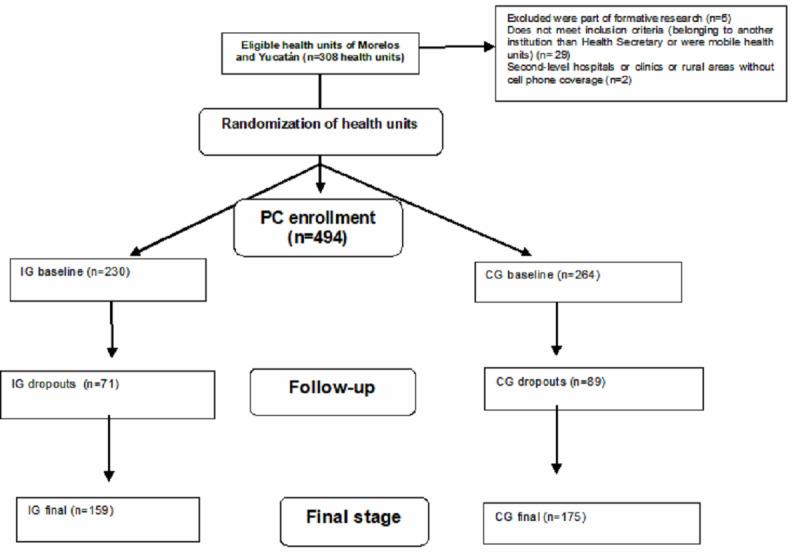
NUTRES, an mHealth intervention, underwent an effectiveness-implementation hybrid trial. Over 36 weeks, participants in the intervention group (IG), totaling 230 individuals, received approximately 108 SMS text messages tailored to their children's age. These messages covered topics such as PA and HF and emphasized the significance of proper child nutrition amidst the COVID-19 pandemic. NUTRES participants were recruited from both urban and rural health units across 2 states in Mexico. Given the COVID-19 context, both baseline and follow-up surveys were conducted via mobile or fixed telephone. The evaluation of effectiveness and implementation used a mixed methods approach. Qualitative analysis delved into participants' experiences with NUTRES and various implementation indicators, including acceptance, relevance, and coverage. Grounded theory was used for coding and analysis. Furthermore, difference-in-differences regression models were used to discern disparities between groups (comparison group [CG] versus IG) concerning knowledge and practices pertaining to infant PA and HF.
RESULTS
Of the total 494 PCs enrolled in NUTRES, 334 persisted until the end of the study, accounting for 67.6% (334/494) participation across both groups. A majority of PCs (43/141, 30.5%, always; and 97/141, 68.8%, sometimes) used the SMS text message information. Satisfaction and acceptability toward NUTRES were notably high, reaching 98% (96/98), with respondents expressing that NUTRES was "good," "useful," and "helpful" for enhancing child nutrition. Significant differences after the intervention were observed in PA knowledge, with social interaction favored (CG: 8/135, 5.9% vs IG: 20/137, 14.6%; P=.048), as well as in HF practice knowledge. Notably, sweetened beverage consumption, associated with the development of chronic diseases, showed divergence (CG: 92/157, 58.6% vs IG: 110/145, 75.9%; P=.003). In the difference-in-differences model, a notable increase of 0.03 in knowledge regarding the benefits of PA was observed (CG: mean 0.13, SD 0.10 vs IG: mean 0.16, SD 0.11; P=.02). PCs expressed feeling accompanied and supported, particularly amidst the disruption of routine health care services during the COVID-19 pandemic.
CONCLUSIONS
While NUTRES exhibited a restricted impact on targeted knowledge and behaviors, the SMS text messages functioned effectively as both a reminder and a source of new knowledge for PCs of Mexican children under 5 years of age. The key lessons learned were as follows: mHealth intervention strategies can effectively maintain communication with individuals during emergencies, such as the COVID-19 pandemic; methodological and implementation barriers can constrain the effectiveness of mHealth interventions; and using mixed methods approaches ensures the complementary nature of results. The findings contribute valuable evidence regarding the opportunities and constraints associated with using mobile phones to enhance knowledge and practices concerning PA and HF among PCs of children under 5 years old.
TRIAL REGISTRATION
ClinicalTrials.gov NCT04250896; https://clinicaltrials.gov/ct2/show/NCT04250896.
背景
在发展中国家,促进身体活动(PA)和健康喂养(HF)对于解决肥胖率的惊人增长至关重要。在墨西哥,利用手机进行行为改变交流以鼓励婴儿 PA 和促进 HF 尤为重要。
目的
本研究旨在探索针对墨西哥 5 岁以下儿童的主要照顾者(PCs)促进 PA 和 HF 的 mHealth 干预措施的有效性和可行性。此外,该研究旨在传播在 COVID-19 大流行期间实施干预措施所获得的见解,并评估行为改变 mHealth 干预措施对更广泛人群的潜力。
方法
NUTRES 是一项 mHealth 干预措施,进行了有效性-实施混合试验。在 36 周的时间里,干预组(IG)的 230 名参与者收到了大约 108 条针对他们孩子年龄的 SMS 文本消息。这些消息涵盖了 PA 和 HF 等主题,并强调了在 COVID-19 大流行期间适当儿童营养的重要性。NUTRES 的参与者来自墨西哥两个州的城市和农村卫生单位。考虑到 COVID-19 的情况,基线和随访调查均通过移动或固定电话进行。有效性和实施的评估采用混合方法。定性分析深入研究了参与者对 NUTRES 和各种实施指标的经验,包括接受度、相关性和覆盖率。使用扎根理论进行编码和分析。此外,使用差异-差异回归模型来识别组间(比较组[CG]与 IG)在婴儿 PA 和 HF 知识和实践方面的差异。
结果
在总共纳入 NUTRES 的 494 名 PCs 中,有 334 名一直坚持到研究结束,占两组总参与率的 67.6%(334/494)。大多数 PCs(43/141,30.5%,总是;和 97/141,68.8%,有时)使用 SMS 文本消息信息。NUTRES 的满意度和可接受度非常高,达到 98%(96/98),受访者表示 NUTRES“好”、“有用”和“有助于”增强儿童营养。干预后观察到 PA 知识有显著差异,社交互动更受青睐(CG:8/135,5.9%对 IG:20/137,14.6%;P=.048),HF 实践知识也有显著差异。值得注意的是,与慢性病发展相关的含糖饮料消费出现差异(CG:92/157,58.6%对 IG:110/145,75.9%;P=.003)。在差异-差异模型中,观察到 PA 益处知识增加了 0.03(CG:平均 0.13,SD 0.10 对 IG:平均 0.16,SD 0.11;P=.02)。PCs 表示感到陪伴和支持,特别是在 COVID-19 大流行期间常规医疗保健服务中断的情况下。
结论
虽然 NUTRES 对目标知识和行为的影响有限,但 SMS 文本消息作为提醒和新知识来源对墨西哥 5 岁以下儿童的 PCs 非常有效。从中吸取的主要经验教训如下:mHealth 干预策略可以在 COVID-19 等紧急情况下有效维持与个人的沟通;方法学和实施障碍可能会限制 mHealth 干预措施的有效性;并使用混合方法确保结果的互补性。这些发现为利用手机增强 5 岁以下儿童的 PCs 对 PA 和 HF 的知识和实践提供了有价值的证据,同时也揭示了其中的机遇和限制。
试验注册
ClinicalTrials.gov NCT04250896;https://clinicaltrials.gov/ct2/show/NCT04250896。
 Zotero 插件