
膀胱癌肿瘤微环境进展及其潜在分子机制:一项系统综述
Advances in tumor microenvironment and underlying molecular mechanisms of bladder cancer: a systematic review.
作者信息
Tang Liu, Xu Haifei, Wu Tong, Wu Wenhao, Lu Yuhao, Gu Jijia, Wang Xiaoling, Zhou Mei, Chen Qiuyang, Sun Xuan, Cai Hongzhou
机构信息
Department of Nursing, Jiangsu Cancer Hospital and The Affiliated Cancer Hospital of Nanjing Medical University and Jiangsu Institute of Cancer Research, Nanjing, Jiangsu, China.
Department of Urology, Nantong Tumor Hospital and Tumor Hospital Affiliated to Nantong University, Nantong, China.
出版信息
Discov Oncol. 2024 Apr 11;15(1):111. doi: 10.1007/s12672-024-00902-8.
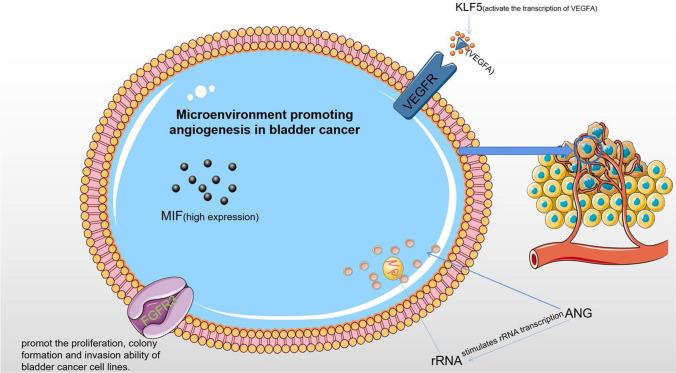
Bladder cancer is one of the most frequent malignant tumors of the urinary system. The prevalence of bladder cancer among men and women is roughly 5:2, and both its incidence and death have been rising steadily over the past few years. At the moment, metastasis and recurrence of advanced bladder cancer-which are believed to be connected to the malfunction of multigene and multilevel cell signaling network-remain the leading causes of bladder cancer-related death. The therapeutic treatment of bladder cancer will be greatly aided by the elucidation of these mechanisms. New concepts for the treatment of bladder cancer have been made possible by the advancement of research technologies and a number of new treatment options, including immunotherapy and targeted therapy. In this paper, we will extensively review the development of the tumor microenvironment and the possible molecular mechanisms of bladder cancer.
膀胱癌是泌尿系统中最常见的恶性肿瘤之一。男性和女性膀胱癌的患病率约为5:2,在过去几年中,其发病率和死亡率均呈稳步上升趋势。目前,晚期膀胱癌的转移和复发被认为与多基因和多层次细胞信号网络功能异常有关,仍然是膀胱癌相关死亡的主要原因。阐明这些机制将极大地有助于膀胱癌的治疗。研究技术的进步以及包括免疫疗法和靶向疗法在内的一些新的治疗选择,为膀胱癌的治疗带来了新的概念。在本文中,我们将广泛综述肿瘤微环境的发展以及膀胱癌可能的分子机制。



 Zotero 插件