
纽约市 COVID-19 大流行期间的医院隔离、重症监护压力和住院患者死亡率。
Hospital segregation, critical care strain, and inpatient mortality during the COVID-19 pandemic in New York City.
机构信息
Center for Health Equity and Community Wellness at the New York City Department of Health and Mental Hygiene, Long Island City, NY, United States of America.
出版信息
PLoS One. 2024 Apr 11;19(4):e0301481. doi: 10.1371/journal.pone.0301481. eCollection 2024.
BACKGROUND
Hospital segregation by race, ethnicity, and health insurance coverage is prevalent, with some hospitals providing a disproportionate share of undercompensated care. We assessed whether New York City (NYC) hospitals serving a higher proportion of Medicaid and uninsured patients pre-pandemic experienced greater critical care strain during the first wave of the COVID-19 pandemic, and whether this greater strain was associated with higher rates of in-hospital mortality.
METHODS
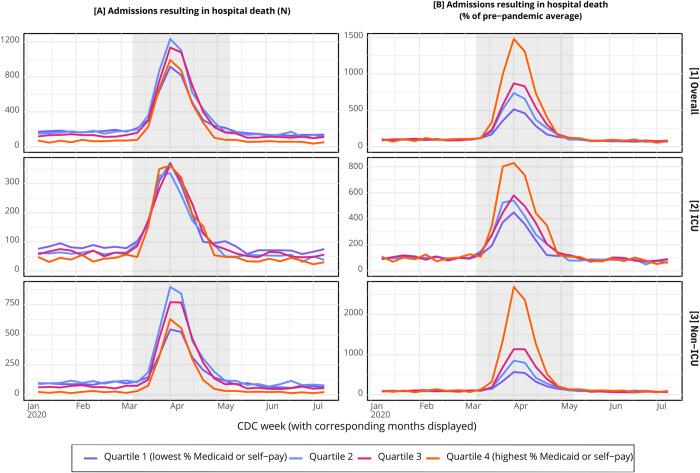
In a retrospective analysis of all-payer NYC hospital discharge data, we examined changes in admissions, stratified by use of intensive care unit (ICU), from the baseline period in early 2020 to the first COVID-19 wave across hospital quartiles (265,329 admissions), and crude and risk-adjusted inpatient mortality rates, also stratified by ICU use, in the first COVID wave across hospital quartiles (23,032 inpatient deaths), based on the proportion of Medicaid or uninsured admissions from 2017-2019 (quartile 1 lowest to 4 highest). Logistic regressions were used to assess the cross-sectional association between ICU strain, defined as ICU volume in excess of the baseline average, and patient-level mortality.
RESULTS
ICU admissions in the first COVID-19 wave were 84%, 97%, 108%, and 123% of the baseline levels by hospital quartile 1-4, respectively. The risk-adjusted mortality rates for ICU admissions were 36.4 (CI = 34.7,38.2), 43.6 (CI = 41.5,45.8), 45.9 (CI = 43.8,48.1), and 45.7 (CI = 43.6,48.0) per 100 admissions, and those for non-ICU admissions were 8.6 (CI = 8.3,9.0), 10.9 (CI = 10.6,11.3), 12.6 (CI = 12.1,13.0), and 12.1 (CI = 11.6,12.7) per 100 admissions by hospital quartile 1-4, respectively. Compared with the reference group of 100% or less of the baseline weekly average, ICU admissions on a day for which the ICU volume was 101-150%, 151-200%, and > 200% of the baseline weekly average had odds ratios of 1.17 (95% CI = 1.10, 1.26), 2.63 (95% CI = 2.31, 3.00), and 3.26 (95% CI = 2.82, 3.78) for inpatient mortality, and non-ICU admissions on a day for which the ICU volume was 101-150%, 151-200%, and > 200% of the baseline weekly average had odds ratios of 1.28 (95% CI = 1.22, 1.34), 2.60 (95% CI = 2.40, 2.82), and 3.44 (95% CI = 3.11, 3.63) for inpatient mortality.
CONCLUSIONS
Our findings are consistent with hospital segregation as a potential driver of COVID-related mortality inequities and highlight the need to desegregate health care to address structural racism, advance health equity, and improve pandemic resiliency.
背景
医院按种族、族裔和医疗保险覆盖范围进行隔离很常见,有些医院提供不成比例的低补偿医疗服务。我们评估了在大流行前,纽约市(NYC)为更多医疗补助和无保险患者服务的医院在 COVID-19 大流行的第一波中是否经历了更大的重症监护压力,以及这种更大的压力是否与更高的住院死亡率有关。
方法
在对所有支付方的 NYC 医院出院数据进行回顾性分析中,我们检查了从 2020 年初基线期到 COVID-19 第一波期间,按 ICU 使用情况分层的入院人数变化(265329 例入院),以及 ICU 使用情况分层的第一波 COVID 中的住院死亡率(23032 例住院死亡),住院死亡率按 2017-2019 年医疗补助或无保险入院比例(第 1 四分位最低,第 4 四分位最高)分层。使用逻辑回归评估 ICU 压力(定义为 ICU 量超过基线平均值)与患者水平死亡率之间的横断面关联。
结果
第 1-4 四分位数医院 ICU 入院人数分别为基线水平的 84%、97%、108%和 123%。ICU 入院患者的风险调整死亡率分别为 36.4(95%CI=34.7,38.2)、43.6(95%CI=41.5,45.8)、45.9(95%CI=43.8,48.1)和 45.7(95%CI=43.6,48.0)每 100 例入院,非 ICU 入院患者的死亡率分别为 8.6(95%CI=8.3,9.0)、10.9(95%CI=10.6,11.3)、12.6(95%CI=12.1,13.0)和 12.1(95%CI=11.6,12.7)每 100 例入院。与每周 ICU 平均量 100%或以下的参考组相比,ICU 量为每周 ICU 平均量的 101%-150%、151%-200%和>200%的那一天的 ICU 入院患者的住院死亡率的比值比分别为 1.17(95%CI=1.10,1.26)、2.63(95%CI=2.31,3.00)和 3.26(95%CI=2.82,3.78),ICU 量为每周 ICU 平均量的 101%-150%、151%-200%和>200%的那一天的非 ICU 入院患者的住院死亡率的比值比分别为 1.28(95%CI=1.22,1.34)、2.60(95%CI=2.40,2.82)和 3.44(95%CI=3.11,3.63)。
结论
我们的研究结果与医院隔离是 COVID 相关死亡率不平等的潜在驱动因素一致,并强调需要消除医疗保健隔离,以解决结构性种族主义,促进健康公平,并提高大流行的弹性。

 Zotero 插件