
血浆半乳糖凝集素-9与经垂直传播感染 HIV 的青少年的认知表现和炎症相关。
Plasma galectin-9 relates to cognitive performance and inflammation among adolescents with vertically acquired HIV.
机构信息
Division of Infectious Diseases, Department of Medicine, Weill Cornell Medicine, New York, USA.
Department of Pediatrics, Yangon Children's Hospital, University of Medicine 1, Yangon, Myanmar.
出版信息
AIDS. 2024 Aug 1;38(10):1460-1467. doi: 10.1097/QAD.0000000000003907. Epub 2024 Apr 26.
OBJECTIVE
Adolescents with perinatally acquired HIV (AWH) are at an increased risk of poor cognitive development yet the underlying mechanisms remain unclear. Circulating galectin-9 (Gal-9) has been associated with increased inflammation and multimorbidity in adults with HIV despite antiretroviral therapy (ART); however, the relationship between Gal-9 in AWH and cognition remain unexplored.
DESIGN
A cross-sectional study of two independent age-matched cohorts from India [AWH on ART ( n = 15), ART-naive ( n = 15), and adolescents without HIV (AWOH; n = 10)] and Myanmar [AWH on ART ( n = 54) and AWOH ( n = 22)] were studied. Adolescents from Myanmar underwent standardized cognitive tests.
METHODS
Plasma Gal-9 and soluble mediators were measured by immunoassays and cellular immune markers by flow cytometry. We used Mann-Whitney U tests to determine group-wise differences, Spearman's correlation for associations and machine learning to identify a classifier of cognitive status (impaired vs. unimpaired) built from clinical (age, sex, HIV status) and immunological markers.
RESULTS
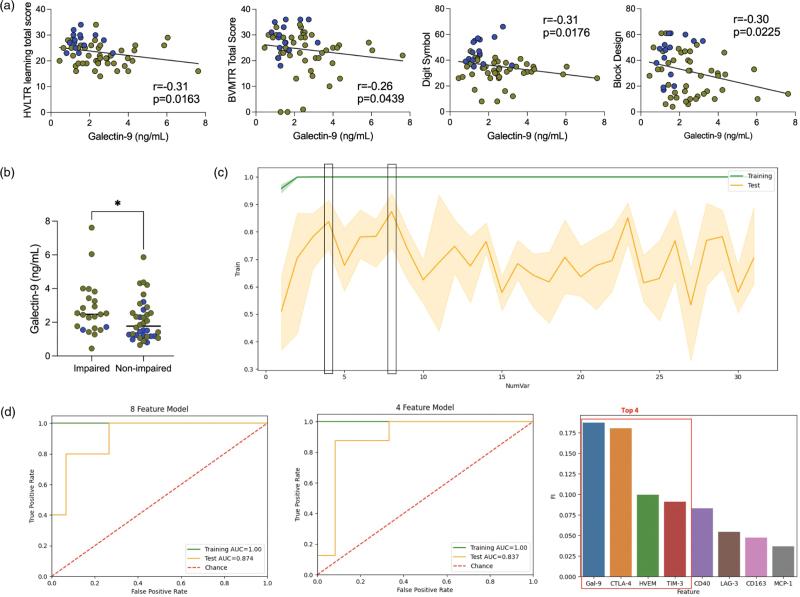
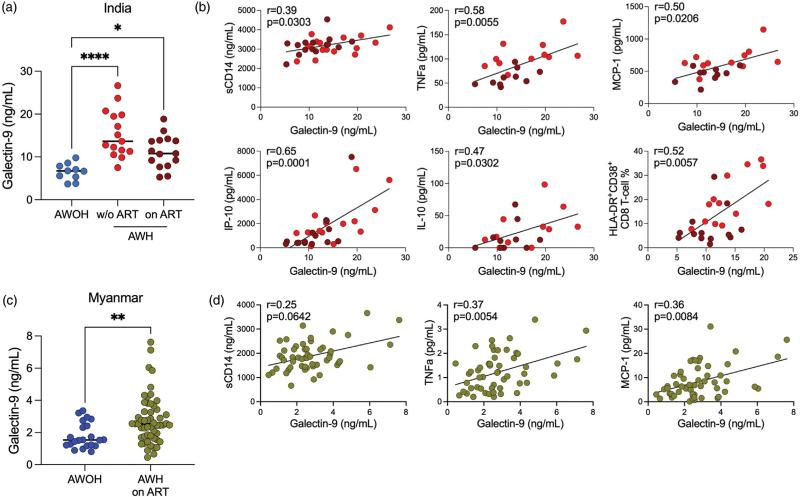
Gal-9 levels were elevated in ART-treated AWH compared with AWOH in both cohorts (all P < 0.05). Higher Gal-9 in AWH correlated with increased levels of inflammatory mediators (sCD14, TNFα, MCP-1, IP-10, IL-10) and activated CD8 + T cells (all P < 0.05). Irrespective of HIV status, higher Gal-9 levels correlated with lower cognitive test scores in multiple domains [verbal learning, visuospatial learning, memory, motor skills (all P < 0.05)]. ML classification identified Gal-9, CTLA-4, HVEM, and TIM-3 as significant predictors of cognitive deficits in adolescents [mean area under the curve (AUC) = 0.837].
CONCLUSION
Our results highlight a potential role of Gal-9 as a biomarker of inflammation and cognitive health among adolescents with perinatally acquired HIV.
目的
先天感染 HIV 的青少年(AWH)认知发育不良的风险增加,但潜在机制尚不清楚。尽管接受了抗逆转录病毒治疗(ART),但循环中的半乳糖凝集素-9(Gal-9)与 HIV 成人患者的炎症反应和多种合并症有关;然而,在 AWH 中 Gal-9 与认知之间的关系尚未得到探索。
设计
本研究为一项横断面研究,纳入了来自印度的两个独立年龄匹配队列的青少年(接受 ART 的 AWH [ n = 15]、未经 ART 治疗的 AWH [ n = 15]和无 HIV 的青少年 [ n = 10])和缅甸的 AWH [接受 ART 的 AWH [ n = 54]和无 HIV 的青少年 [ n = 22])。缅甸的青少年接受了标准化的认知测试。
方法
通过免疫测定法测量血浆 Gal-9 和可溶性介质,通过流式细胞术测量细胞免疫标志物。我们使用曼-惠特尼 U 检验来确定组间差异,使用斯皮尔曼相关性分析来确定关联,使用机器学习来构建基于临床(年龄、性别、HIV 状态)和免疫标志物的认知状态(受损与未受损)分类器。
结果
两个队列中,接受 ART 治疗的 AWH 的 Gal-9 水平均高于无 HIV 的青少年(均 P < 0.05)。在 AWH 中,Gal-9 水平升高与炎症介质(sCD14、TNFα、MCP-1、IP-10、IL-10)和激活的 CD8 + T 细胞水平升高相关(均 P < 0.05)。无论 HIV 状态如何,Gal-9 水平升高与多个认知测试领域(语言学习、视觉空间学习、记忆、运动技能)的认知测试分数降低相关(均 P < 0.05)。ML 分类确定 Gal-9、CTLA-4、HVEM 和 TIM-3 是青少年认知缺陷的重要预测因子[平均曲线下面积(AUC)为 0.837]。
结论
我们的研究结果突出了 Gal-9 作为先天感染 HIV 的青少年炎症和认知健康的潜在生物标志物的作用。
 Zotero 插件