
基于液相色谱-质谱联用的非靶向代谢组学和电子舌测定不同品种菊花(菊华)茶的代谢谱和感官品质的显著变化
Distinct Changes in Metabolic Profile and Sensory Quality with Different Varieties of (Juhua) Tea Measured by LC-MS-Based Untargeted Metabolomics and Electronic Tongue.
作者信息
Tian Xing, Wang Haodong, Chen Liang, Yuan Hanwen, Peng Caiyun, Wang Wei
机构信息
TCM and Ethnomedicine Innovation & Development International Laboratory, Innovative Material Medical Research Institute, School of Pharmacy, Hunan University of Chinese Medicine, Changsha 410208, China.
Department of Food and Drug Engineering, School of Pharmacy, Hunan University of Chinese Medicine, Changsha 410208, China.
出版信息
Foods. 2024 Apr 1;13(7):1080. doi: 10.3390/foods13071080.
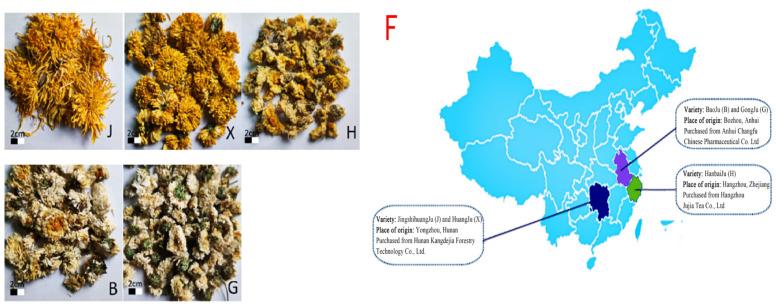
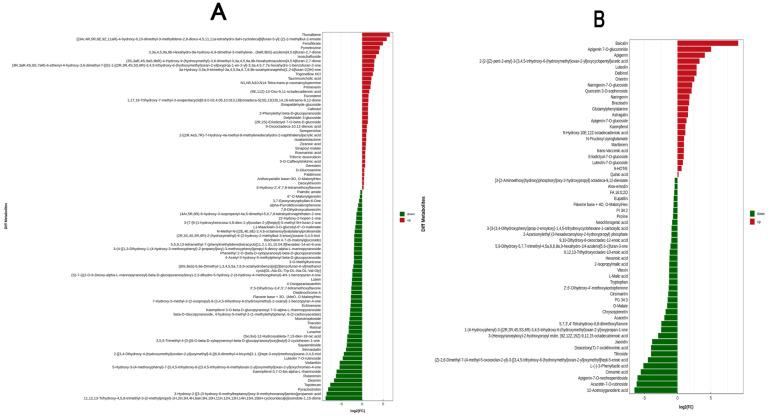
tea, a typical health tea with the same origin as medicine and food, is famous for its unique health benefits and flavor. The taste and sensory quality of (Juhua) tea are mainly determined by secondary metabolites. Therefore, the present research adopted untargeted metabolomics combined with an electronic tongue system to analyze the correlation between the metabolite profiles and taste characteristics of different varieties of tea. The results of sensory evaluation showed that there were significant differences in the sensory qualities of five different varieties of tea, especially bitterness and astringency. The results of principal component analysis (PCA) indicated that there were significant metabolic differences among the five teas. A total of 1775 metabolites were identified by using untargeted metabolomics based on UPLC-Q-TOF/MS analysis. According to the variable importance in projection (VIP) values of the orthogonal projections to latent structures discriminant analysis (OPLS-DA), 143 VIP metabolites were found to be responsible for metabolic changes between Huangju and Jinsi Huangju tea; among them, 13 metabolites were identified as the key metabolites of the differences in sensory quality between them. Kaempferol, luteolin, genistein, and some quinic acid derivatives were correlated with the "astringency" attributes. In contrast, l-(-)-3 phenyllactic acid and L-malic acid were found to be responsible for the "bitterness" and "umami" attributes in tea. Kyoto Encyclopedia of Genes and Genomes pathway enrichment analysis showed that the flavonoid and flavonol biosynthesis pathways had important effects on the sensory quality of tea. These findings provide the theoretical basis for understanding the characteristic metabolites that contribute to the distinctive sensory qualities of tea.
茶,一种与药食同源的典型保健茶,以其独特的保健功效和风味而闻名。(菊花)茶的口感和感官品质主要由次生代谢产物决定。因此,本研究采用非靶向代谢组学结合电子舌系统,分析不同品种茶的代谢物谱与口感特征之间的相关性。感官评价结果表明,五种不同品种的茶在感官品质上存在显著差异,尤其是苦味和涩味。主成分分析(PCA)结果表明,五种茶之间存在显著的代谢差异。基于超高效液相色谱-四极杆飞行时间质谱(UPLC-Q-TOF/MS)分析的非靶向代谢组学共鉴定出1775种代谢物。根据正交投影到潜在结构判别分析(OPLS-DA)的变量重要性投影(VIP)值,发现143种VIP代谢物是导致黄菊茶和金丝皇菊茶之间代谢变化的原因;其中,13种代谢物被确定为它们感官品质差异的关键代谢物。山奈酚、木犀草素、染料木黄酮和一些奎尼酸衍生物与“涩味”属性相关。相比之下,l-(-)-3-苯乳酸和L-苹果酸被发现是茶中“苦味”和“鲜味”属性的原因。京都基因与基因组百科全书(KEGG)通路富集分析表明,黄酮类和黄酮醇生物合成途径对茶的感官品质有重要影响。这些发现为理解有助于茶独特感官品质的特征代谢物提供了理论依据。



 Zotero 插件