
利用肉桂提取物合成金簇和纳米颗粒——机理与动力学研究
Synthesis of Gold Clusters and Nanoparticles Using Cinnamon Extract-A Mechanism and Kinetics Study.
作者信息
Luty-Błocho Magdalena, Cyndrowska Jowita, Rutkowski Bogdan, Hessel Volker
机构信息
AGH University of Krakow, Faculty of Non-Ferrous Metals, al. A. Mickiewicza 30, 30-059 Krakow, Poland.
AGH University of Krakow, Faculty of Metals Engineering and Industrial Computer Science, al. A. Mickiewicza 30, 30-059 Krakow, Poland.
出版信息
Molecules. 2024 Mar 22;29(7):1426. doi: 10.3390/molecules29071426.
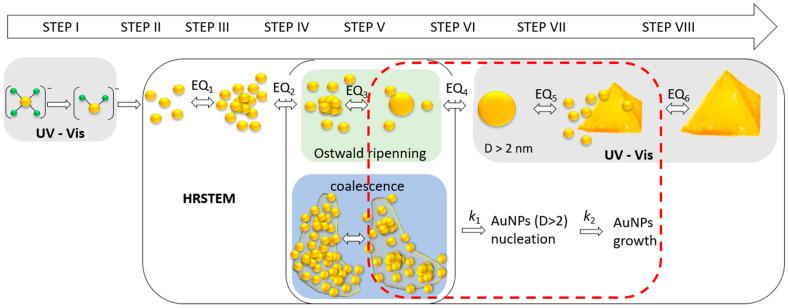
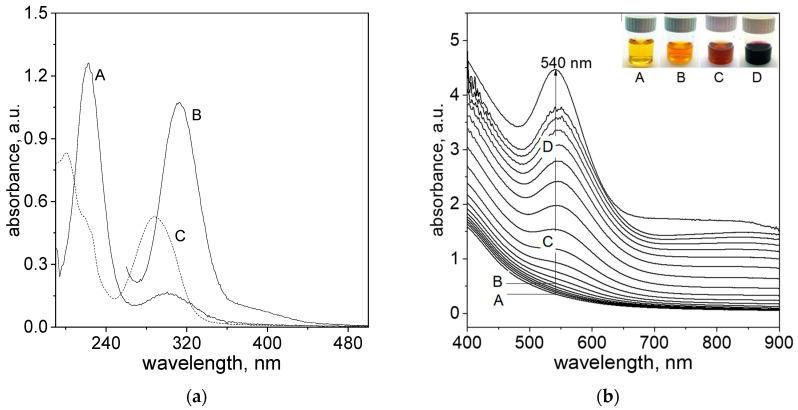
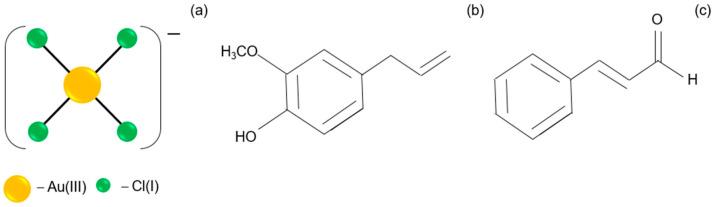
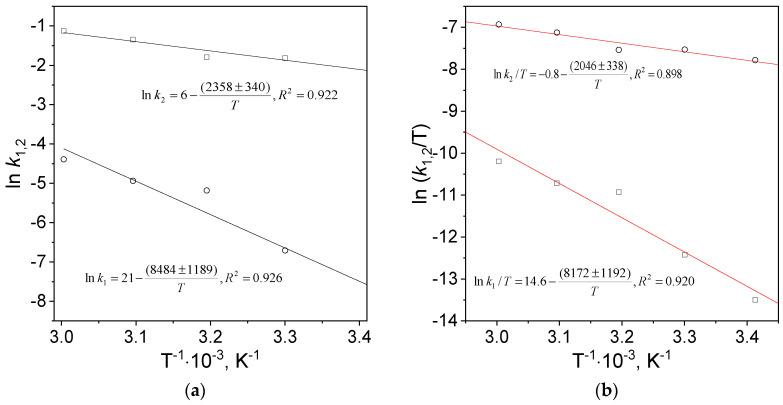
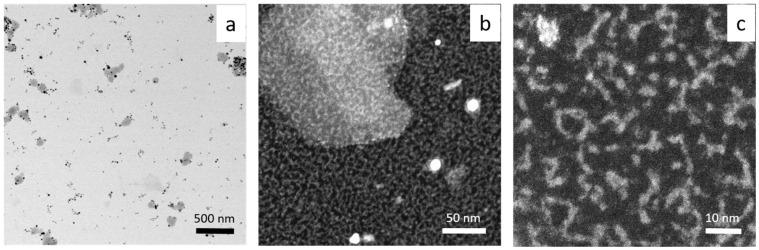
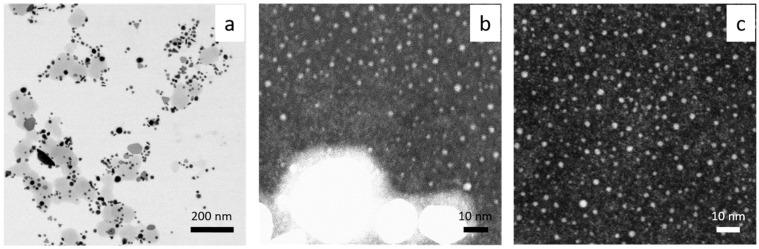
In this work, UV-Vis spectrophotometry, High Resolution Scanning Transmission Electron Microscopes and selected experimental conditions were used to screen the colloidal system. The obtained results complement the established knowledge regarding the mechanism of nanoparticle formation. The process of gold nanoparticles formation involves a two-step reduction of Au ions to Au(0); atom association and metastable cluster formation; autocatalytic cluster growth; ultra-small particle formation (1-2 nm, in diameter); particle growth and larger particles formation; and further autocatalytic crystal growth (D > 100 nm). As a reductant of Au(III) ions, a cinnamon extract was used. It was confirmed that eugenol as one of the cinnamon extract compounds is responsible for fast Au(III) ion reduction, whereas cinnamaldehyde acts as a gold-particle stabilizer. Spectrophotometry studies were carried out to track kinetic traces of gold nanoparticle (D > 2 nm) formation in the colloidal solution. Using the Watzky-Finke model, the rate constants of nucleation and autocatalytic growth were determined. Moreover, the values of energy, enthalpy and entropy of activation for stages related to the process of nanoparticle formation (Index 1 relates to nucleation, and Index 2 relates to the growth) were determined and found to be E = 70.6 kJ, E = 19.6 kJ, ΔH = 67.9 kJ/mol, ΔH = 17 kJ/mol, ΔS = -76.2 J/(K·mol), ΔS = -204.2 J/(K·mol), respectively. In this work the limitation of each technique (spectrophotometry vs. HRSTEM) as a complex tool to understand the dynamic of the colloidal system was discussed.
在本研究中,采用紫外-可见分光光度法、高分辨率扫描透射电子显微镜以及选定的实验条件来筛选胶体体系。所得结果补充了关于纳米颗粒形成机制的既有知识。金纳米颗粒的形成过程包括将金离子两步还原为Au(0);原子缔合和亚稳簇形成;自催化簇生长;超小颗粒形成(直径1 - 2 nm);颗粒生长和较大颗粒形成;以及进一步的自催化晶体生长(D > 100 nm)。作为Au(III)离子的还原剂,使用了肉桂提取物。已证实,作为肉桂提取物化合物之一的丁香酚负责快速还原Au(III)离子,而肉桂醛则充当金颗粒稳定剂。进行分光光度法研究以追踪胶体溶液中金纳米颗粒(D > 2 nm)形成的动力学轨迹。使用Watzky-Finke模型,确定了成核和自催化生长的速率常数。此外,还确定了与纳米颗粒形成过程相关阶段(索引1与成核相关,索引2与生长相关)的活化能、焓和熵值,分别为E = 70.6 kJ、E = 19.6 kJ、ΔH = 67.9 kJ/mol、ΔH = 17 kJ/mol、ΔS = -76.2 J/(K·mol)、ΔS = -204.2 J/(K·mol)。在本研究中,讨论了每种技术(分光光度法与高分辨率扫描透射电子显微镜)作为理解胶体体系动态的复杂工具的局限性。




 Zotero 插件