
管理癌症患儿食源性感染的风险:粒细胞减少症饮食仍是一种选择吗?
Managing the Risk of Foodborne Infections in Pediatric Patients with Cancer: Is the Neutropenic Diet Still an Option?
机构信息
Pediatric Clinic, University Hospital, Department of Medicine and Surgery, University of Parma, 43126 Parma, Italy.
Pediatric Hematology and Oncology, IRCCS Azienda Ospedaliero-Universitaria di Bologna, 40138 Bologna, Italy.
出版信息
Nutrients. 2024 Mar 27;16(7):966. doi: 10.3390/nu16070966.
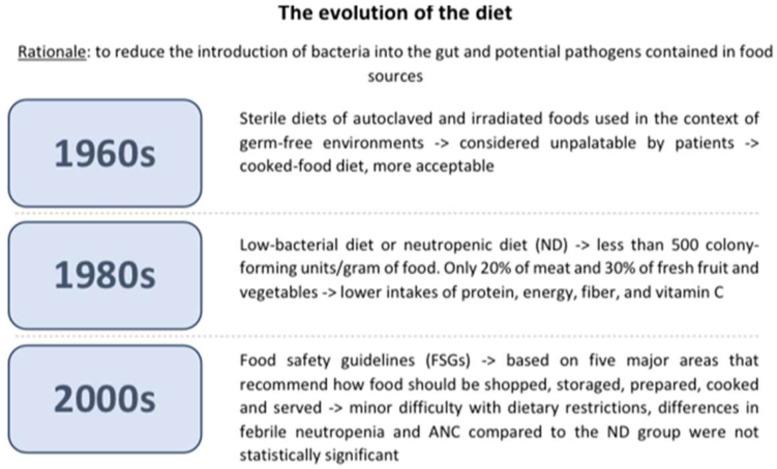
Infections pose a significant threat to morbidity and mortality during treatments for pediatric cancer patients. Efforts to minimize the risk of infection necessitate preventive measures encompassing both environmental and host-focused strategies. While a substantial number of infections in oncologic patients originate from microorganisms within their native microbiological environment, such as the oral cavity, intestines, and skin, the concrete risk of bloodstream infections linked to the consumption of contaminated food and beverages in the community cannot be overlooked. Ensuring food quality and hygiene is essential to mitigating the impact of foodborne illnesses on vulnerable patients. The neutropenic diet (ND) has been proposed to minimize the risk of sepsis during neutropenic periods. The ND aims to minimize bacterial entry into the gut and bacterial translocation. However, a standardized definition for ND and consensus guidelines for specific food exclusions are lacking. Most centers adopt ND during neutropenic phases, but challenges in achieving caloric intake are common. The ND has not demonstrated any associated benefits and does not ensure improved overall survival. Consequently, providing unified and standardized food safety instructions is imperative for pediatric patients undergoing hematopoietic cell transplantation (HCT). Despite the lack of evidence, ND is still widely administered to both pediatric and adult patients as a precautionary measure. This narrative review focuses on the impact of foodborne infections in pediatric cancer patients and the role of the ND in comparison to food safety practices in patients undergoing chemotherapy or HCT. Prioritizing education regarding proper food storage, preparation, and cooking techniques proves more advantageous than merely focusing on dietary limitations. The absence of standardized guidelines underscores the necessity for further research in this field.
在儿科癌症患者的治疗过程中,感染对发病率和死亡率构成了重大威胁。为了最大限度地降低感染风险,需要采取预防措施,包括环境和宿主为重点的策略。虽然肿瘤患者的大量感染源自其原生微生物环境中的微生物,如口腔、肠道和皮肤,但不能忽视与社区中受污染的食物和饮料摄入相关的血流感染的具体风险。确保食物质量和卫生对于减轻食源性疾病对脆弱患者的影响至关重要。中性粒细胞减少症饮食(ND)已被提出用于最大限度地降低中性粒细胞减少期败血症的风险。ND 的目的是尽量减少细菌进入肠道和细菌易位。然而,缺乏 ND 的标准化定义和特定食物排除的共识指南。大多数中心在中性粒细胞减少期采用 ND,但实现热量摄入的挑战很常见。ND 并没有显示出任何相关的益处,也不能确保整体生存率的提高。因此,为接受造血细胞移植(HCT)的儿科患者提供统一和标准化的食品安全说明至关重要。尽管缺乏证据,但 ND 仍被广泛用于儿科和成年患者作为预防措施。本叙述性综述重点关注食源性感染对儿科癌症患者的影响以及 ND 与接受化疗或 HCT 的患者的食品安全实践的比较。优先考虑有关正确食物储存、准备和烹饪技术的教育,比仅仅关注饮食限制更有利。缺乏标准化指南突显出该领域进一步研究的必要性。
 Zotero 插件