
感知运动轨迹的后效应。
Aftereffect of perceived motion trajectories.
作者信息
Nakayama Ryohei, Tanaka Mai, Kishi Yukino, Murakami Ikuya
机构信息
Department of Psychology, The University of Tokyo, 7-3-1 Hongo, Bunkyo-ku 113-0033, Tokyo, Japan.
出版信息
iScience. 2024 Mar 28;27(4):109626. doi: 10.1016/j.isci.2024.109626. eCollection 2024 Apr 19.
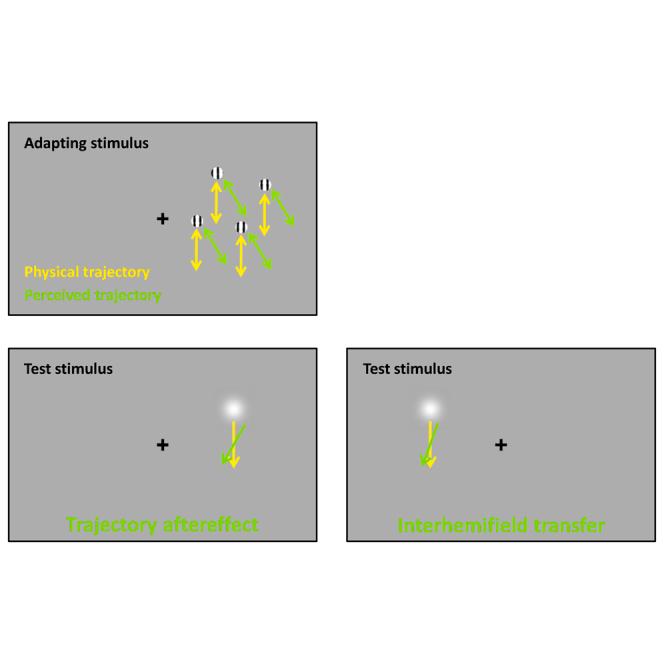
If our visual system has a distinct computational process for motion trajectories, such a process may minimize redundancy and emphasize variation in object trajectories by adapting to the current statistics. Our experiments show that after adaptation to multiple objects traveling along trajectories with a common tilt, the trajectory of an object was perceived as tilting on the repulsive side. This trajectory aftereffect occurred irrespective of whether the tilt of the adapting stimulus was physical or an illusion from motion-induced position shifts and did not differ in size across the physical and illusory conditions. Moreover, when the perceived and physical tilts competed during adaptation, the trajectory aftereffect depended on the perceived tilt. The trajectory aftereffect transferred between hemifields and was not explained by motion-insensitive orientation adaptation or attention. These findings provide evidence for a trajectory-specific adaptable process that depends on higher-order representations after the integration of position and motion signals.
如果我们的视觉系统对运动轨迹有独特的计算过程,这样的过程可能会通过适应当前统计数据来最小化冗余并强调物体轨迹的变化。我们的实验表明,在适应多个沿具有共同倾斜度的轨迹移动的物体后,一个物体的轨迹会被感知为向排斥侧倾斜。无论适应刺激的倾斜是物理性的还是由运动诱导的位置偏移产生的错觉,这种轨迹后效都会出现,并且在物理和错觉条件下其大小没有差异。此外,当在适应过程中感知到的倾斜和物理倾斜相互竞争时,轨迹后效取决于感知到的倾斜。轨迹后效会在半视野之间转移,并且不能用对运动不敏感的方向适应或注意力来解释。这些发现为一种特定于轨迹的可适应过程提供了证据,该过程依赖于位置和运动信号整合后的高阶表征。



 Zotero 插件