
末次盛冰期模式效应降低了气候敏感性估计值。
Last Glacial Maximum pattern effects reduce climate sensitivity estimates.
作者信息
Cooper Vincent T, Armour Kyle C, Hakim Gregory J, Tierney Jessica E, Osman Matthew B, Proistosescu Cristian, Dong Yue, Burls Natalie J, Andrews Timothy, Amrhein Daniel E, Zhu Jiang, Dong Wenhao, Ming Yi, Chmielowiec Philip
机构信息
Department of Atmospheric Sciences, University of Washington, Seattle, WA, USA.
School of Oceanography, University of Washington, Seattle, WA, USA.
出版信息
Sci Adv. 2024 Apr 19;10(16):eadk9461. doi: 10.1126/sciadv.adk9461. Epub 2024 Apr 17.
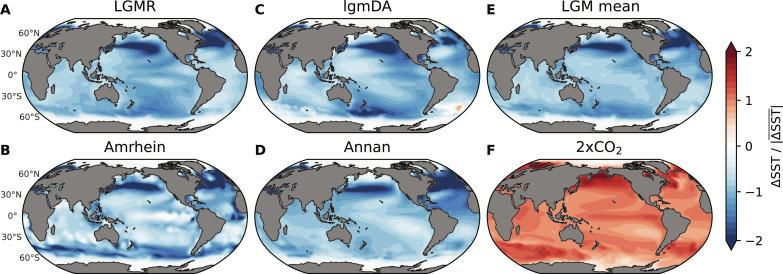
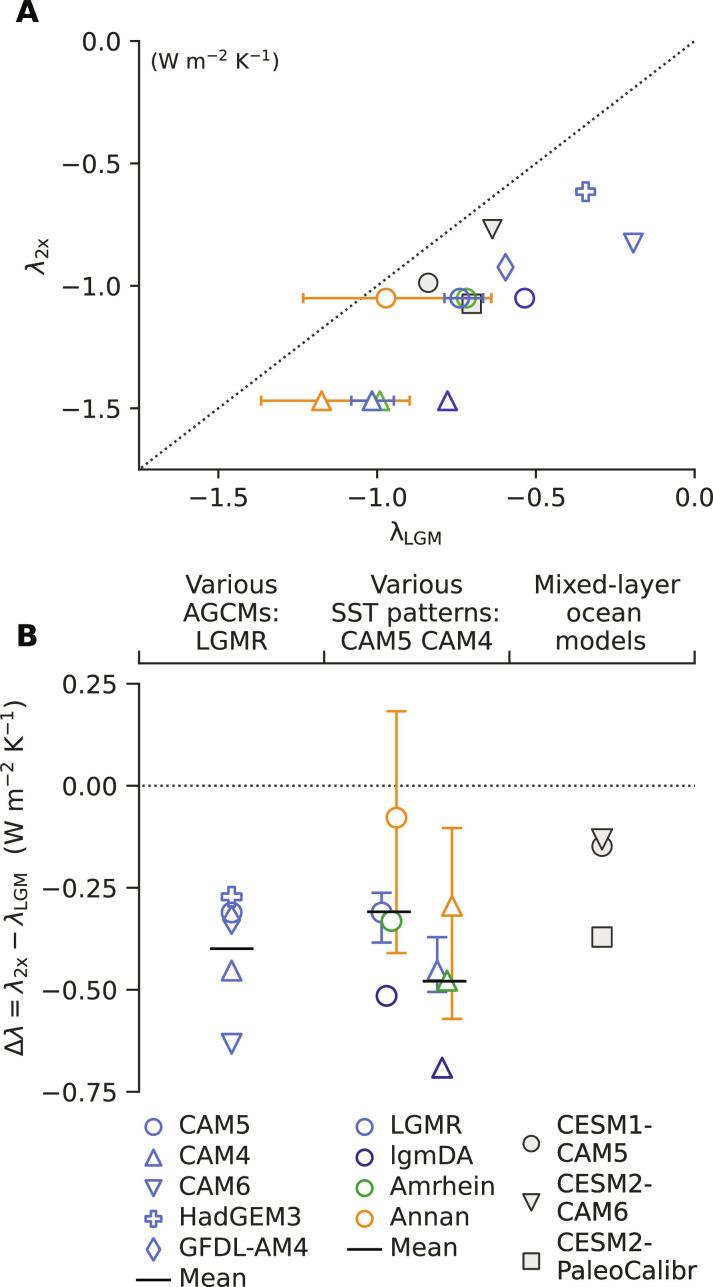
Here, we show that the Last Glacial Maximum (LGM) provides a stronger constraint on equilibrium climate sensitivity (ECS), the global warming from increasing greenhouse gases, after accounting for temperature patterns. Feedbacks governing ECS depend on spatial patterns of surface temperature ("pattern effects"); hence, using the LGM to constrain future warming requires quantifying how temperature patterns produce different feedbacks during LGM cooling versus modern-day warming. Combining data assimilation reconstructions with atmospheric models, we show that the climate is more sensitive to LGM forcing because ice sheets amplify extratropical cooling where feedbacks are destabilizing. Accounting for LGM pattern effects yields a median modern-day ECS of 2.4°C, 66% range 1.7° to 3.5°C (1.4° to 5.0°C, 5 to 95%), from LGM evidence alone. Combining the LGM with other lines of evidence, the best estimate becomes 2.9°C, 66% range 2.4° to 3.5°C (2.1° to 4.1°C, 5 to 95%), substantially narrowing uncertainty compared to recent assessments.
在此,我们表明,在考虑温度模式之后,末次盛冰期(LGM)对平衡气候敏感性(ECS)——即温室气体增加导致的全球变暖——施加了更强的限制。控制ECS的反馈取决于地表温度的空间模式(“模式效应”);因此,利用末次盛冰期来限制未来变暖需要量化温度模式在末次盛冰期降温与现代变暖过程中如何产生不同的反馈。将数据同化重建与大气模型相结合,我们发现气候对末次盛冰期强迫更为敏感,因为冰盖会放大温带地区的降温,而这种反馈是不稳定的。仅根据末次盛冰期的证据,考虑到末次盛冰期的模式效应,现代ECS的中位数为2.4°C,66%的范围是1.7°至3.5°C(1.4°至5.0°C,5%至95%)。将末次盛冰期的证据与其他证据相结合,最佳估计值变为2.9°C,66%的范围是2.4°至3.5°C(2.1°至4.1°C,5%至95%),与近期评估相比,不确定性大幅降低。


 Zotero 插件