
老年人在中低收入国家获得初级卫生保健的情况:系统范围审查。
Access of older people to primary health care in low and middle-income countries: A systematic scoping review.
机构信息
School of Nursing, Midwifery, and Health Systems, University College Dublin, Dublin, Ireland.
Library, University College Dublin, Dublin, Ireland.
出版信息
PLoS One. 2024 Apr 19;19(4):e0298973. doi: 10.1371/journal.pone.0298973. eCollection 2024.
INTRODUCTION
Ensuring access for older people to Primary Health Care (PHC) is vital to achieve universal health coverage, improve health outcomes, and health-system performance. However, older people living in Low-and Middle-Income Countries (LMICs) face barriers constraining their timely access to appropriate care. This review aims to summarize the nature and breadth of literature examining older people's experiences with access to PHC in LMICs, and access barriers and enablers.
METHODS
Guided by Arksey and O'Malley's framework, four databases [CINAHL, Cochrane, PubMed, and Embase] were systematically searched for all types of peer-reviewed articles published between 2002 and 2023, in any language but with English or French abstract. Gray literature presenting empirical data was also included by searching the United Nations, World Health Organization, and HelpAge websites. Data were independently screened and extracted.
RESULTS
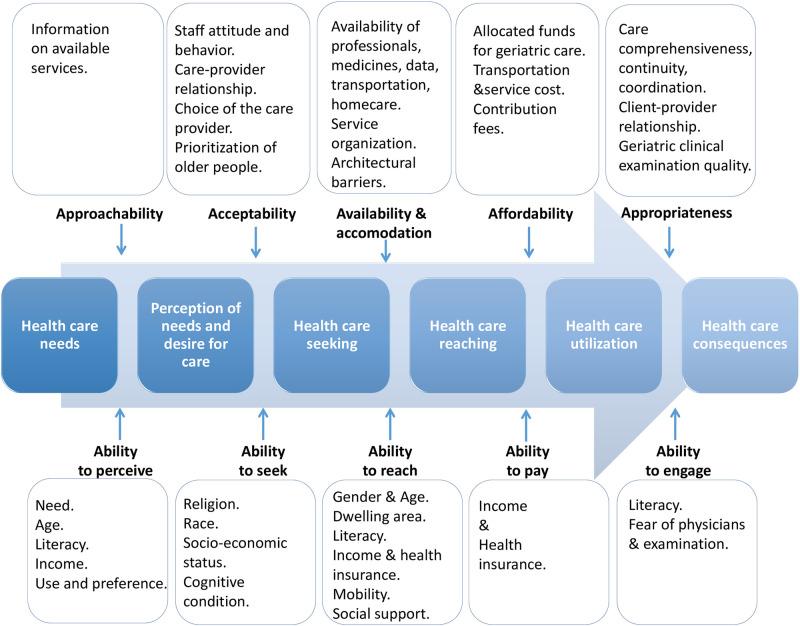
Of 1165 identified records, 30 are included. Data were generated mostly in Brazil (50%) and through studies adopting quantitative designs (80%). Older people's experiences varied across countries and were shaped by several access barriers and enablers classified according to the Patient-Centered Access to Healthcare framework, featuring the characteristics of the care delivery system at the supply side and older people's attributes from the demand side. The review identifies that most access barriers and enablers pertain to the availability and accommodation dimension, followed by the appropriateness, affordability, acceptability, and approachability of services. Socio-economic level and need perception were the most reported characteristics that affected older people's access to PHC.
CONCLUSIONS
Older people's experiences with PHC access varied according to local contexts, socioeconomic variables, and the provision of public or private health services. Results inform policymakers and PHC practitioners to generate policies and services that are evidence-based and responsive to older people's needs. Identified knowledge gaps highlight the need for research to further understand older people's access to PHC in different LMICs.
引言
确保老年人能够获得初级卫生保健(PHC)对于实现全民健康覆盖、改善健康结果和卫生系统绩效至关重要。然而,生活在中低收入国家(LMICs)的老年人在及时获得适当护理方面面临着各种限制。本综述旨在总结探讨 LMICs 中老年人获得 PHC 的体验、以及获得途径的障碍和促进因素的文献的性质和广度。
方法
根据 Arksey 和 O'Malley 的框架,系统地检索了四个数据库[CINAHL、Cochrane、PubMed 和 Embase],以获取 2002 年至 2023 年间发表的所有类型的同行评议文章,语言不限,但需有英文或法文摘要。还通过搜索联合国、世界卫生组织和 HelpAge 网站,纳入呈现实证数据的灰色文献。数据由两位独立筛选和提取。
结果
在 1165 条记录中,有 30 条被纳入。数据主要来自巴西(50%),且采用定量设计的研究(80%)。各国老年人的体验各不相同,受到多种获得途径的障碍和促进因素的影响,这些障碍和促进因素根据以患者为中心的医疗保健获得框架进行分类,其特征是供应方的医疗服务提供系统的特点和需求方老年人的特点。综述发现,大多数获得途径的障碍和促进因素与服务的可及性和包容性维度有关,其次是服务的适宜性、可负担性、可接受性和可及性。社会经济地位和需求认知是影响老年人获得 PHC 的最常见特征。
结论
老年人获得 PHC 的体验因当地背景、社会经济变量以及公共或私人卫生服务的提供而有所不同。研究结果为政策制定者和 PHC 从业者提供了信息,以制定基于证据且能满足老年人需求的政策和服务。确定的知识空白突显了在不同 LMICs 中进一步了解老年人获得 PHC 的必要性。


 Zotero 插件