
罗马 III 标准捕捉到更高的肠易激综合征 SNP 遗传性,并强调了与心血管特征的新的遗传联系。
Rome III Criteria Capture Higher Irritable Bowel Syndrome SNP-Heritability and Highlight a Novel Genetic Link With Cardiovascular Traits.
机构信息
School of Biological Sciences, Monash University, Clayton, Australia.
Department of Genetics, University of Groningen, University Medical Center Groningen, Groningen, the Netherlands.
出版信息
Cell Mol Gastroenterol Hepatol. 2024;18(2):101345. doi: 10.1016/j.jcmgh.2024.04.002. Epub 2024 Apr 19.
BACKGROUND & AIMS: Irritable bowel syndrome (IBS) shows genetic predisposition, and large-scale genome-wide association studies (GWAS) are emerging, based on heterogeneous disease definitions. We investigated the genetic architecture of IBS defined according to gold standard Rome Criteria.
METHODS
We conducted GWAS meta-analyses of Rome III IBS and its subtypes in 24,735 IBS cases and 77,149 asymptomatic control subjects from 2 independent European cohorts (UK Biobank and Lifelines). Single-nucleotide polymorphism (SNP)-based heritability (h) and genetic correlations (r) with other traits were calculated. IBS risk loci were functionally annotated to identify candidate genes. Sensitivity and conditional analyses were conducted to assess impact of confounders. Polygenic risk scores were computed and tested in independent datasets.
RESULTS
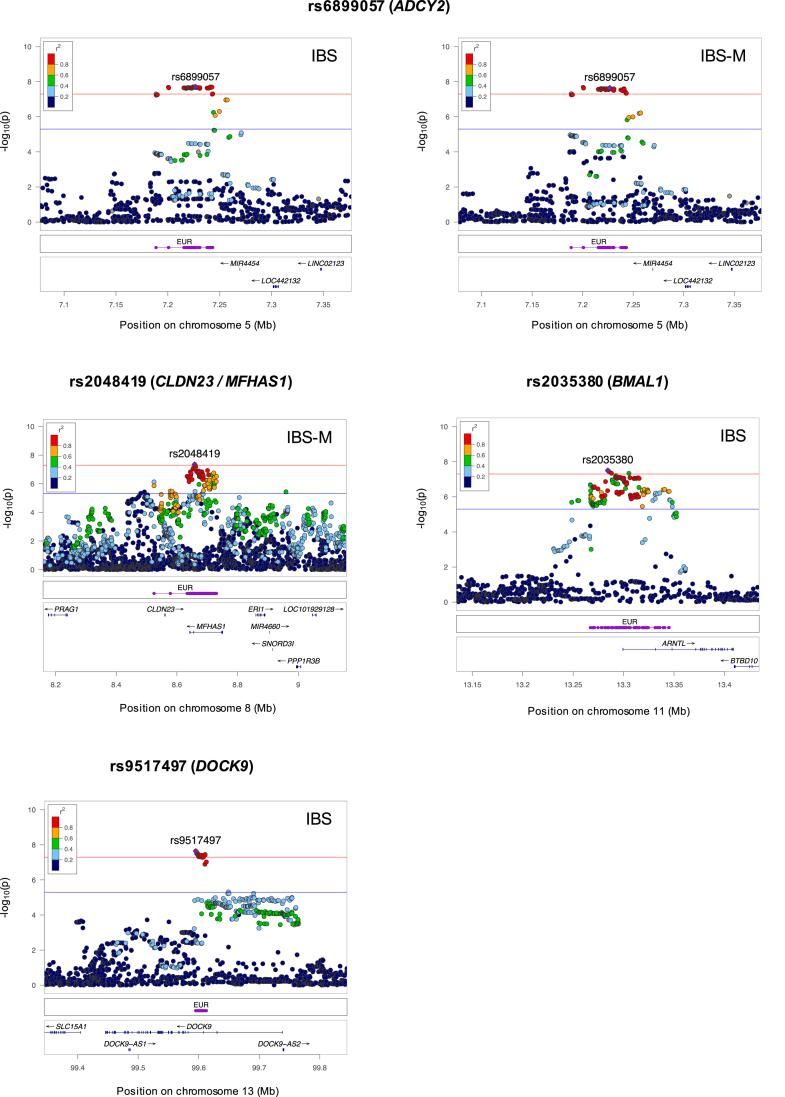
Rome III IBS showed significant SNP-heritability (up to 13%) and similar genetic architecture across subtypes, including those with manifestations at the opposite ends of the symptom spectrum (r = 0.48 between IBS-D and IBS-C). Genetic correlations with other traits highlighted commonalities with family history of heart disease and hypertension, coronary artery disease, and angina pectoris (r = 0.20-0.45), among others. Four independent GWAS signals (P < 5×10) were detected, including 2 novel loci for IBS (rs2035380) and IBS-mixed (rs2048419) that had been previously associated with hypertension and coronary artery disease. Functional annotation of GWAS risk loci revealed genes implicated in circadian rhythm (BMAL1), intestinal barrier (CLDN23), immunomodulation (MFHAS1), and the cyclic adenosine monophosphate pathway (ADCY2). Polygenic risk scores allowed the identification of individuals at increased risk of IBS (odds ratio, 1.34; P = 1.1×10).
CONCLUSIONS
Rome III Criteria capture higher SNP-heritability than previously estimated for IBS. The identified link between IBS and cardiovascular traits may contribute to the delineation of alternative therapeutic strategies, warranting further investigation.
背景与目的
肠易激综合征(IBS)表现出遗传倾向,并且基于异质疾病定义的大规模全基因组关联研究(GWAS)正在出现。我们调查了根据罗马标准定义的 IBS 的遗传结构。
方法
我们对来自两个独立的欧洲队列(英国生物银行和 Lifelines)的 24735 例 IBS 病例和 77149 例无症状对照进行了罗马 III IBS 及其亚型的 GWAS 荟萃分析。基于单核苷酸多态性(SNP)的遗传率(h)和与其他特征的遗传相关性(r)进行了计算。对 IBS 风险基因座进行了功能注释,以鉴定候选基因。进行了敏感性和条件分析,以评估混杂因素的影响。计算了多基因风险评分,并在独立数据集中进行了测试。
结果
罗马 III IBS 显示出显著的 SNP 遗传率(高达 13%),并且在各亚型之间具有相似的遗传结构,包括在症状谱两端表现出的亚型(IBS-D 和 IBS-C 之间的 r=0.48)。与其他特征的遗传相关性突出了与心脏病和高血压家族史、冠状动脉疾病和心绞痛(r=0.20-0.45)等的共同之处。检测到 4 个独立的 GWAS 信号(P < 5×10),包括与高血压和冠状动脉疾病相关的 IBS(rs2035380)和 IBS 混合(rs2048419)的 2 个新基因座。GWAS 风险基因座的功能注释显示了参与昼夜节律(BMAL1)、肠屏障(CLDN23)、免疫调节(MFHAS1)和环磷酸腺苷途径(ADCY2)的基因。多基因风险评分可识别出 IBS 风险增加的个体(优势比,1.34;P=1.1×10)。
结论
罗马 III 标准比以前估计的 IBS 具有更高的 SNP 遗传率。已确定的 IBS 与心血管特征之间的联系可能有助于确定替代治疗策略,值得进一步研究。

 Zotero 插件