
短期环境温度暴露与中老年人肺功能的关联:一项中国的纵向研究。
Associations of short-term ambient temperature exposure with lung function in middle-aged and elderly people: A longitudinal study in China.
作者信息
Qiu Weihong, Wang Bin, Feng Xiaobing, He Heng, Fan Lieyang, Ye Zi, Nie Xiuquan, Mu Ge, Liu Wei, Wang Dongming, Zhou Min, Chen Weihong
机构信息
Department of Occupational and Environmental Health, School of Public Health, Tongji Medical College, Huazhong University of Science and Technology, Wuhan 430030, China.
Department of Epidemiology and Health Statistics, School of Public Health, Fujian Medical University, Fuzhou 350122, China.
出版信息
Eco Environ Health. 2024 Feb 10;3(2):165-173. doi: 10.1016/j.eehl.2024.01.008. eCollection 2024 Jun.
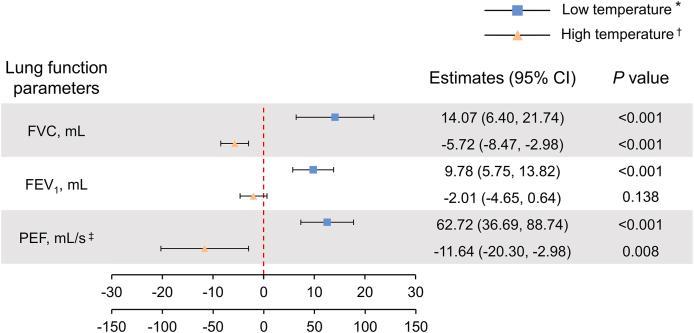
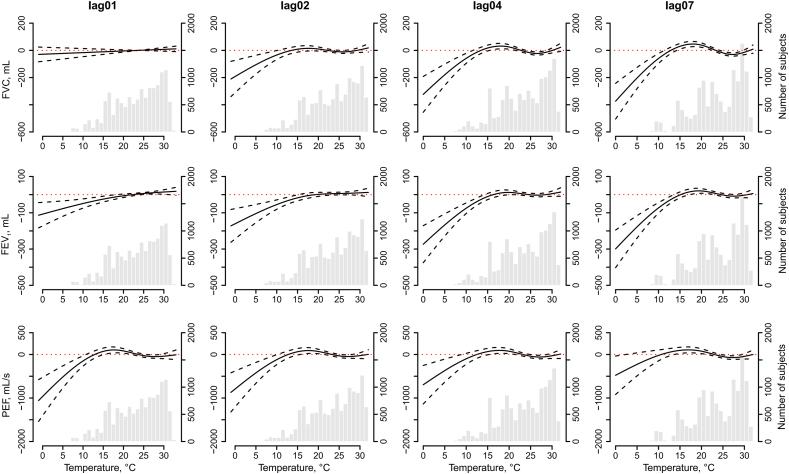
The short-term associations of ambient temperature exposure with lung function in middle-aged and elderly Chinese remain obscure. The study included 19,128 participants from the Dongfeng-Tongji cohort's first (2013) and second (2018) follow-ups. The lung function for each subject was determined between April and December 2013 and re-assessed in 2018, with three parameters (forced vital capacity [FVC], forced expiratory volume in 1 s [FEV], and peak expiratory flow [PEF]) selected. The China Meteorological Data Sharing Service Center provided temperature data during the study period. In the two follow-ups, a total of 25,511 records (average age: first, 64.57; second, 65.80) were evaluated, including 10,604 males (41.57%). The inversely J-shaped associations between moving average temperatures (lag01-lag07) and FVC, FEV, and PEF were observed, and the optimum temperatures at lag04 were 16.5 °C, 18.7 °C, and 16.2 °C, respectively. At lag04, every 1 °C increase in temperature was associated with 14.07 mL, 9.78 mL, and 62.72 mL/s increase in FVC, FEV, and PEF in the low-temperature zone (<the optimum temperatures), whereas 5.72 mL, 2.01 mL, and 11.64 mL/s decrease in the high-temperature zone (≥the optimum temperatures), respectively (all < 0.05). We observed significant effect modifications of gender, age, body mass index, body surface area, smoking status, drinking status, and physical activity on the associations (all < 0.05). Non-optimal temperatures may cause lung function decline. Several individual characters and lifestyles have effect modification on the temperature effects.
中国中老年人环境温度暴露与肺功能的短期关联仍不明确。该研究纳入了东风-同济队列首次(2013年)和第二次(2018年)随访的19128名参与者。每位受试者的肺功能在2013年4月至12月期间测定,并于2018年重新评估,选取了三个参数(用力肺活量[FVC]、第1秒用力呼气量[FEV]和呼气峰值流速[PEF])。中国气象数据共享服务中心提供了研究期间的温度数据。在两次随访中,共评估了25511条记录(平均年龄:首次,64.57岁;第二次,65.80岁),其中包括10604名男性(41.57%)。观察到移动平均温度(滞后01-滞后07)与FVC、FEV和PEF之间呈倒J形关联,滞后04时的最佳温度分别为16.5℃、18.7℃和16.2℃。在滞后04时,低温区(<最佳温度)温度每升高1℃,FVC、FEV和PEF分别增加14.07 mL、9.78 mL和62.72 mL/s,而高温区(≥最佳温度)则分别降低5.72 mL、2.01 mL和11.64 mL/s(均<0.05)。我们观察到性别、年龄、体重指数、体表面积、吸烟状况、饮酒状况和身体活动对这些关联有显著的效应修正作用(均<0.05)。非最佳温度可能导致肺功能下降。几个个体特征和生活方式对温度效应有效应修正作用。

 Zotero 插件